Submitted by WA Contents
Carlo Ratti Associati unveils design for the Alpine Bivouac for the 2026 Winter Olympics
Italy Architecture News - Dec 04, 2025 - 05:26 2507 views

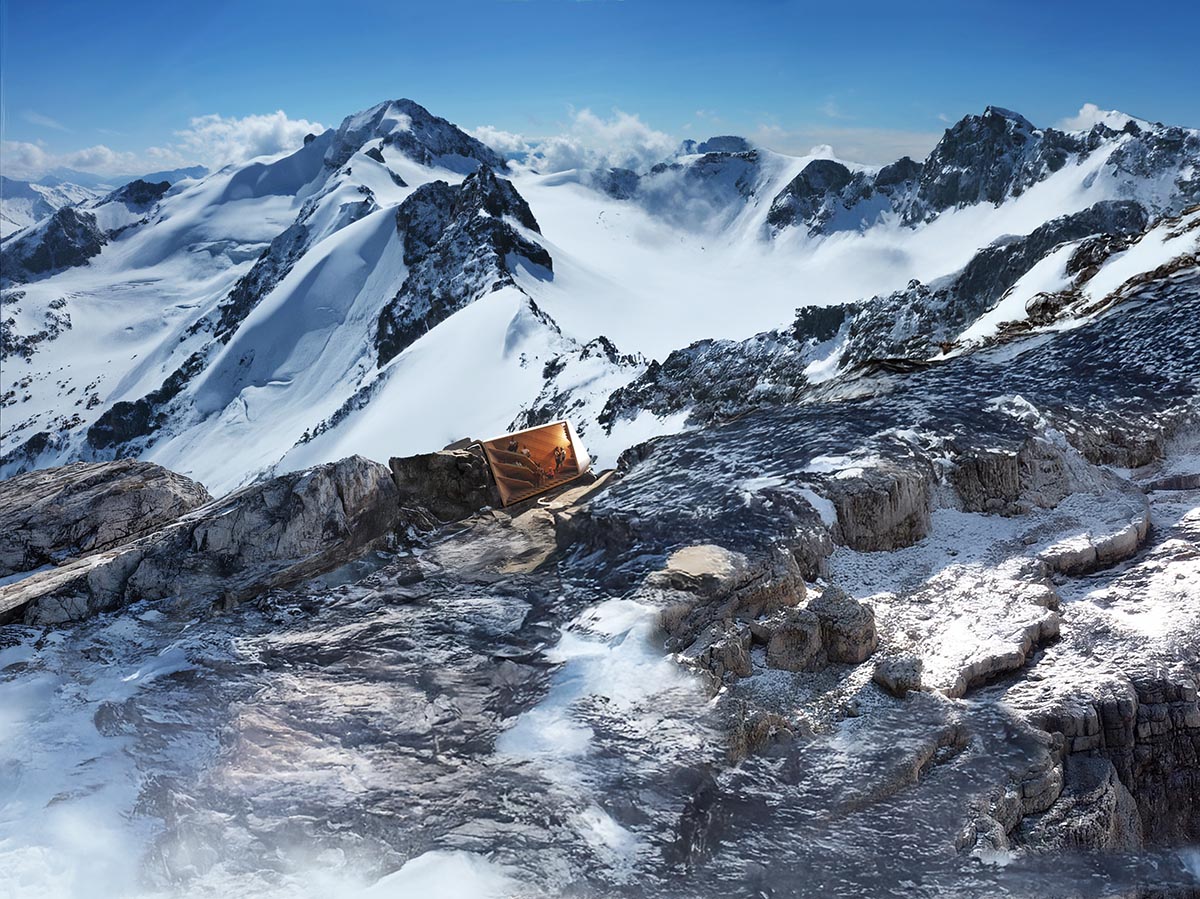
In ahead of the 2026 Winter Olympics, CRA-Carlo Ratti Associati and Salone del Mobile Milano present the design of a digitally manufactured bivouac that merges in perfectly with the untamed Alpine terrain.
The facility, which was built with self-sufficiency in mind, includes water harvesting by air condensation and energy production and storage.
The structure will be airlifted to its permanent alpine location, where it will provide mountaineers a permanent haven, after making its premiere as an urban pavilion during the 2026 winter games.

The goal of CRA's design methodology is to blur the distinction between natural and artificial structures. The team produced an accurate 3D model of the terrain by digitally scanning alpine rock formations, which influenced the design of the shelter.
Inspired by the crystalline formations of the Alps, the project is a shell structure composed of aluminum, aerogel, and cross-laminated timber (CLT) that melds with its environment.
The bivouac's 5KW peak photovoltaic system with storage, which powers all of its energy requirements, including network connectivity, is part of its fully self-sufficient design. The bivouac uses an air condensation technology to generate several liters of drinkable water per day in an area without access to natural water sources, guaranteeing climbers and hikers always have access to clean water, even during crises.

The shelter takes a more understated approach, blending in with the surroundings, in contrast to traditional bivouacs, which are painted in vivid colors to guarantee visibility in foggy or gloomy weather. Rather, a bright red light will only turn on when visibility is poor, lessening its visual impact while maintaining safety during crucial situations.
A contemplative perspective of the surrounding Alps is provided by the bivouac's glass wall. In addition to serving as a shelter, the building offers a transient haven for introspection, relaxation, and reconnecting with the natural world.

The bivouac will have a dual existence. In order to honor alpine culture, it will first be displayed as a temporary pavilion in conjunction with the 2026 Winter Olympics. It will be transported by helicopter to its ultimate permanent location at a high altitude following the event, where it will continue to benefit climbers for many decades to come.
The building bridges urban culture and mountain heritage in a sustainable, long-lasting manner, and this two-phase lifetime exemplifies the deeper principles of circular architecture.
"Unfortunately, today bivouacs often look like airships that have landed on our beautiful alpine landscapes. Here we took the opposite approach: a structure that blends as much as possible with the surroundings,” said Carlo Ratti, professor at MIT and the Politecnico di Milano, co-founder of CRA, and director of the Biennale Architettura 2025.
"Great 20th-century Italian architect Gio Ponti once said that architecture is 'like a crystal'. We took that literally in this design, using digital fabrication to design a bivouac as if it were part of the natural rock formations that shape the Alps," Ratti explained.
"For the Salone, the bivouac by CRA-Carlo Ratti Associati conveys a vision of design we share: one capable of blending landscape, innovation, and respect. It speaks of a future in which architecture does not impose itself but adapts, observes, and enters into dialogue with the environment, highlighting our material of choice—wood—as an emblem of conversation with nature. It is a gesture that turns research into a form of harmony with the natural world and that, in its journey from our Milan to the Alps, expresses the principles we share: a circular, responsible design,” stated Maria Porro, President of Salone del Mobile.Milano.
The bivouac is the most recent of CRA's important projects that combine the natural and manmade worlds. The studio's award-winning Olympic torches for the Milano Cortina 2026 games and the recently unveiled AquaPraça in Venice, the focal point of the Italian Pavilion during COP30, are examples of earlier projects.
CRA emphasizes its dedication to designing building that works with nature rather than against it through initiatives like the Alpine Bivouac.

AquaPraça, a floating cultural plaza by Höweler + Yoon and CRA-Carlo Ratti Associati, is the centerpiece of the UN Climate Change Conference (COP30) in Belém, Brazil. The project premiered on September 5 at the 19th International Architecture Exhibition of the 2025 Venice Architecture Biennale and will serve as a permanent cultural infrastructure.
In addition, the studio revealed an earthy and sunken business canteen for Mutti, global leader in tomato-based products.
All images are courtesy of Carlo Ratti Associati.
> via Carlo Ratti Associati