Submitted by WA Contents
ZHA and CY Lee unveil design for National Innovation, Creativity and Finance Center in Taipei
Taiwan Architecture News - Mar 26, 2026 - 07:34 46164 views
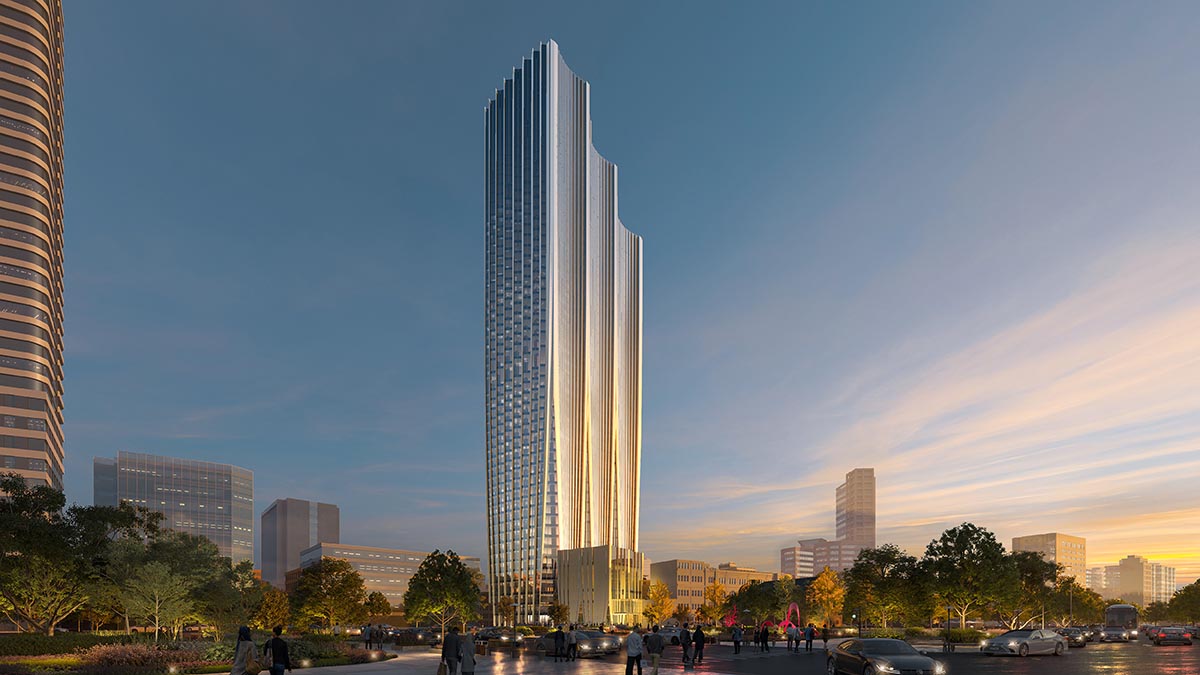
After the international design competition, Zaha Hadid Architects (ZHA), in collaboration with C.Y. Lee & Partners, have been selected as the designers for the new National Innovation, Creativity, and Finance Center (NICFC) in Taipei, Taiwan.
The stock exchange, futures exchange, depository & clearing corporation, and other four Financial Supervisory Commission institutions will be housed in NICFC, which is situated in the center of Taipei's Beimen area, the city's financial center.
NICFC is located in one of the busiest areas of the city, close to Taipei Main Station, the old post office building and railway museum, Beimen Gate and MRT Station, and the numerous cultural attractions surrounding Zhongshan Hall. It is situated at the intersection of Zhongxiao West Road and Bo'ai Road.
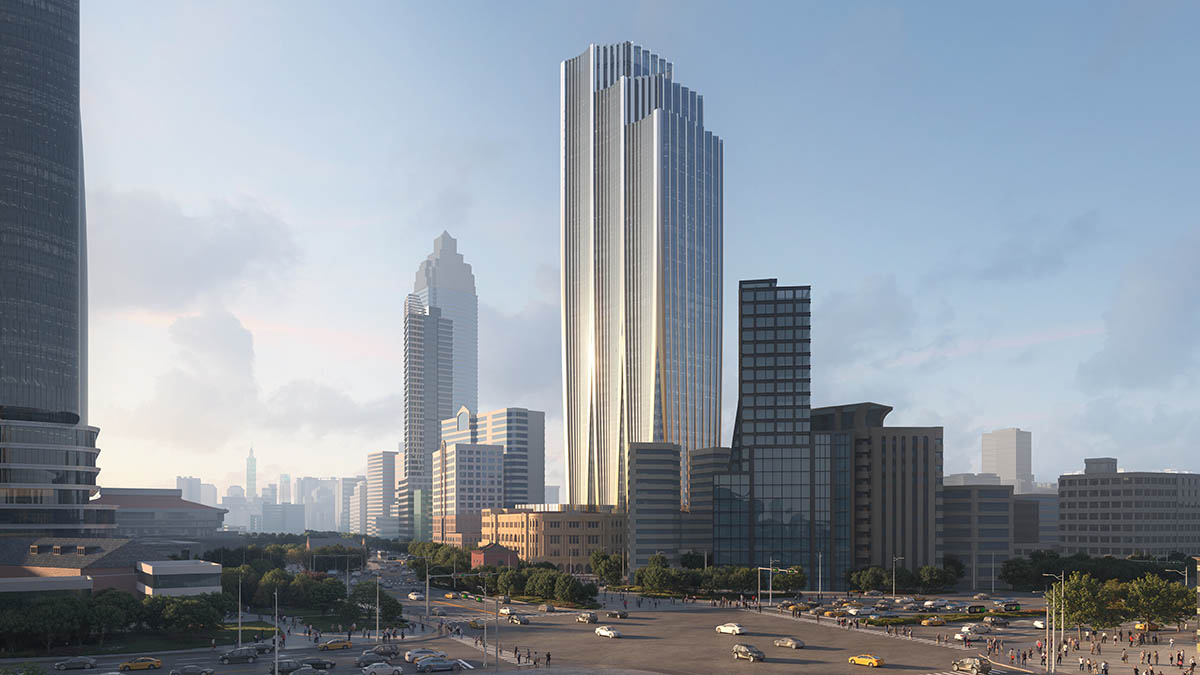
The 175,000 square meter design of NICFC prioritizes accessibility and walkability in accordance with the guidelines set forth by Taipei's Western Gateway Project, which aims to improve the city's public environment.
The design maintains Beimen's urban vistas and streetscapes to guarantee that the district's legacy is discernible in the contemporary city by connecting the district's existing civic nodes with a network of connected pedestrian plazas, courtyards, and pathways.
NICFC will keep the elaborate original building and rebuild its subsequent, now-outdated additions next to the Taipei Beimen Post Office, a recently restored heritage landmark that opened in 1930. In order to preserve its history and provide a significant new public area for the city, the existing 95-year-old structure will be converted into a museum and cultural center.
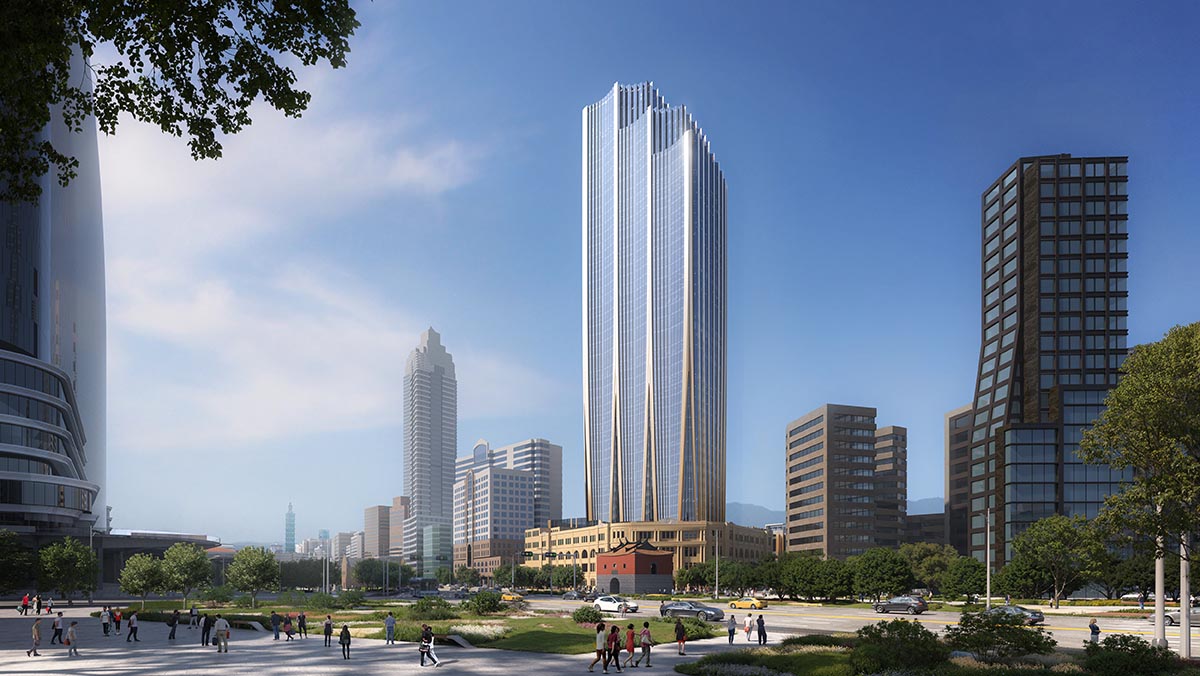
The post office's historic building will be transformed into a community center within its renovated portico, and its parcel, mail, and administrative services will be moved to a new location with the infrastructure required for postal services in the twenty-first century. With immersive exhibits, literary archives, and artifacts, its original interior will be rebuilt as a postal communications museum, transforming the location into a hub for locals and tourists that honors its significance in the history and growth of the city.
NICFC's five-story platform, which has several pleated columns supporting a sculptural glass canopy that protects a sizable new plaza between the old and new buildings for public performances and events, is designed to resemble the size of the nearby post office from the 1930s.
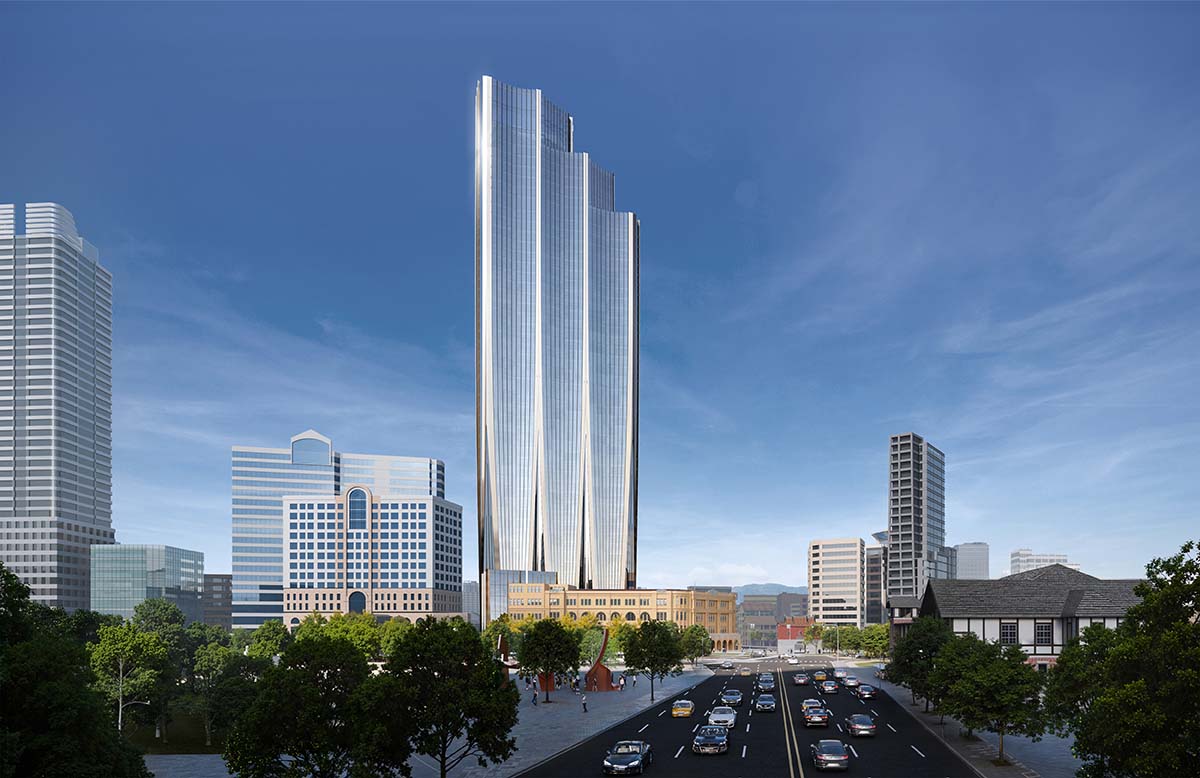
The tower's 47-story architecture, which is set apart from the nearby heritage building, is inspired by the natural fluting structures seen in the Phalaenopsis orchid, a native flower of the island. This delicate fluting supports the orchid's flower's petals and sepals, unfolding and spreading outward as it expands.
Each of the four financial institutions has its own separate space within the tower, which is designed to maximize comfort, flexibility, and efficiency while attaining floor area usage rates of over 70%. In addition to a conference center, several levels of the tower will offer shared flexible office and meeting rooms that offer privacy, vertical integration, and adaptability.
Three separate elevator banks service the floors of the banking institution and rental offices, as well as elevators for dignitaries and services, guaranteeing smooth everyday operations and safe event logistics.
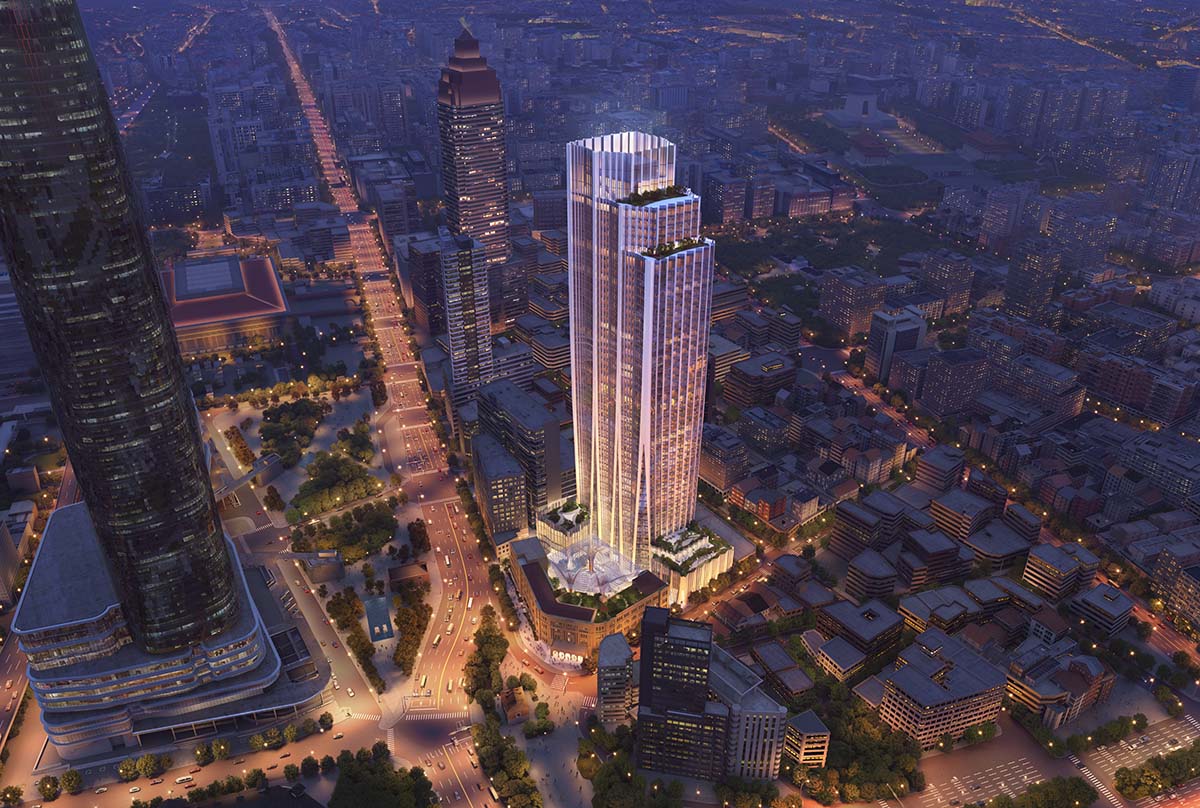
The northern façade of the skyscraper features concave bays that provide sweeping views of Taipei and the Qixing and Guanyin mountains beyond. The tower's views of Taipei 101 and the Xinyi District to the east line up with the city's main axis.
The western façade, which looks out over the Tamsui River's natural surroundings, has a geometric pattern and rhythm created by a system of vertical pleats. In order to accommodate the civic institutions of the administrative district to the south, the tower's southern façade complies with the city's current regulations. In order to give shade and lessen lateral wind effects, the tower steps back in layers at higher floors.
A responsive pleated façade system is incorporated into NICFC's design to control airflow and solar radiation. This precisely designed system, which is defined by the tower's curvature, adjusts to different depths and angles to reduce solar heat gain and direct air flow.
This allows the architecture to "breathe" like a living thing, improving the tower's environmental performance in Taipei's humid subtropical climate.
As a new standard for the area, NICFC aims to achieve dual sustainability certification (LEED Platinum and EEWH Diamond) and is built to run at net-zero carbon emissions.
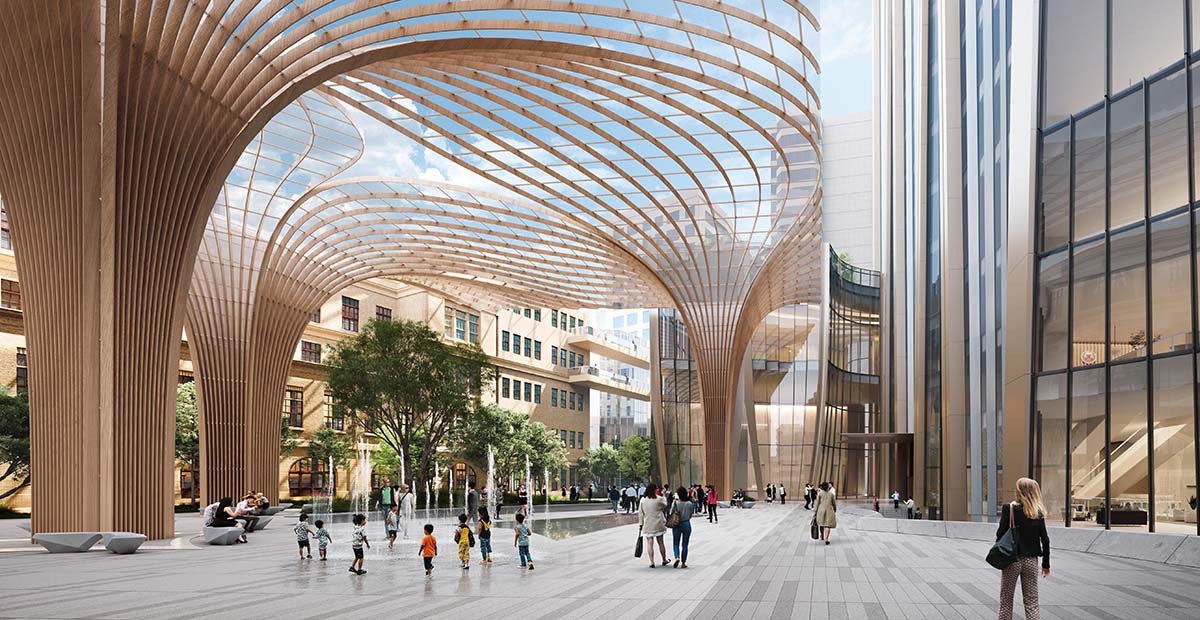
The architectural envelope integrates a high-performance double-glazed unitized curtain wall system within a pleated façade to balance energy efficiency and occupant comfort. Solar arrays will be mounted on the tower's roof, and photovoltaics will be integrated into the façade to provide on-site energy generation.
The tower's design uses modular structural systems and recyclable, low-VOC materials to reduce embodied carbon and improve lifespan durability. It also uses thorough digital mapping and 3D modeling of the site to optimize orientation, composition, and façade performance. Water demand from the municipal supply will be decreased by implementing a rainwater collection, storage, and reuse system.
Recently, Zaha Hadid Architects unveiled its most recent project, a vertex hotel that honors the region's distinctive environmental landscape while embodying the fusion of design and technology. In addition, the firm revealed the silk-inspired bridge of Hangzhou with a sinuous form in Hangzhou, China. Moreover, the studio won an international competition to design a new mixed-use tower in Belgrade, Serbia.
Project facts
Architect: Zaha Hadid Architects (ZHA)
ZHA Principal: Patrik Schumacher
ZHA Competition Project Directors: Paulo Flores (Design) , Shao-wei Huang (Overall)
ZHA Competition Commercial Director: Charles Walker
ZHA Competition Project Architects: Mei-Ling Lin, Sebastian Andia
ZHA Competition Project Design Lead: Harry Spraiter
ZHA Competition Team: Abhilash Menon, Aditya Ambare, Aleksander Mastalski, Alex Nap, Arjun Kaicker, Bahaa Alnassrallah, Barbara Schickermueller, Berkin Islam, Bogdan Zaha, Carlos Bausa Martinez, Chales Walker, Christoph Geiger, Daniel Hamdan, Disha Shetty, Harry Spraiter, Henry Louth, Huiyuan Li, Jing Xu, Karina Linnsen, Lorena Espaillat Bencosme, Martin Gsandtner, Mei-Ling Lin, Ningxin Zheng, Patrik Schumacher, Paulo Flores, Sebastian Andia, Shao-wei Huang, Shajay Bhooshan, Shardul Awasthi, Shibani Choudhury, Teodor Andonov, Tommaso Casucci, Uli Blum, Vishu Bhooshan, Yusuf Rafi
ZHA Environmental & Sustainability Team: Abhilash Menon, Aleksander Mastalski, Bahaa Alnassrallah, Carlos Bausa Martinez(Team Lead), Disha Shetty, Jing Xu, Shibani Choudhury
ZHA CODE: Henry Louth, Shajay Bhooshan(Team Lead), Teodor Andonov, Tommaso Casucci, Vishu Bhooshan
ZHA+I: Arjun Kaicker (Team Lead), Christoph Geiger, Daniel Hamdan, Lorena Espaillat Bencosme, Uli Blum (Team Lead), Yusuf Rafi
Consultants
Executive Architect (JV): C.Y.Lee & Partners
Associate Architect (JV): Oneness & Associates Architects Planners
General Engineering Consultants (JV): CECI Engineering Consultants, Inc.
Structural Design and Seismic Supervision: Evergreen Consulting Engineering, Inc.
Structure Concept: Cundall Engineering Design Consulting Co., Ltd
Sustainability Consultants: Arup Group Ltd.
Geotechnical Consultant: Sino Geotechnology INC
MEP: Cheng-Yi United Engineering Consultants Co., Ltd.
Environmental Consultant: Segreene Sustainable Design & Consulting, Inc.
Façade Design Consultant: VS-A Facade Engineering
Traffic consultant: EasyGoGo Technology Inc.
Landscape Consultant: Environmental Arts Design
International Workplace Consultant: Cushman & Wakefield
Historic Restoration Consultant: Pu-Ming Tseng Architect & Associates
Cultural Consultant: Yichung Chan Architects & Associates
Property Management Consultant: Professor Kung-Jen Tu
Interior Design: Olin International Design Co. Ltd.
Lighting Design consultant: Unolai design
All renderings © X Universe Visual Design.
> via ZHA