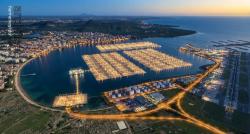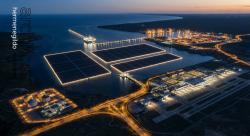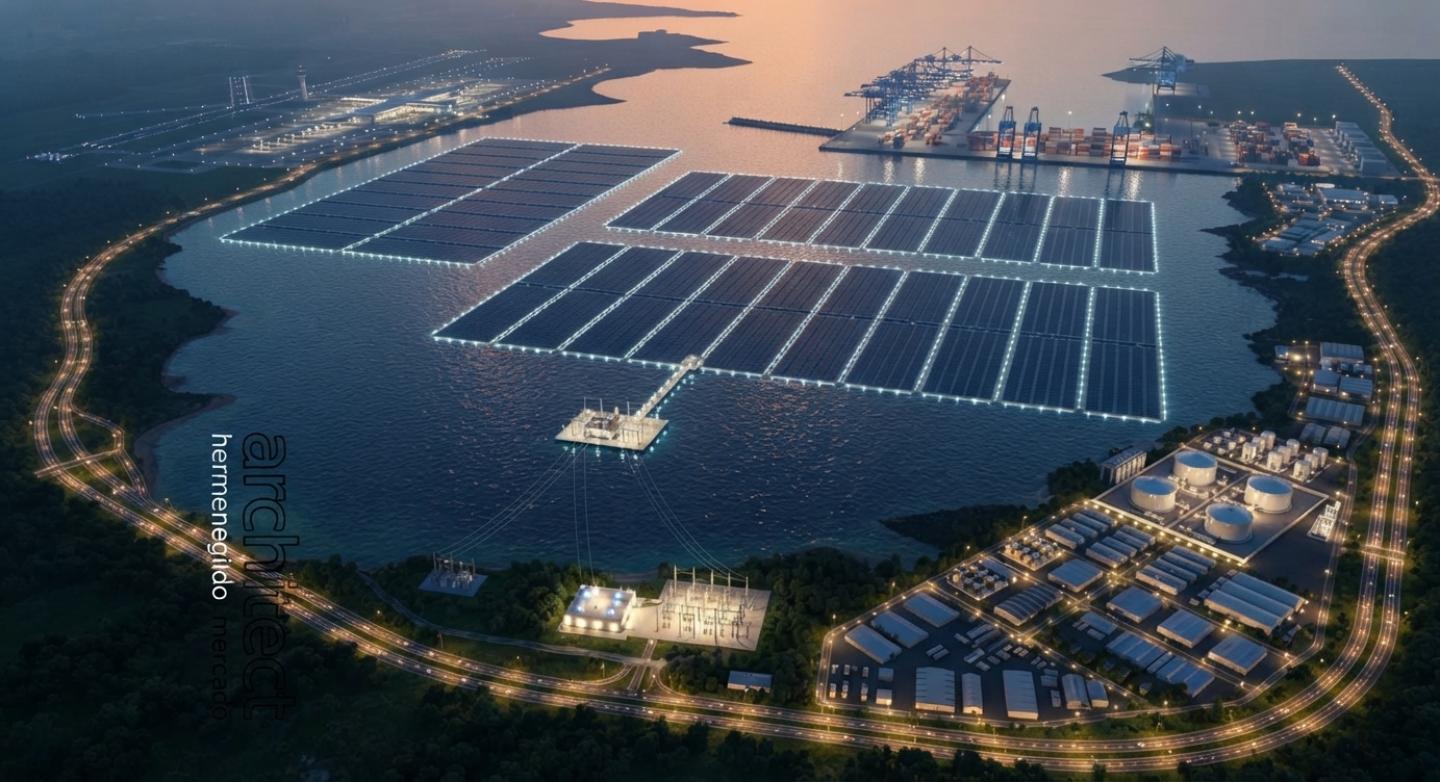
PROPOSED 7.2 GW CAGAYAN FLOATING SOLAR PHOTOVOLTAIC POWER PLANT
Executive Summary & Commercial Positioning
The project is positioned as the renewable-energy backbone of the proposed Sta. Ana Mega Infrastructure Development Corridor. Its commercial rationale is strengthened by proximity to large prospective electricity loads including the proposed automated deep seaport, international airport, CNSERIEP, CEZA/Port Irene, industrial and logistics parks, smart agriculture, healthcare, education and digital infrastructure.
The marine location is intended to reduce the land-acquisition burden of a terrestrial solar development while permitting a dedicated private energy network to serve nearby strategic loads. The project is intended to operate as an integrated energy platform rather than an isolated generation facility, with BESS and smart dispatch supporting reliability and demand matching.
Project Identification & Investment Snapshot
The proposed 7.2 GW Cagayan Floating Solar Photovoltaic (FPV) Power Plant is conceived as an ultra-utility-scale renewable-energy generation platform. The project combines floating bifacial PV arrays across 7,000 hectares of water surface, a multi-GWh BESS system, and an exclusive private 190-kilometer 500kV Extra-High Voltage (EHV) double-circuit transmission line connecting directly to the New Santiago 500kV Substation Hub in Isabela. This private grid connection seamlessly integrates with the NGCP Nagsaag–Santiago 500kV Transmission Backbone Project to bypass local constraints and completely secure full power evacuation capacity.
Item Indicative Value / Parameters
Installed Capacity 7.2 GW (7,200 MW)
Development Phases 3 × 2.4 GW
Indicative Water Surface Area ~7,000 hectares (Casambalangan Coastal Corridor)
Private Transmission Line 190 km Dedicated 500kV Double-Circuit EHV Line
Interconnection Terminal New Santiago 500kV Substation Hub, Isabela
(Nagsaag–Santiago Backbone)
Onshore Land Requirements 80 Hectares (Absolute Substation Acquisition) 950 Hectares
(ROW Easement Corridor)
Total CAPEX US$8.55 Billion (Adjusted upward to include dedicated
private grid assets)
Annual OPEX US$155 Million
Annual Generation ~15,768 GWh
Average Tariff US$0.06 / kWh
Annual Gross Revenue ~US$946 Million
Annual Operating Surplus ~US$791 Million / year
Indicative Project Life 25 Years
Target Construction Period 24–36 months (Phased Deployment)
Project Status Advanced Conceptual Development / For Board Evaluation
/ Not Shovel-Ready
2026
C. Project Design, Smart Technology & Phased Development
C1. PV, Floating Platform, SCADA/AI, BESS & Transmission Architecture
The electrical architecture combines bifacial PV arrays, modular floating platforms, utility-scale inverters, medium- and high-voltage collection, private GIS substations, transformers, subsea/underground cabling where appropriate, protection systems, metering, SCADA and an AI-driven energy-management platform. To resolve grid bottlenecks, a 190 km private 500kV Extra-High Voltage (EHV) double-circuit transmission system is implemented from the Santa Ana landfall to the New Santiago 500kV Substation Hub in Isabela.
The onshore infrastructure consists of 4 compact Gas-Insulated Switchgear (GIS) substations (totaling 80 hectares) and a containerized Lithium Iron Phosphate (LFP) BESS compound scaled at 1.8 GW / 7.2 GWh (integrated within the energy hub assets) to buffer generation and maintain absolute grid compliance.
C2. Three-Phase Development Program & Energy Hub
The project is executed in three symmetrical 2.4 GW phases, enabling modular deployment of generation and parallel matching of transmission capabilities. Phase 1 achieves the initial 2.4 GW commercial platform, including the primary 500kV EHV line pylon setup. Phases 2 and 3 sequentially add the remaining 2.4 GW increments up to the total 7.2 GW threshold.
D. Integrated Cagayan Infrastructure Platform
D1. Airport, Seaport, CNSERIEP & CEZA/Port Irene Integration
The FPV plant is conceived as the energy foundation of the proposed Cagayan Mega Infrastructure Development. Integration with the proposed international airport and automated deep seaport will allow large industrial-scale off-take. The port's high demand for automated cranes and refrigeration infrastructure requires a massive, un-curtailed clean energy system.
D2. Smart Hospital, BRICS International University, Smart Farm & Green-Hydrogen Horizon
The energy infrastructure supports local advanced assets including the 300-bed Cagayan Smart Hospital (US$270M reference CAPEX) and the 4.0-hectare BRICS International University campus (US$160M reference CAPEX), which are connected through an enclosed elevated climate-controlled bridgeway. Furthermore, the BESS Smart Farm & Business Park operates as a key load partner, using stable power for cold storage and automated agricultural systems.
F. Investment, Ownership, Land, Design & Procurement
F1. FDI/SPV, Ownership, Land Rights & Business Model
The proposed investment model uses a dedicated Philippine project Special Purpose Vehicle (SPV) to manage project rights, financing, procurement, engineering, construction and long-term operations. The proposed equity framework is 90% foreign strategic financial investor and 10% Rapid Technologies Development Inc. as local industrial/project-development partner, subject to Philippine law, applicable ownership restrictions and final contractual arrangements.
For private land required for onshore substations, transmission facilities and BESS compounds, the source brief contemplates formal Authority to Sell arrangements with registered landowners. Titles, encumbrances, boundaries, rights-of-way and authority documents must be independently verified by legal counsel and relevant registries before financial close.
The development sequence is conceptually: Board Evaluation → Investment Approval → Due Diligence → SPV Incorporation → Pre-Development MOA → Detailed Engineering/DAEDS → Government Permitting → Construction Tendering → Commercial Operation. Physical expansion should be linked to confirmed offtake and technical readiness so that capital deployment remains aligned with demand.
F2. DAEDS, EPC Tendering & Implementation Sequence
Following pre-development approval, the SPV is expected to engage qualified international marine-solar, electrical, civil, environmental and other specialist consultants for Detailed Architectural and Engineering Design Services (DAEDS). The source brief identifies Architect Hermenegildo C. Mercado, UAP as Designer/Architect-of-Record for the project concept, with final technical design to be completed by the appropriate multidisciplinary team.
Construction procurement is envisioned through a competitive international tender for a Tier-1 EPC contractor or appropriately packaged EPC/EPCM structure. The project is divided into three symmetrical 2.4 GW packages so that the first operating platform can commence generation while later phases are developed. Performance guarantees, schedule controls, equipment warranties, marine logistics planning and contingency provisions should be incorporated into final EPC documentation.