BAVI HERITAGE
Architecture Shaped by Limits
Key points
- Adaptive reuse of a former stone and woodworking complex embedded within an existing forest landscape in Ba Vì, Vietnam
- Architectural organization derived from inherited foundations, circulation routes, and terrain morphology
- Four pavilion typologies differentiated through topographical response and deliberate avoidance of existing mature trees
- Vertical spatial configuration minimizing footprint and preserving soil permeability
- Material juxtaposition revealing temporal continuity between retained stone structures and new concrete interventions
- Sustainability embedded within spatial and structural logic rather than applied as a separate technical layer
________________________________________
Bavi Heritage is a small-scale resort located within a planted forest of pine, oak, and native tall trees in Ba Vì, Vietnam. Before its transformation, the site functioned as a large stone and woodworking complex, consisting of workshops and storage buildings constructed from local stone and plantation timber. More than a physical condition, the site embodies a layered memory of manual labor, craftsmanship, and generational continuity tied to the land.
Rather than approaching the project as a new resort inserted into nature, Bavi Heritage is conceived as a process of spatial reconfiguration, in which contemporary architecture is shaped by pre-existing ecological, structural, and cultural limits. The central question of the project is not one of form-making, but whether architecture can emerge without severing the continuity of place.
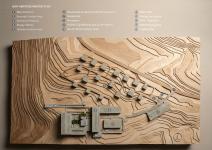
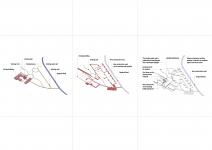
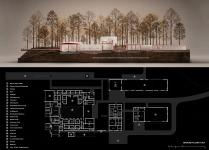
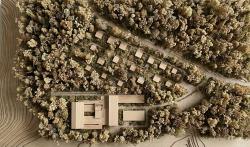
The design positions heritage as a living structure rather than a static artifact. Foundations, stone walls, circulation routes, and spatial logic inherited from decades of industrial use are treated as active design frameworks. Instead of demolition and replacement, the project adopts a strategy of minimal intervention and adaptive reuse, allowing existing structures to guide new architectural organization. Key functions such as reception, back-of-house, and technical spaces are built directly upon former workshop foundations, significantly reducing excavation, construction waste, and embodied energy while preserving the site’s topographical continuity.
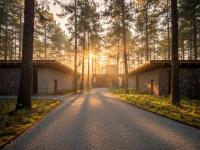
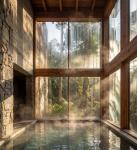
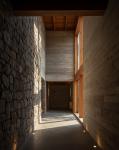
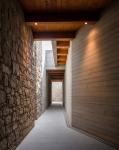
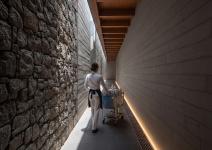
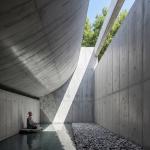
Architecturally, the project does not seek to conceal the passage of time. Rough stone walls are retained and reinforced, deliberately juxtaposed with new exposed concrete structures. The contrast between old and new is left legible, forming a spatial dialogue rather than a seamless fusion. History is not represented symbolically; it is revealed through material presence and structural continuity.
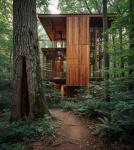
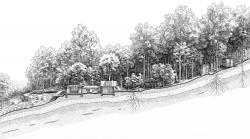
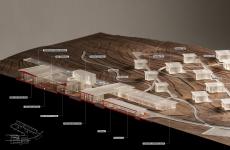
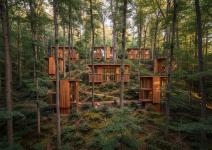
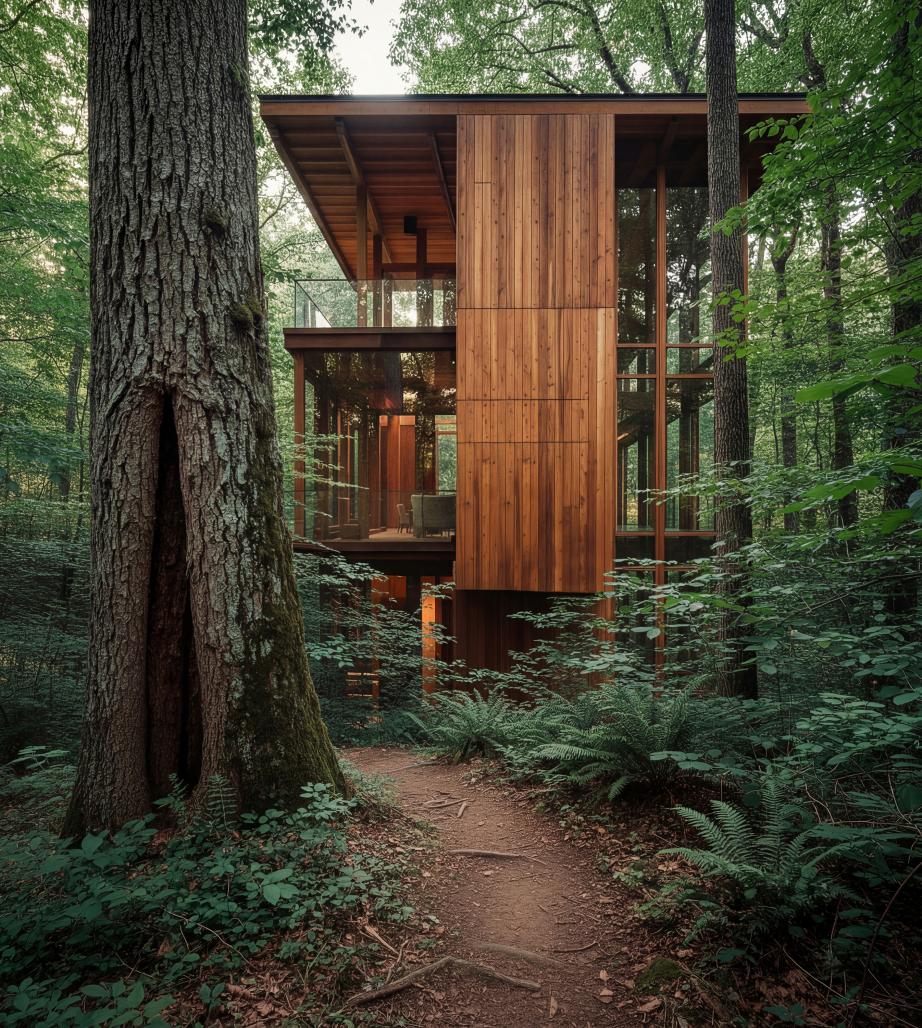
One of the project’s primary challenges lies in negotiating the tension between resort development and forest preservation. The site is defined by dense vegetation, complex root systems, and a sensitive microclimate—conditions typically incompatible with conventional hospitality planning. Instead of imposing an idealized master plan, the design accepts ecological constraints as formative parameters. Accommodation units, referred to as Pavilions, are placed exclusively within existing natural clearings identified through on-site surveys.
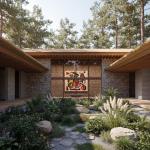
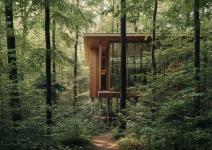
Four pavilion types are developed in direct response to variations in terrain and the precise location of existing trees, allowing each unit to adjust its form and placement in order to avoid root systems and minimize disturbance to the natural ground condition.
To minimize ground disturbance, they are organized vertically rather than horizontally, reducing footprint while maintaining spatial efficiency. Access paths remain compacted earth rather than hard paving, preserving soil permeability and terrain continuity. Controlled inconvenience is embraced as a conscious architectural choice rather than a compromise.
In this sense, the forest is not treated as a backdrop but as a structural agent that shapes architectural decisions. The buildings do not compete with their environment; they are configured by it.
A parallel challenge involves the reuse of an industrial heritage lacking conventional monumentality. The former workshops—raw, utilitarian, and visually understated—could easily be dismissed as obstacles to new development. Rather than aestheticizing or erasing them, the project focuses on translating their spatial and structural logic into a contemporary framework. Former industrial circulation routes are reinterpreted as long, naturally lit corridors that function as primary spatial arteries, enhancing cross-ventilation and moderating the tropical microclimate.
Sustainability in Bavi Heritage is not addressed as a separate technical layer, but as a direct outcome of design logic. The reuse of existing structures reduces material consumption and construction energy; open and transitional spaces limit reliance on mechanical cooling; local stone and plantation timber minimize transportation impact and enhance climatic adaptability. Rainwater is collected, filtered, and reused through courtyards and gardens, integrated with a nearly century-old well that historically functioned as the site’s hydrological center. Together, these elements form a closed-loop water system supporting both daily use and landscape irrigation.
At the location of the former family house, a Private Zen House is constructed as an intimate architectural layer dedicated to meditation and retreat. Detached from commercial programmatic demands, this building sustains a personal and spiritual connection between the owner and the land. The upper meditation space opens directly to the forest canopy, allowing light, wind, and ambient sound to become integral components of the architectural experience.
Through these decisions, Bavi Heritage deliberately redefines the notion of luxury in resort architecture. Value is not derived from material opulence or scale, but from restraint, authenticity, and proximity to nature. Architecture here acts as an enabling framework rather than a dominating presence, allowing users to perceive their relationship with landscape, memory, and time.
Bavi Heritage ultimately proposes architecture as a practice of acceptance rather than control. By working within ecological, structural, and cultural limits, the project demonstrates that architectural quality can emerge not from overcoming constraints, but from allowing those constraints to shape space, experience, and meaning.
2025
Project name: BAVI HERITAGE
Location: Vietnam
Site area: 9,5ha
GFA: 13.971,7m2
Density: 9,6%
Building function: Resort, Spa(Jjimjilbang), Restaurant, Workshop space, Resort accommodation in pavilions.
Principal Architect: Nguyễn Thái Sơn
Design team: David Lee, Sophia muller, Nguyễn Thành Phong
Green building team: SAA Green team
Structural Design Engineer: Hà Văn Kha
MEP Design Engineer: Trịnh Tiến Đông
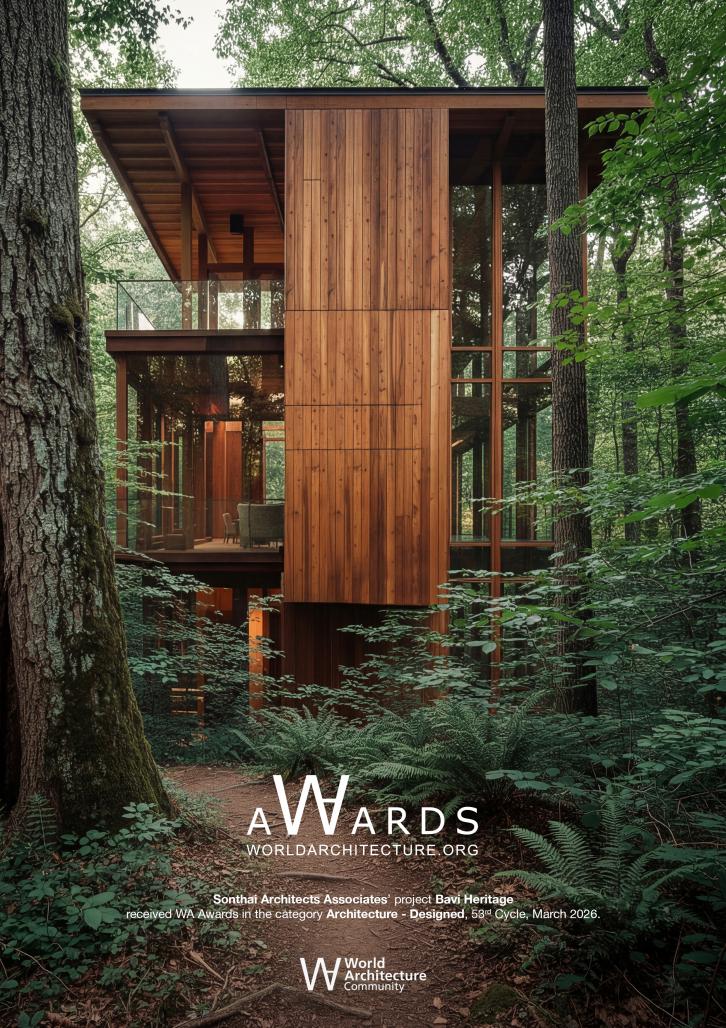
Bavi Heritage by Sonthai Architects Associates (SAA) in Vietnam won the WA Award Cycle 53. Please find below the WA Award poster for this project.
Downloaded 0 times.
Son Thai