The Crimson Veil: A Dialogue Between Steel and Sunlight in the Central Highlands
By Architect Samuel Le Project: Mixed-Use Residential (Nhà ở Cấp III) Location: Village 5B, Da Teh Commune, Lam Dong Province, Vietnam Principal Architect: Le Nguyen Quang Khiem (Samuel Le) – I.O.Y Construction
In the sprawling, sun-drenched landscape of Da Teh, a district in Vietnam's Lam Dong province known for its unforgiving heat and intense humidity, the vernacular architecture has long been dominated by pragmatic, often defensive concrete structures. However, a new intervention, situated on a corner plot in Village 5B, challenges this status quo. Titled "The Crimson Veil," this project is not merely a residence; it is a bold statement on the reconciliation of industrial materiality with tropical living, redefining the typology of the Vietnamese "shophouse."
The Urban Context and the bold Manifesto
The site is positioned at a junction, demanding a design that addresses dual frontages while maintaining privacy for the occupants. The owner, Ms. Duyen, required a functional duality: a commercial space on the ground floor capable of engaging with the street, and a serene, private sanctuary on the upper level.
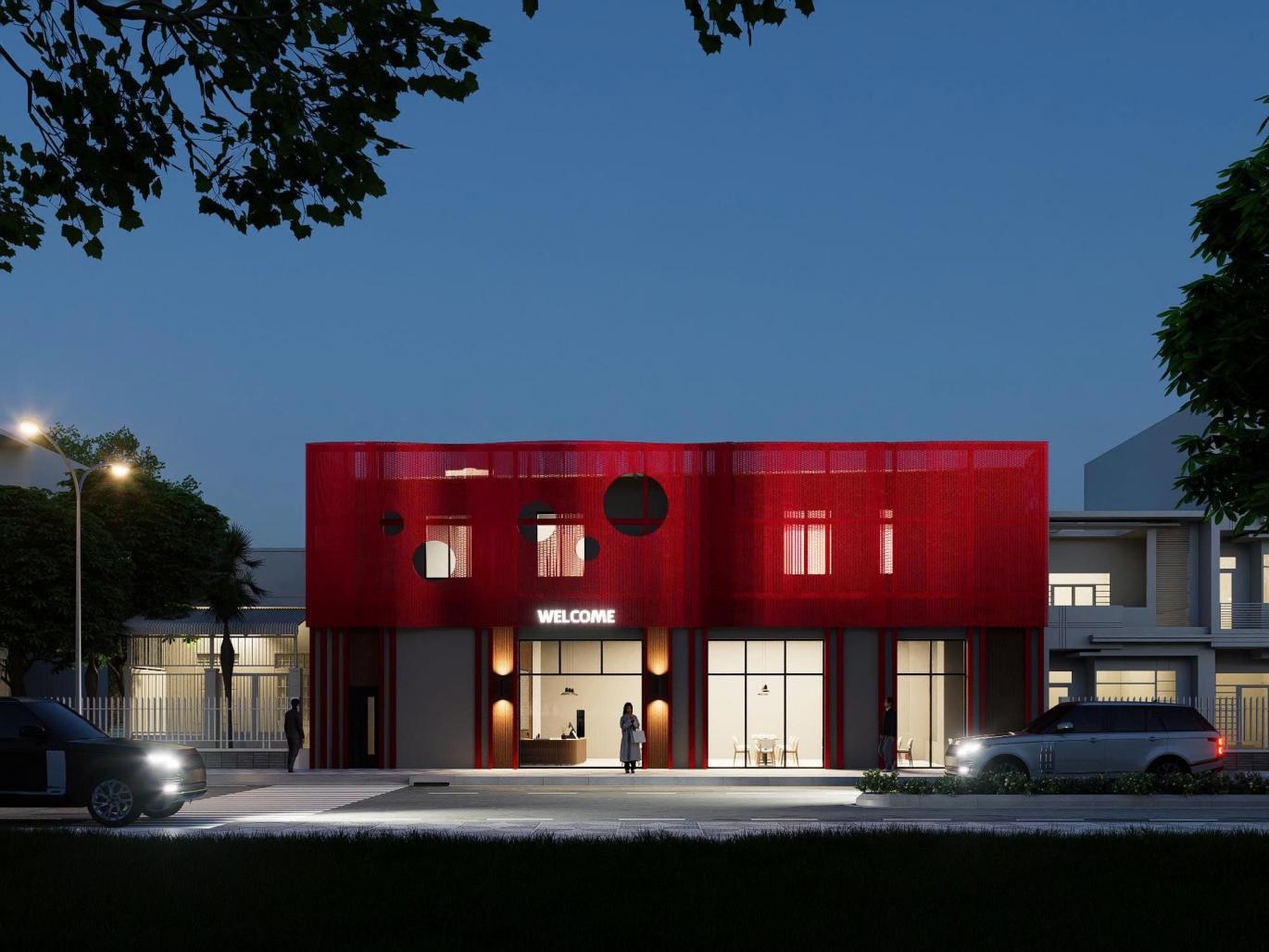
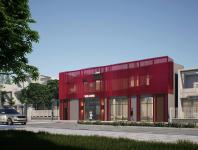
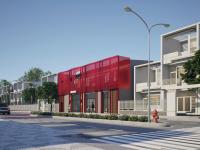
Instead of retreating behind heavy masonry walls, the design strategy embraces transparency and lightness. The immediate visual impact of the building is its striking color palette—a deep, visceral crimson that wraps the upper volume. This is not a shy building. In a context often washed in beige and grey, The Crimson Veil stands as an urban marker, a point of orientation that asserts its presence through color, reminiscent of the bold chromatic applications found in the works of Bernard Tschumi.
The Double-Skin Facade: A Passive Shield
The defining architectural feature of the project is the "Double-Skin Facade." The exterior shell is constructed from a custom-fabricated steel framework clad in oval-perforated metal sheets. This is not merely a cosmetic application but a critical climate-responsive device.
Da Teh's climate necessitates a solution for heat gain. The red metal mesh acts as a brise-soleil, filtering the harsh tropical sunlight before it strikes the inner glass and masonry walls. This creates a thermal buffer zone—a layer of air sandwiched between the skin and the building core. As the metal heats up, the air in this cavity rises, creating a natural convection current that draws cooler air from below, effectively cooling the building envelope through the stack effect.
Visually, the perforation transforms the building’s mass. During the day, the skin appears solid and impenetrable, offering privacy to the bedrooms located on the first floor. At night, the dynamic reverses; the internal lights glow through the mesh, turning the monolithic red block into a translucent, glowing lantern. The large, seemingly random circular voids cut into the facade act as curated viewports, breaking the rigidity of the grid and offering framed vignettes of the surrounding neighborhood to the inhabitants.
Spatial Organization and Tectonics
The plan follows a logical stratification of functions, typical of the mixed-use townhouse but executed with a modern spatial fluidity.
The Ground Plane (Commercial & Public): The ground floor is dedicated to commerce, likely a café or showroom. The design utilizes a structural grid with a 5-meter span, allowing for a column-free, open-plan interior. The interface with the street is dissolved through the use of large glass partitions and doors, blurring the boundary between the interior commercial space and the public sidewalk. A "WELCOME" sign is integrated directly into the steel lintel, signaling the transition from the public realm to the semi-private interior.
The Upper Plane (Residential & Private): Ascending the staircase—a minimalist composition of MDF wood treads floating on a steel spine anchored to the wall —one enters the private residence. Here, the layout is efficient yet generous. The first floor houses a living area, a kitchen-dining space, and two bedrooms.
The ceiling height varies, following the slope of the hidden mono-pitch corrugated iron roof (Mai Tole) , which directs rainwater efficiently to the rear collection system. This sloping roof is cleverly concealed behind the high parapet of the red facade, maintaining the illusion of a flat-roofed, cubic modernist box while utilizing the superior drainage properties of a pitched roof—a pragmatic nod to the local heavy rainfall.
Materiality and Detail
The project celebrates the raw honesty of industrial materials. The structural steel, the perforated oval mesh , and the aluminum-framed glass are assembled with precision. The detailed drawings reveal a meticulous approach to connections, particularly in the steel staircase where the handrail (Phi 40 iron pipe) is offset 900mm from the treads, creating a sense of lightness.
There is also a sensitivity to nature within the industrial shell. The design incorporates small pockets of greenery, such as the planter box filled with gravel and shade-tolerant plants situated beneath the stairs. This injection of biophilia softens the hardness of the metal and glass, grounding the floating aesthetics of the staircase.
Conclusion: A Modern Typology
The Crimson Veil is more than a house; it is a prototype for modern living in Vietnam’s developing urban/rural fringe. It demonstrates that climate adaptation does not require a sacrifice of aesthetic boldness. By wrapping the functional core in a breathable, protective "armor" of red steel, I.O.Y Construction has created a building that is physically cool but visually hot.
As the architect, my intention was to create a dialogue. A dialogue between the private life and the public street, between the industrial steel and the organic human need for shelter, and ultimately, between the building and the sun. In the red glow of the facade, we find not just a color, but a protective embrace—a modern "Dan Giap" for the contemporary family.
2025
2025
Project Name: The Crimson Veil (Residential & Commercial Complex)
Location: Village 5B, Da Teh Commune, Lam Dong Province, Vietnam Principal Architect: Le Nguyen Quang Khiem (Samuel Le) – I.O.Y Construction Gross Floor Area (GFA): 231.9 m² Structural Height: 7.85 m
Site & Zoning The project is situated on an irregular, elongated corner plot with a primary frontage extending 18.5 meters along the street. The building footprint maximizes the site boundaries, utilizing a tapered depth ranging from approximately 5.7 meters to 9.2 meters, adapting to the acute angle of the existing land survey.
Structural System The building employs a hybrid structural framework, prioritizing a pre-engineered steel column and beam system to facilitate rapid construction and flexible spatial planning. The structural grid is defined by spans of 4.5 meters to 5.0 meters, allowing for a column-free interior on the ground floor to support commercial activities. The foundation and floor slabs utilize reinforced concrete, with the ground floor finished at 0.000 elevation and the second floor structural slab set at 4.250 elevation.
Facade & Envelope The defining architectural element is a double-skin facade system. The outer layer comprises custom-fabricated oval-perforated steel sheets (Tấm sắt lỗ oval) , anchored to a secondary galvanized steel framework consisting of 100x50mm box sections. This permeable screen serves as a passive thermal control device, mitigating solar gain while allowing natural ventilation. Behind this metal veil, the building envelope consists of masonry walls and aluminum-framed glazing. The ground floor features expansive glass walls, including a primary entrance of 3200mm (W) x 3300mm (H), ensuring maximum visual connectivity for the retail space.
Roofing & Drainage The roof utilizes a mono-pitch concealed system clad in corrugated iron sheeting (Mai Tole). The roof pitch is directed towards a rear reinforced concrete gutter (Sê-nô), hidden behind the facade parapet to maintain the purity of the building's cubic volume.
Vertical Circulation Internal circulation is managed via a cantilevered-style staircase. The structure consists of a shaped steel frame anchored directly into the load-bearing wall , supporting treads finished with MDF wood. The stair width is 1000mm , featuring a minimalist Ø40mm iron handrail offset 50mm from the wall to maximize the clear passage width.
Spatial Configuration
Level 1 (Ground): Designated for commercial use (Cafe/F&B), featuring an open plan with a 4.25m floor-to-ceiling height and a dedicated guest restroom.
Level 2: Private residential zone comprising a Living Room, Kitchen-Dining area, and two Bedrooms. The ceiling follows the roof slope, reaching a peak height of 3.6m at the facade line.
PROJECT TEAM & CREDITS
Design Consultant:
I.O.Y CONSTRUCTION (Intelligence of Youth Company Ltd).
Key Personnel:
Principal Architect / Project Lead: Mr. Le Nguyen Quang Khiem (Samuel Le)
Role: Overall project direction, final approval, and "Stamped for Inspection" authority.
Design Architect: Mr. Tang Vinh Anh Khoa
Role: Lead architectural design and concept development.
Technical Engineer: Mr. Truong Quang Chinh
Role: Technical detailing, structural solutions, and engineering coordination.
Design Verifier / QC: Mr. Nguyen Trieu Vi
Role: Quality control, drawing inspection, and technical compliance review.
General Information:
Client: Ms. Duyen (Lam Dong).
Location: Village 5B, Da Teh Commune, Lam Dong Province.
Project Classification: Level III Residential Building.
Khiem Le
Favorited 1 times