Submitted by WA Contents
Calling designers: Transcendent Design and The Space In-Between International Design Competition
United Arab Emirates Architecture News - Dec 13, 2025 - 09:08 57938 views
The ACSF/2A Organizing Committee is pleased to announce an extension of the Competition Registration and Submission Schedule, as well as the Venue for the Awards Ceremony.
New Registration and Submission deadline: June 1, 2026.
Participants who have already registered and begun developing their concepts are encouraged to refine their designs and 500-word essay and submit them by the new deadline, along with the required fee.
This additional time supports deeper conceptual design engagement allowing both participants and jurors more opportunity for thoughtful reflection, evaluation, and recognition of visionary projects shaping the future of the built environment and human life on earth.
Awards Ceremony
The Awards ceremony will coincide with the ACSF 16 Symposium at Kyoto University, Japan hosted by the Kyoto University Institute for the Future of Human Society from June 2–7, 2027.
Participants can register via this link.
Download the competition brief.
Our Vision Of a Better World obliges us to encompass a deep comprehension of the critical historical impacts that have affected the world in modern times. Those causal forces have radically transformed the world, which today has brought the whole earth and humankind to the brink of untold ecological, social, and psychological disaster. For the survival of the whole of nature and the well-being of humanity, we are obliged to lay the foundations for a renewed awareness of the realities and purpose of existence to transform into a civilization that will replace the dehumanized world that is now disintegrating and disappearing before our very eyes.
The built environment’s lengthy history as a communicative and affective media portends its enduring capacity to serve the highest ideals and address the most vexing problems. Indeed, the built environment was often believed to provide portentous places for personal improvement and, by extension, the evolution of culture. It still has that promise and potential.
Competition Theme
Through this international design competition, we seek an alternative path to this dead end - a vision of organic exuberance, human delight and flourishing that lies waiting in the paradigm of “Transcendent Design and the Space In-Between.”
“Transcendence Design” is the spatial embodiment of reality beyond the tangible. It seeks to manifest the unseen, inviting us into a realm of heightened awareness where space becomes a bridge between the material and ineffable (metaphysical, spiritual), prompting reflection, awe, or connection to something greater than oneself.
“The Space In-Between” is a familiar concept to many cultures and philosophies — in Buddhism, Sunyata is the voidness that constitutes ultimate reality, in Sufism, the Barzakh is the liminal world of the creative Imagination, in Japanese, Ma is the gap or interval that exists between objects, situations, or relationships, in Depth Psychology, self-realization is seen to take place within a liminal space. Therefore, it is more than simply other functional spaces, more than a physical boundary or threshold — “The Space In-Between” is an invitation to explore the experience of “Transcendence.”
Competition Conditions
The Architecture, Culture, and Spirituality Forum (ACSF) has been exploring just such a path for over two decades. ACSF, with its international community of scholars and practitioners in both Western and Eastern cultures, upholds that the design and experience of the built environment can assist the spiritual development of humanity in the service of addressing the world’s most pressing problems.
On the fifth anniversary of the completion of extensive multi-cultural research on this subject, we launched the ACSF Declaration of Transcendent Human Habitat.
As an integral part of the competition conditions, we invite design submissions of unbuilt theoretical and conceptual projects that align with the ACSF Declaration of Transcendent Human Habitat and foster human and planetary flourishing, spiritual growth, and the experience of the transcendent within a sustainable environment for present and future generations.
Declaration Principles
Projects should align with the following ACSF Declaration Principles: We profess a worldview that our tangible and intangible universe has a spiritual dimension, and that this ineffable realm is central to pursuing, finding, appreciating, and supporting life’s meanings. This spiritual dimension is conceived as an order in the universe that is transcendent in terms of being beyond us at all levels and posited as the ultimate source from which all beings rise, depend on, and return to.
We recognize the three principles of contemplation, compassion, and moderation as the perennial and complementary core values and intentions common to the spiritual practice of many world traditions that can serve as pillars to cultivate human spirituality in the process of envisioning, planning, designing, and realizing the built environment. The Contemplative principle aligns our inner, private self with the spiritually transcendent through a profound, personal sense of unity, while Compassion cultivates our empathy for the other and Moderation invokes self-restraint to foster a sustainable future existence.
Criteria
The following seven interconnected and interdependent criteria are proposed for effectively engaging and steering public policy, development practice, urban planning, architectural design, and their implementation toward spirituality-inspired and nurturing built environments at scales ranging from the dwelling unit to the cluster, neighborhood, community, city, and region:
1. Cultural Consciousness: Inspires an integral respect for the diversity of cultural heritages and generates a spiritual sense of identity and belonging.
2. Participation: Empowers personal and communal engagement for democratic and inclusive decision making regarding built environments.
3. Environmental Adaptation: Fosters human habitats to be realized in spiritual and material harmony with nature, the cosmos, and the energy income of the earth.
4. Justice: Ensures ethical and legal means by which equity and spiritual freedom can be achieved.
5. Ecotechnology: Cultivates the innovative integration and realization of sustainable, urban systems of goods and services within healthy ecosystems and flows.
6. Essential Simplicity: Nurtures a moral and aesthetic economy of means to achieve spiritual vitality and beauty in architecture and the built environment.
7. Beauty: Cultivates the qualities of a thing or person to give pleasure to the senses by the harmonious order and unity of its parts that exalts the mind or spirit toward the Good, True, and Absolute.
Eligible Project Types:
- Architecture
- Urban Design
- Landscape Architecture
- All designs should evidence spiritual and transcendent approaches to the design of built environments that align with the Declaration Principles and Criteria.
- Projects should be conceptual and unbuilt.
- They should be designed for spiritual, religious or secular functions, at any scale.
- Submissions should be situated in real sites or within existing buildings or spaces.
- They will be designed by individuals or teams who are the sole authors of the work.
- Your ability to communicate effectively will leave a lasting impact on your audience.
- Effectively communicating involves not only delivering a message but also resonating with the experiences, values, and emotions of those listening and participating.
Essay Question Prompts
1. What, in your opinion, are the critical historical impacts and causal forces that have affected the world in modern times? How does your design address them?
2. What is your vision for the future of life on Earth? How does your design fulfil that vision?
3. How does your design engage with metaphysical, mythic, symbolic, imaginal, ontological, or metaphoric levels of meaning?
4. Describe any notable personal experiences of participating in this design competition. Have you noticed any changes in how you would now approach your work moving forward?
Schedule & Venue
Competition announcement: June 1, 2025
Registration fee, design, early submission: June 1, 2026
Jury review & announcement: December 1, 2026
Awards ceremony & symposium: June 2-7, 2027
Closing date for Q&A: February 1, 2026
Venue: The Awards Ceremony will now coincide with ACSF Symposium 16 Co-hosted with ACSF and by the Kyoto University Institute for the Future of Human Society, Japan in June 2027.
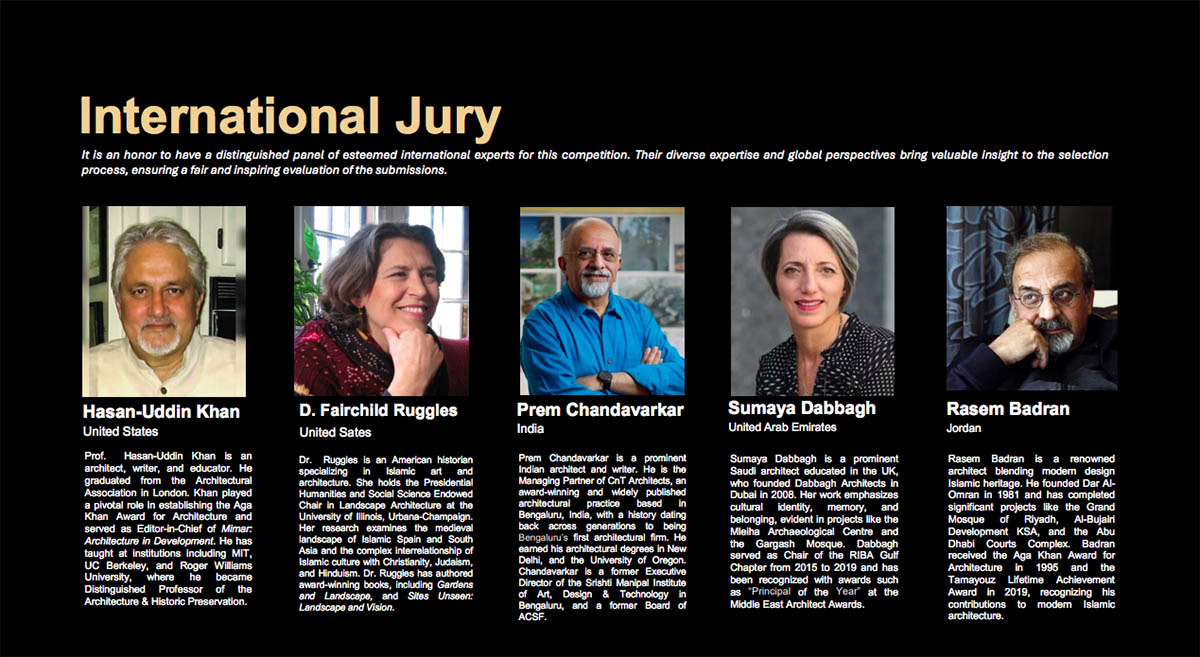
The International Jury for the competition
International Jury
It is an honor to have a distinguished panel of esteemed international experts for this competition. Their diverse expertise and global perspectives bring valuable insight to the selection process, ensuring a fair and inspiring evaluation of the submissions.
Prof. Hasan-Uddin Khan, United States
Prof. Hasan-Uddin Khan is an architect, writer, and educator. He graduated from the Architectural Association in London. Khan played a pivotal role in establishing the Aga Khan Award for Architecture and served as Editor-in-Chief of Mimar: Architecture in Development. He has taught at institutions including MIT, UC Berkeley, and Roger Williams University, where he became Distinguished Professor of the Architecture & Historic Preservation.
Prof. D. (Dede) Fairchild Ruggles, United States
Dr. Ruggles is an American historian specializing in Islamic art and architecture. She holds the Presidential Humanities and Social Science Endowed Chair in Landscape Architecture at the University of Illinois, Urbana-Champaign. Her research examines the medieval landscape of Islamic Spain and South Asia and the complex interrelationship of Islamic culture with Christianity, Judaism, and Hinduism. Dr. Ruggles has authored award-winning books, including Gardens and Landscape, and Sites Unseen: Landscape and Vision.
Prem Chandavarkar, India
Prem Chandavarkar is a prominent Indian architect and writer. He is the Managing Partner of CnT Architects, an award-winning and widely published architectural practice based in Bengaluru, India, with a history dating back across generations to being Bengaluru’s first architectural firm. He earned his architectural degrees in New Delhi, and the University of Oregon. Chandavarkar is a former Executive Director of the Srishti Manipal Institute of Art, Design & Technology in Bengaluru, and a former Board of ACSF.
Sumaya Dabbagh, United Arab Emirates
Sumaya Dabbagh is a prominent Saudi architect educated in the UK, who founded Dabbagh Architects in Dubai in 2008. Her work emphasizes cultural identity, memory, and belonging, evident in projects like the Mleiha Archaeological Centre and the Gargash Mosque. Dabbagh served as Chair of the RIBA Gulf Chapter from 2015 to 2019 and has been recognized with awards such as “Principal of the Year” at the Middle East Architect Awards.
Rasem Badran, Jordan
Rasem Badran is a renowned architect blending modern design Islamic heritage. He founded Dar Al-Omran in 1981 and has completed significant projects like the Grand Mosque of Riyadh, Al-Bujairi Development KSA, and the Abu Dhabi Courts Complex. Badran received the Aga Khan Award for Architecture in 1995 and the Tamayouz Lifetime Achievement Award in 2019, recognizing his contributions to modern Islamic architecture.
Jury Selection Criteria
All entries will be reviewed by a jury composed of internationally recognized individuals.
The best entries will be selected by considering how they embody the following main two items expressed by the submission’s alignment with most or all its seven interconnected and interdependent criteria:
1. Competition Theme “Transcendent Design and the Space In-Between”
2. The Declaration’s principles of Contemplation, Moderation, and Compassion
3. The Seven Criteria
Prizes
Total Prize Fund: $10,000 USD
3 Winners & 4 Honorable Mentions, Quality Trophies & Citations
Monetary Awards:
1st Prize: $5,000 USD
2nd Prize: $3,000 USD
3rd Prize: $2,000 USD
4 Honorable Mentions
Global Promotion: The award-winning projects will be documented and widely promoted through 2A Media and Magazine, the ACSF website, and various other channels.
Submission Requirements
1. Two (2) A2 size landscape-orientated presentation boards must be submitted as PDF formatted files not to exceed 10 MB total. The boards can include sketches, renderings, plans, sections, elevations, diagrams, and/or other representations to explain the project. The competition emphasizes impactful visuals and graphics.
2. A 500-word Essay that critically analyzes the current state of our built environment and proposes a forward-thinking vision that aligns with the competition theme of “Transcendent Design and the Space In-Between” and the principles and criteria of the ACSF Declaration of Transcendent Human Habitat. The essay should illustrate how design embodies these ideals and reflect on the role of design in shaping a sustainable and spiritually transcendent future.
Submission Fee
Participants from Global North $80.00 USD / (USA, Canada, United Kingdom, nations of the European Union, Singapore, Japan, South Korea, Australia, & New Zealand)
Students & participants from all other countries: $20.00 USD
All images are courtesy of ACSF.