Where Home Follows You - Designing for a community that moved countries — together.
Which neighbourhood in Netanya was chosen by an entire community from New Jersey – and why?
They wanted to make aliyah to Israel, but not give up the community they had known for years. This is how the upscale Nof HaTayelet neighborhood in Netanya became a magnet for Jews from New Jersey, and how the Bazelet Architects firm designed a garden apartment that blends American taste, religious lifestyle, and a view of the Mediterranean.
________________________________________
In recent years, demand from North American Jews for residential properties in Israel has been rising — but this case is not just another family choosing to make aliyah. This is an entire community from New Jersey that made an extraordinary decision: to move to Israel together.
Rather than scattering across different cities and neighborhoods, community members were looking for an area where they could continue living the lifestyle they knew — with the same friends, the same synagogue, the same community framework and sense of belonging. After considering several areas in the country, the choice fell on the Nof HaTayelet neighborhood in Netanya, one of the city's most prestigious residential neighborhoods, stretching along the coastline and benefiting from proximity to the sea, high-quality construction, and a growing international community.
"The idea was not just to make aliyah, but to do it as a community," explain architects Shira Dromi and Anuk Ron of Bazelet Architects, who designed a spacious garden apartment for one of the first families to arrive in the neighborhood. "It was important to them to preserve the social and family fabric from New Jersey, alongside the dream of living in Israel and near the sea. Today we're already planning additional projects for neighbors and friends from the same community who have joined the move."
The apartment, approximately 180 sqm with a garden of about 150 sqm, is located in one of the neighborhood's most prestigious complexes and feels entirely like a private home. The owners, a couple who made aliyah from New Jersey, wanted to create a luxurious, warm, and welcoming living environment that would blend American taste with their new life in Israel.
"The clients came with a very different concept of luxury from what we're used to seeing here," say the architects. "While Israeli design in recent years has leaned toward minimalism, light tones, and matte surfaces, in the United States people still love shine, presence, warm and golden tones, and rich materiality."
This choice is reflected in nearly every corner of the home: warm-toned wood cladding, prominent gilded lighting, impressive stone surfaces, and deep tones that give the space a classic sense of luxury.
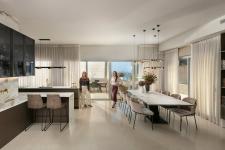
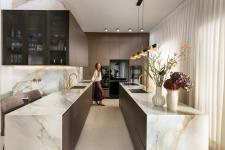
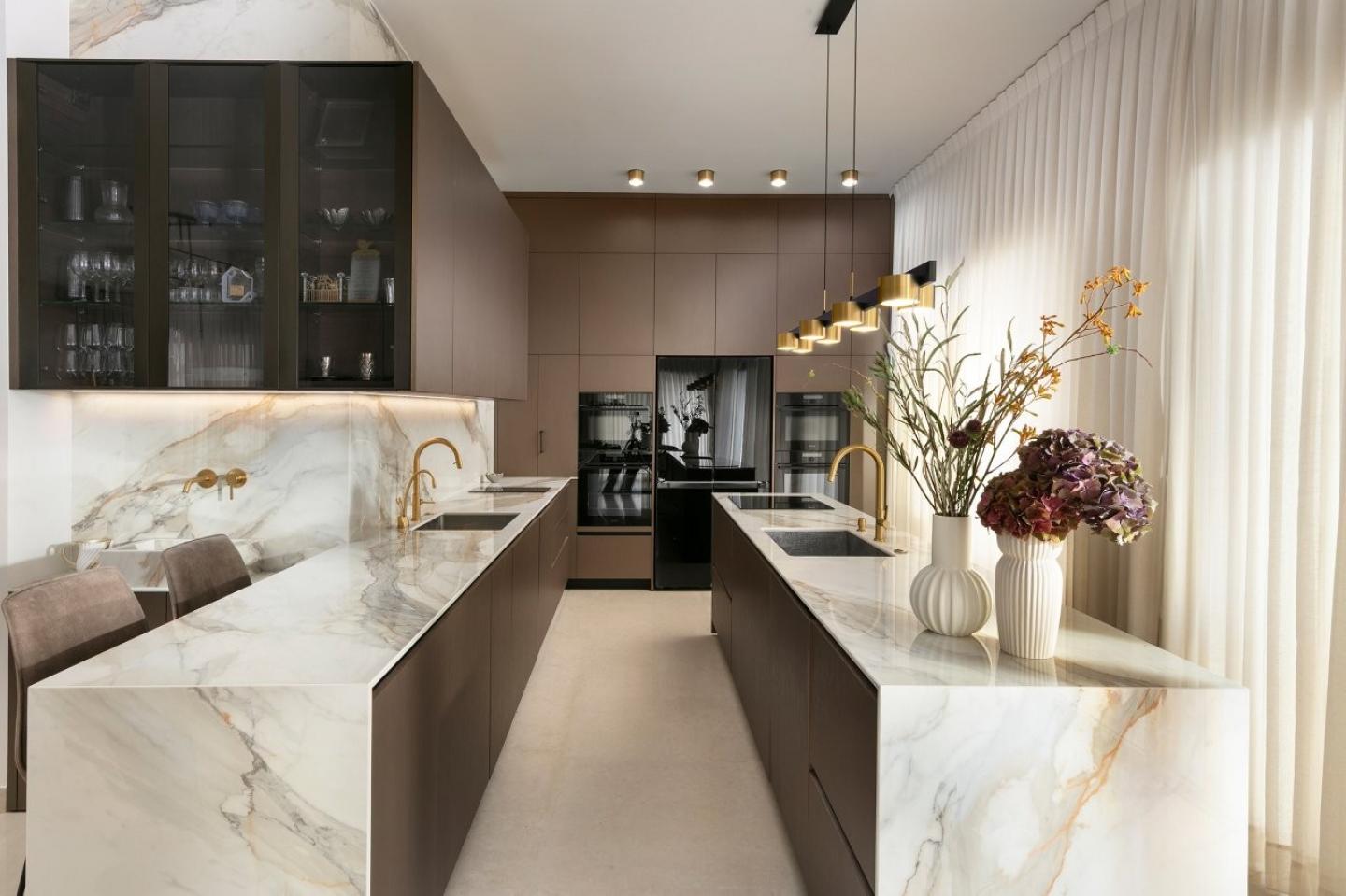
One of the home's central spaces is the kitchen, designed around the owners' family and communal lifestyle. It is an especially large kitchen featuring two parallel work areas and a central island approximately 3.3 meters long. A significant portion of the island was designed for serving food and entertaining, with the understanding that the home regularly hosts family members and children who come from the United States for extended visits.
"The kitchen is the heart of the home," say the Bazalt team. "Much of the planning focused on the question of how to accommodate a large number of people comfortably, especially on Shabbat and holidays." The stone surfaces from Gatinio Marble continue from the countertop up the walls, climbing upward and creating a rich, refined look. The handwashing station — an important feature in a religious home — was also integrated as an inseparable part of the design language.
Kashrut requirements also received special attention. The family, accustomed in the United States to working with specific materials, wanted to ensure that all finishing materials met the halachic standards they were used to. And so, complete with a kashrut certificate, the Gatinio Marble countertop was welcomed straight into the kitchen.
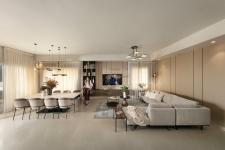
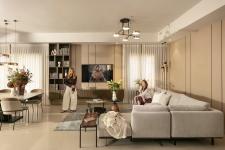
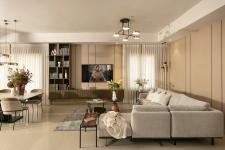
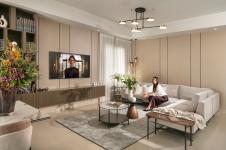
One of the most striking features of the home is the absence of a television as the room's focal point. Instead, an exceptionally large seating arrangement was designed, facing out toward the open view of the Mediterranean. "It was important to them to sit and look at the sea," the architects explain. "Not at the screen."
The seating system, custom-designed for the project, can accommodate a large number of people and creates a space suited to conversation, family gatherings, and quality time together. Adjacent to the living room, a large sideboard was custom-designed for the family's religious lifestyle, with dedicated space for their collection of sacred books.
The dining area forms another significant focal point in the home. The large table was designed for wide-scale family entertaining, and above it hang two large gilded light fixtures. "The clients really wanted to see dominant lighting," say the Bazalt team. "That's part of the American design language. In Israel, people are more accustomed to recessed or technical lighting, but here the lighting is part of the design statement." The chairs, in warm brown tones with leather backs, were carefully selected to allow for extended seating around the Shabbat table.
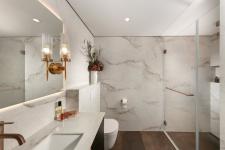
The bathrooms continue the home's design language, with earthy tones, rich textures, and warm materiality that creates a sense of continuity between the spaces.
But beyond the design, this project tells a broader story about one of the more interesting trends in the Israeli real estate market: entire communities of North American Jews choosing not just to make aliyah, but to do it together.
The Nof HaTayelet neighborhood in Netanya — already considered one of the city's most prestigious residential areas thanks to its proximity to the sea, quality construction, and strong demographic — is gradually becoming an attraction for new immigrants seeking to combine quality of life, community living, and a sense of belonging.
The apartment designed by Bazelet Architects reflects a much wider phenomenon: a new wave of aliyah to Israel, where not just a family moves — but an entire community chooses to begin a new chapter together.
2026
2026
The apartment, approximately 180 sqm with a garden of about 150 sqm, is located in one of the neighborhood's most prestigious complexes and feels entirely like a private home
Design: Bazelet Architects, architects Shira Dromi and Anuk Ron Stone