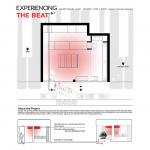
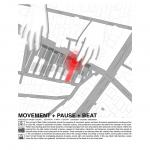
Beat Café is an architectural interpretation of urban rhythm. In this project, the concept of “Beat” extends beyond its conventional musical meaning and is redefined as the pulse of city life—a rhythm shaped by pedestrian movement, pauses, conversations, light, sound, and everyday human interactions.
Cities are composed of multiple rhythms unfolding simultaneously: the flow of pedestrians, brief stops, casual conversations, passing vehicles, shifting light conditions, ambient sounds, and temporary gatherings that continuously emerge and disappear within the urban landscape. Individually, these events may seem ordinary, yet together they form the living cadence of the city. The project originated from a simple question: how can a fragment of this dispersed urban vitality be condensed into a small-scale spatial experience?
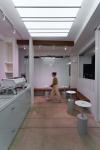
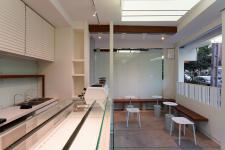
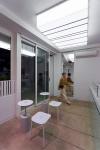
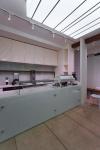
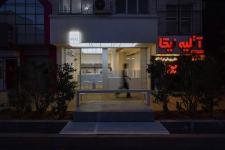
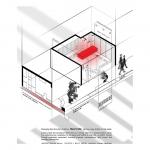
In response, the café was conceived as a space that absorbs, organizes, and reveals everyday urban flows. The primary design strategy was to dissolve the rigid boundary between the city and the café. By aligning the interior floor level with the sidewalk, entering the café is experienced not as crossing a threshold but as a natural continuation of movement through the city. This spatial continuity allows pedestrian movement, fleeting glances, brief pauses, and the presence of café users to coexist within a shared field, establishing an ongoing relationship between public space and the interior.
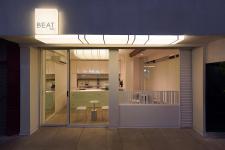
Light plays a significant role in expressing the project's central idea. The red glow that emerges at night is not merely an aesthetic choice; it acts as a visual beat within the urban fabric. As the street recedes into relative darkness, the café becomes a recognizable point of reference, interrupting the monotony of the nighttime streetscape, attracting attention, and creating moments of pause and spatial awareness. In this way, the project functions not as an isolated object but as an active participant in the life of the street.
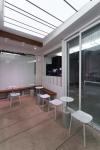
The auditory dimension follows a similar approach. Rather than excluding the sounds of the city, the project embraces them as part of the spatial experience. Traffic noise, passing vehicles, fragments of conversation, and the music within the café are perceived as overlapping layers that contribute to a dynamic and vibrant atmosphere. Here, the notion of Beat is not confined to music; it is continuously recreated through the interaction between urban sounds, human activity, and space.
From this perspective, Beat Café is more than a place to drink coffee. It is a setting for experiencing the everyday rhythms of urban life. The project seeks to bring together ordinary yet meaningful moments—from movement and observation to pause, conversation, and collective presence—transforming them into a shared architectural experience.
2025
2026
Light plays a significant role in expressing the project's central idea. The red glow that emerges at night is not merely an aesthetic choice; it acts as a visual beat within the urban fabric. As the street recedes into relative darkness, the café becomes a recognizable point of reference, interrupting the monotony of the nighttime streetscape, attracting attention, and creating moments of pause and spatial awareness. In this way, the project functions not as an isolated object but as an active participant in the life of the street.
The auditory dimension follows a similar approach. Rather than excluding the sounds of the city, the project embraces them as part of the spatial experience. Traffic noise, passing vehicles, fragments of conversation, and the music within the café are perceived as overlapping layers that contribute to a dynamic and vibrant atmosphere. Here, the notion of Beat is not confined to music; it is continuously recreated through the interaction between urban sounds, human activity, and space.
From this perspective, Beat Café is more than a place to drink coffee. It is a setting for experiencing the everyday rhythms of urban life. The project seeks to bring together ordinary yet meaningful moments—from movement and observation to pause, conversation, and collective presence—transforming them into a shared architectural experience.
Mahsa Najafi
Yasamin Shiravanian