Cam Ranh Naval History Museum: Memories Of The Current
1. Project Statement: What shapes the current — the present moment — is always the past. Yet the current also evokes the ceaseless movement of water, reminding us that the ocean itself is more than a landscape: it is a living archive of memory. Water does not simply flow; it carries. It holds within its depths the silence of loss, the echoes of battles, and the voices of those who once navigated its vastness.
From the silent depths of the ocean to the restless surface of unruly waves, and to the horizon where the sky collides with boundless blue, each layer holds traces of history. For naval soldiers, these waters were not just a landscape but a frontier — where the boundary between life and death is blurred, where sacrifice became the price of peace, where the memories endures in every current that touches the shore. The ocean, in this way, becomes both witness and messenger: it remembers, and in its endless rhythm, it delivers those memories to us.
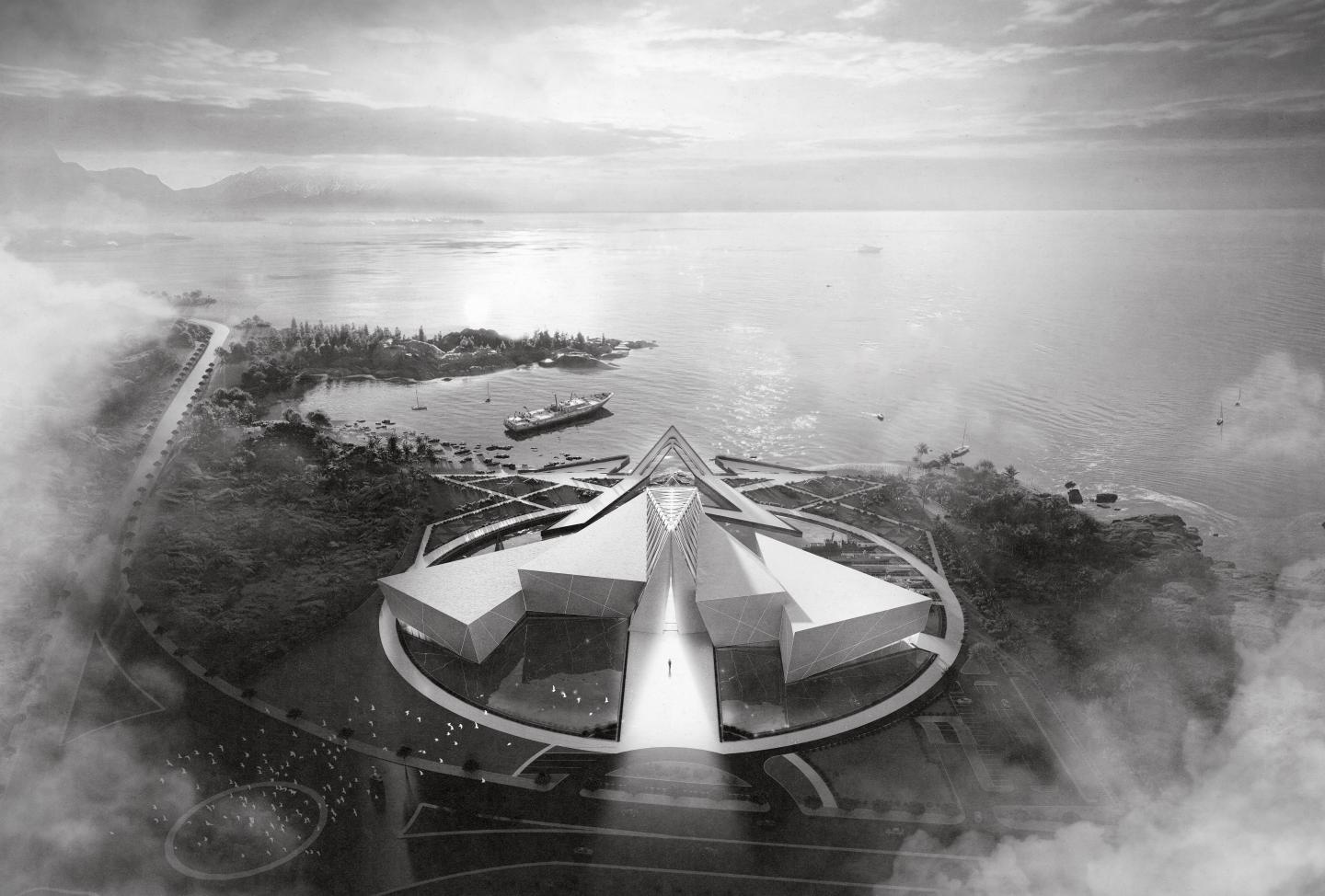
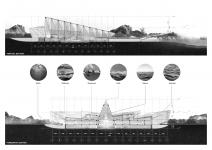
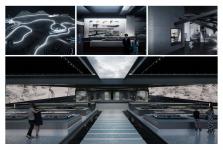
The architecture emerges from this layered reading of the sea. The building is conceived as a spatial translation of depth, turbulence, and horizon. Solid masses rise and fracture like waves under tension, while circulation unfolds as a gradual movement from compression to openness. A vertical axis anchors the journey, drawing visitors upward toward light and the distant horizon. In this way, the museum does not simply display history; it embodies the motion of the current itself, allowing memory to be experienced as movement rather than as static remembrance.
2. Site context: Cu Hin, Cam Ranh
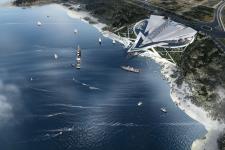
Geographic: Cam Ranh is embraced by mountains and the sea, forming a naturally protected bay where land and water converge, which is a setting that physically reflects the idea of “current” and flow.
History: Khanh Hoa has long been recognized as one of Vietnam’s most significant maritime military regions. Cam Ranh Bay, in particular, has served as a strategic naval harbor across different historical periods, embedding narratives of defense, resilience, and sacrifice into the landscape. The project draws from this historical continuity, acknowledging the province’s enduring relationship with the sea.
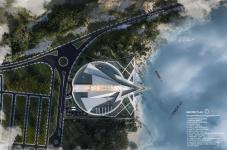
Political Layer: The site aligns along important national defense axes. Extending southward connects toward Naval Region 4 Command, a major naval base, while projecting eastward leads toward the Truong Sa (Spratly) Islands. These orientations situate the project within a broader geopolitical framework of maritime sovereignty and territorial awareness, reinforcing the museum’s role as a spatial reminder of national presence at sea.
Contemporary Development: As Cam Ranh continues to develop as a strategic coastal and tourism hub, the museum acts as a cultural anchor, preserving maritime memory while engaging with the province’s evolving identity between defense, economy, and global connection.
3. Design Methodology: The museum is conceived as the convergence of two currents — one unfolding horizontally across history, the other rising vertically toward transcendence.
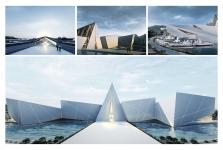
Horizontal axis: The narrative moves in fractured, jagged geometries that echo the turbulence of the sea and the instability of national memory. These broken lines trace a journey shaped by uncertainty, resilience, and defense. From this horizontal current, five crests rise like waves in motion, each representing one of Vietnam’s five naval regions. Though distinct in form and positioned at varying elevations, they remain interconnected, embodying both individuality and unity within the same oceanic system of protection.
Vertical axis: Intersecting this movement stands a 40-meter tower — the vertical current that anchors and elevates the experience. It emerges at the center as a spatial and emotional culmination, where horizontal motion meets upward aspiration. If the horizontal axis carries the weight of collective memory, the vertical axis transforms it into clarity and hope. Moving upward through light and openness, the visitor transitions from turbulence to stillness, from depth to horizon.
4. The Orientation:
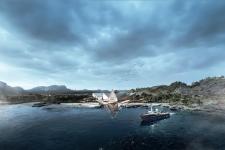
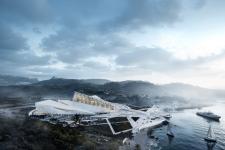
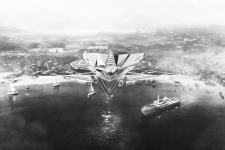
The overall form of the building is conceived as a directional gesture, resembling an arrow pointing toward the East or a wave unfolding and flowing outward to the sea. This deliberate orientation establishes a strong axial movement from land to water, reinforcing the project’s relationship with the coastline.
The eastern edge becomes both a visual and symbolic horizon. As the building narrows and extends in that direction, its geometry intensifies the sense of projection and forward momentum, like a force emerging from the mainland toward open waters. Through this spatial alignment, the architecture subtly emphasizes the strategic and cultural importance of Vietnam’s eastern coastline. Rather than stating it explicitly, the form itself becomes a quiet assertion, a built gesture that acknowledges the sea not only as landscape, but as identity and sovereignty.
2025
1. Basic Info:
Total Site Area: 7.06 ha
Gross Floor Area: 25,834 m²
Building Coverage Ratio: 30%
Floor Area Ratio (FAR): 0.25
Building Classification: Grade I
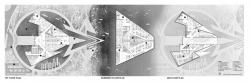
Number of Floors: 3 (1 basement floor)
Capacity: 3,355 people
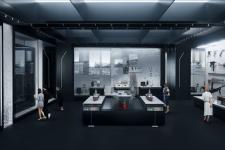
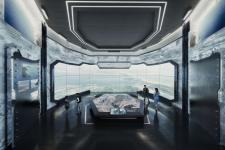
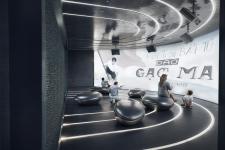
2. Main function block: The Cam Ranh Naval Museum consists of five principal zones: Exhibition Area, Public and Community Area, Research and Administrative Area, Collection Storage, and Memorial Plaza.
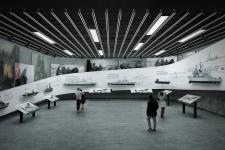
The Exhibition Area unfolds along a horizontal axis, representing the historical current of Vietnam’s naval defense. The Public Area functions as an open civic interface, connecting visitors to the coastal landscape. The Research and Administrative Area supports academic and archival activities, while the Storage ensures preservation of artifacts and documents. At the center, the Memorial Tower rises vertically as a spatial culmination — a symbolic intersection between memory and aspiration.
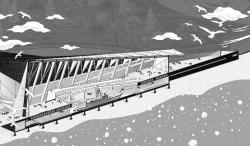
3. Design Along the Water Axis: The central memorial hall spans 30 meters in width and is structured by a repetitive steel frame system with 12-meter column spacing. The primary load-bearing system consists of inclined steel trusses connected to reinforced concrete cores at both ends, ensuring lateral stability against coastal wind loads. The triangulated geometry increases structural rigidity while reducing material weight.
The gradually descending floor is formed through a stepped slab system integrated into the main structural grid, ensuring efficient load transfer and controlled drainage.
A double-layered glass façade acts as a thermal buffer. The ventilated cavity reduces heat gain and protects the interior from salt-laden coastal air, while low-E glazing improves daylight performance and energy efficiency.Acoustic treatments are integrated within the roof structure to control reverberation, maintaining a calm and dignified atmosphere inside the large-span space.
4. Oversized Artifact Transportation: The Cam Ranh Naval Museum requires the display of large-scale naval artifacts that cannot be transported by road. To address this, the design integrates a dedicated waterway access. An elevated bridge within the Memorial Zone rises 18 meters above the water, allowing small vessels to pass beneath and enter an internal dock. From this dock, oversized artifacts are transferred directly to a freight elevator system connected to the basement level.
This strategy separates service circulation from public movement while fully utilizing the site’s proximity to Cam Ranh Bay — allowing maritime artifacts to return to the sea through water-based transport.
5. Light and Water as a Spatial Guide:
Light and water are composed as intertwined spatial elements that shape both movement and perception. Natural light filters through layered glazing and reflects gently on the water surface, creating shifting patterns that animate the interior throughout the day. The presence of water softens the structural geometry, introducing fluidity within the rigid frame. Reflecting pools trace the main axis of the space, guiding visitors forward while reinforcing a sense of continuity. The subtle sound and movement of water encourage stillness and contemplation, without imposing heaviness or sorrow.
Designer: Van Thao Nguyen Huu
Supervisor: Dr.Arch. Pham Phu Cuong
Van Thao Nguyen Huu

Favorited 2 times