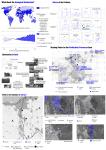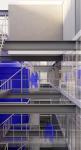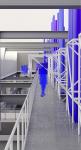
In İzmir, the legacy of industrial production extends beyond visible urban fabric and accumulates beneath it. In Sarnıç, Gaziemir—an area defined by groundwater potential—decades of mining activity, industrial operations, and buried hazardous residues have produced a layered condition of soil and aquifer contamination. Heavy metals, industrial solvents, and legacy nuclear waste traces remain embedded within geological strata. The environmental crisis is not absent; it is subterranean.
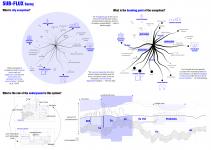
SUB-FLUX approaches contamination as a structural byproduct of industrial metabolism rather than an isolated technical malfunction. The project is positioned directly within the well-field landscape, acknowledging groundwater not only as a resource but as a vulnerable ecological system. Instead of isolating remediation as an invisible engineering process, the project spatializes environmental repair and integrates it into public life.
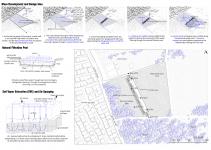
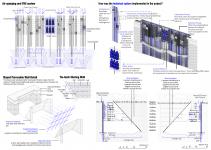
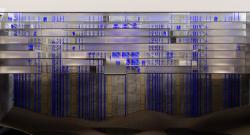
The parcel is transformed into a reed-field filtration landscape. Natural filtration pools initiate passive phytoremediation, allowing contaminated surface water to be filtered through vegetation and soil before infiltrating downward. This gradual percolation directs water toward a permeable inclined retaining wall embedded within a sectional excavation. The wall operates simultaneously as structural support and ecological interface: filtered water seeps through controlled mesh layers, making infiltration visible.
The decision to build underground is intentional. The subterranean realm is where industrial impact remains concealed—where contamination accumulates beyond civic perception. By occupying this hidden layer, SUB-FLUX reveals the environmental consequences of extraction and production while actively addressing them. Cleaning becomes an act of exposure.
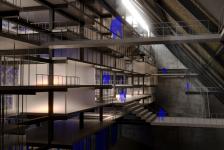
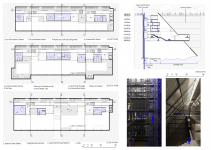
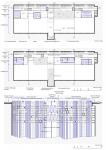
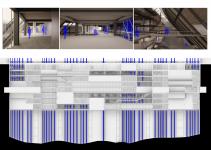
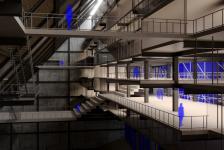
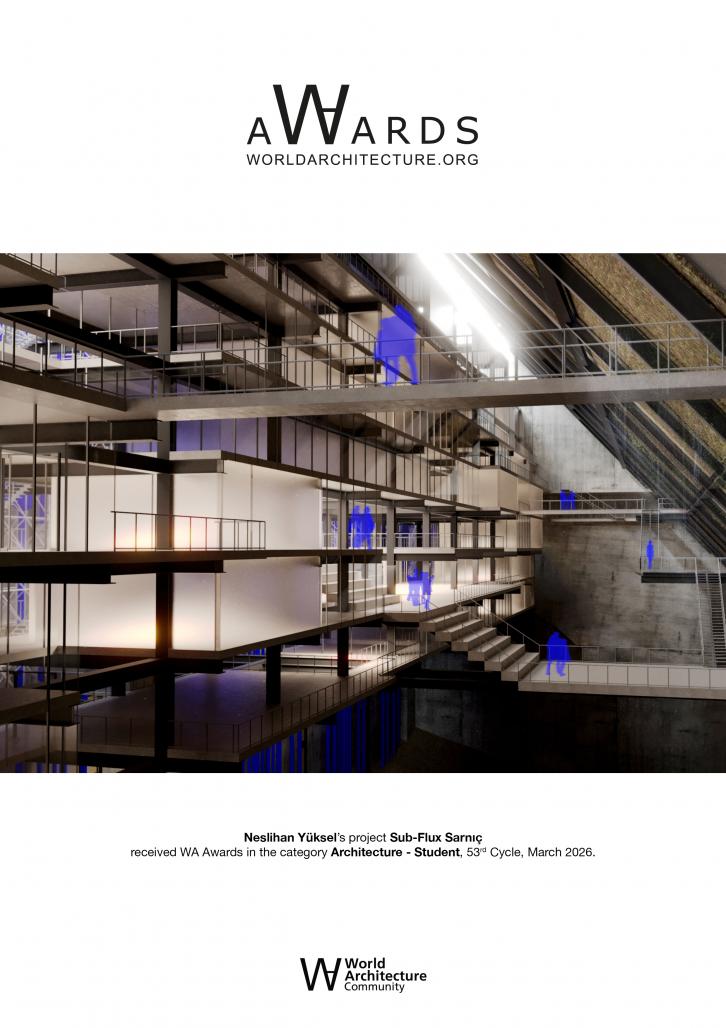
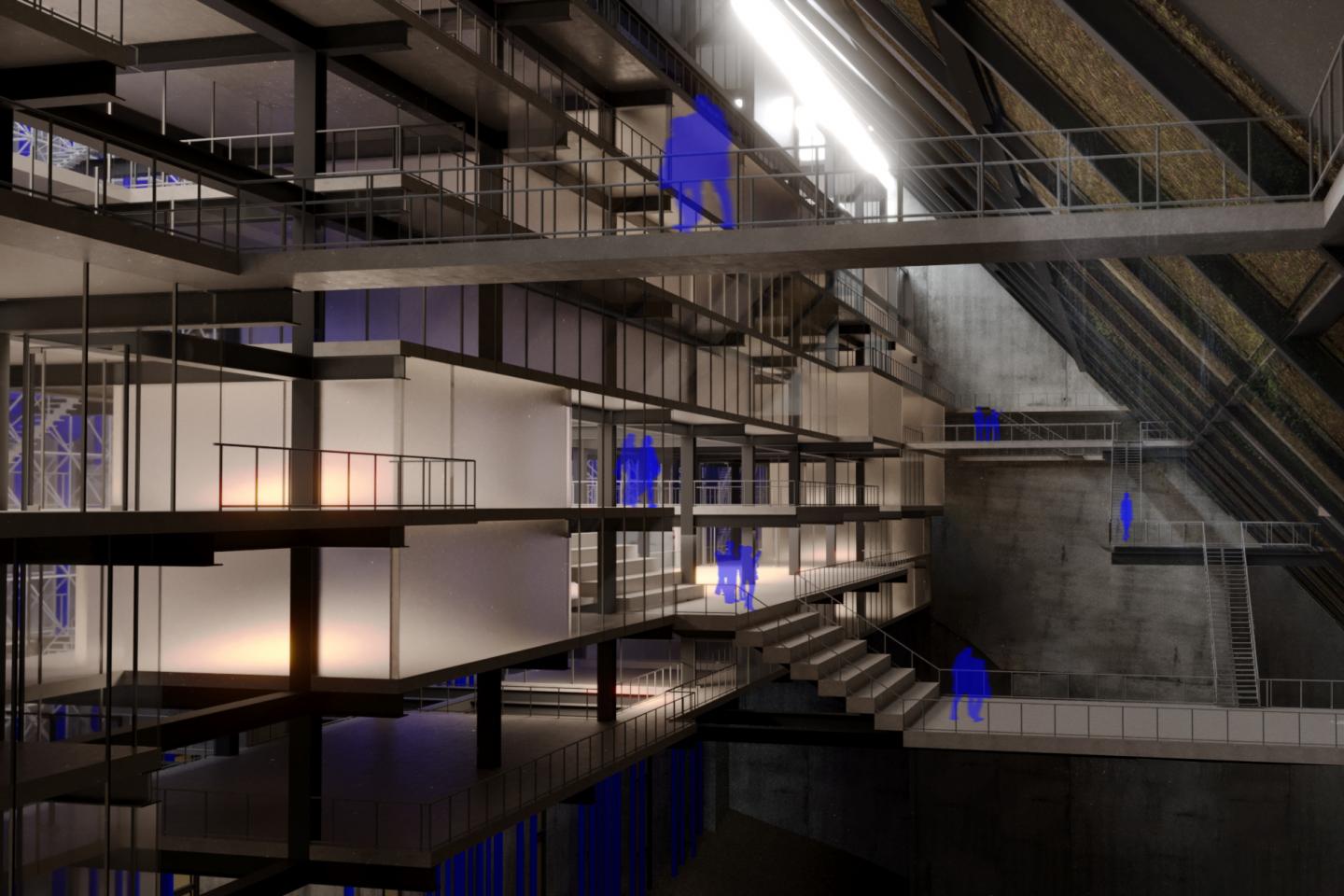
Rather than treating remediation as an invisible technical operation, the project spatializes the process of environmental repair. Air Sparging (AS) and Soil Vapor Extraction (SVE) systems are integrated directly into the architectural structure, transforming groundwater purification into a visible and accessible experience. Technical lines, extraction wells, compressors, and vapor treatment units are not enclosed behind walls. Visitors can traverse the remediation infrastructure through steel mesh catwalks and a single-run stair that intersects the technical shafts, allowing close observation of the purification sequence.
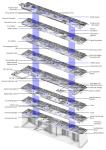
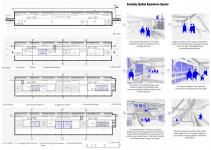
The intervention is organized as a multi-level vertical section embedded within the terrain. Laboratories, monitoring platforms, eco-galleries, digital simulation areas, and educational spaces align along a continuous circulation spine descending through geological layers. Visitors, researchers, and local communities engage with the remediation system not as spectators, but as participants within an active environmental process.
In SUB-FLUX, the underground is not a concealed technical void but an exposed environmental interface.
Water is not stored—it is restored.
Infrastructure is not hidden—it is revealed.
By merging environmental engineering with architectural space, the project proposes a new civic model of ecological infrastructure—one that repairs contamination while simultaneously making its mechanisms legible to the public.
Construction Strategy
The excavation employs a staged retaining system allowing surface landscape restoration while subterranean construction continues below grade.
Inclined structural walls are stabilized through ground anchorage (soil anchor) systems resisting lateral earth pressure. Permeable mesh layers and integrated drainage channels allow controlled groundwater infiltration while maintaining structural stability.
Environmental Remediation System
Surface Layer – Passive Filtration:
Reed fields and natural filtration pools initiate phytoremediation and sedimentation.
Subsurface Layer – Active Remediation:
Air Sparging injects pressurized air into saturated soil layers to volatilize contaminants.
Soil Vapor Extraction captures and treats contaminated vapors before atmospheric release.
Observation Layer – Civic Interface:
Steel mesh catwalks intersect remediation shafts, enabling direct public engagement with active purification systems.
2025
Location: Sarnıç District, Gaziemir – İzmir, Türkiye
Total Built Area: Approx. 10,000 m²
Program Type: Ecological Remediation & Public Research Infrastructure
Primary Environmental Systems: Air Sparging (AS) Soil Vapor Extraction (SVE), Natural Filtration Pools
Underground Sectional Intervention: Multi-level vertical excavation
Structural System: Reinforced concrete retaining system with integrated steel secondary framework
Designer: Neslihan Yüksel
Instructors: Assoc. Prof. Dr. Ülkü İnceköse, Assoc. Prof. Dr. Ebru Yılmaz, R.A. Ceren Ergüler
SUB-FLUX Sarnıç by Neslihan Yüksel in Turkey won the WA Award Cycle 53. Please find below the WA Award poster for this project.
Downloaded 0 times.
Neslihan Yüksel