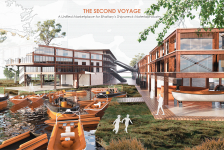
The Second Voyage : A Unified Marketplace for Bhatiary's Shipwreck Material Industry
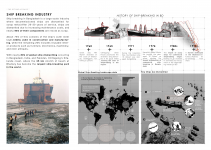
Bhatiary Union, located in Sitakunda Upazila of Chittagong Division, Bangladesh, has evolved into one of the most distinctive marketplaces shaped directly by the global ship-breaking industry.After 20–30 years of service, ships are dismantled due to increasing maintenance costs, and nearly 95% of their components are resold as scrap.
With nearly 80% of global ship dismantling occurring in Bangladesh, India, and Pakistan, Chittagong’s Sitakunda coast—particularly the 25 km stretch of beach at Bhatiary—has become the largest ship-breaking yard in the world.
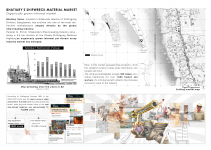
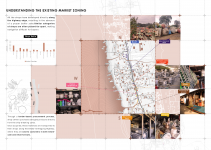
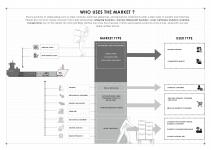
Along the Sitakunda coast, where dismantled ships arrive at the end of their journeys, another story unfolds quietly. Over the years, along a 3.5 km stretch of the Dhaka–Chittagong National Highway, an organically grown yet vibrant informal ship scrap industry market has emerged. Here, salvaged ship products—from the smallest screw to large-scale machinery, furniture, electronics—are bought and sold. It is vibrant, chaotic, and deeply human, sustained by the labour and resilience of traders and workers.
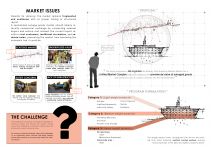
Market Issues:
Despite its vibrancy, the market remains fragmented and scattered, with no proper zoning or civic facilities.The market lacks structured layout, safety, and basic facilities, making movement difficult and work harder than they need to. The current layout of the market results in lost customers, inefficient circulation, and reduced sales, preventing the market from becoming the economic hub it could be.
This thesis begins with empathy for this everyday scene.It questions how architecture can meaningfully support the people who depend on this place without taking away its character.
Proposal:
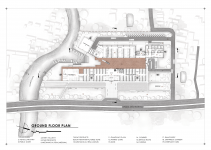
The proposal envisions a unified market complex set within an 8.3-acre site along the existing strip, designed to enhance the commercial value of salvaged goods while introducing civic and cultural functions into the surrounding industrial fabric.
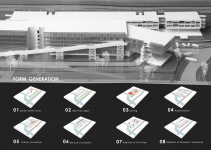
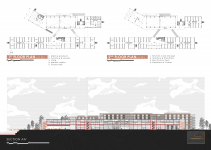
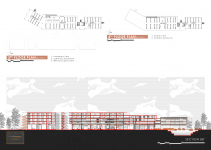
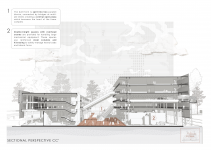
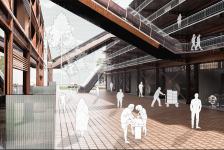
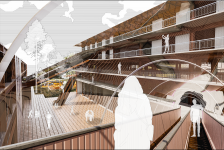
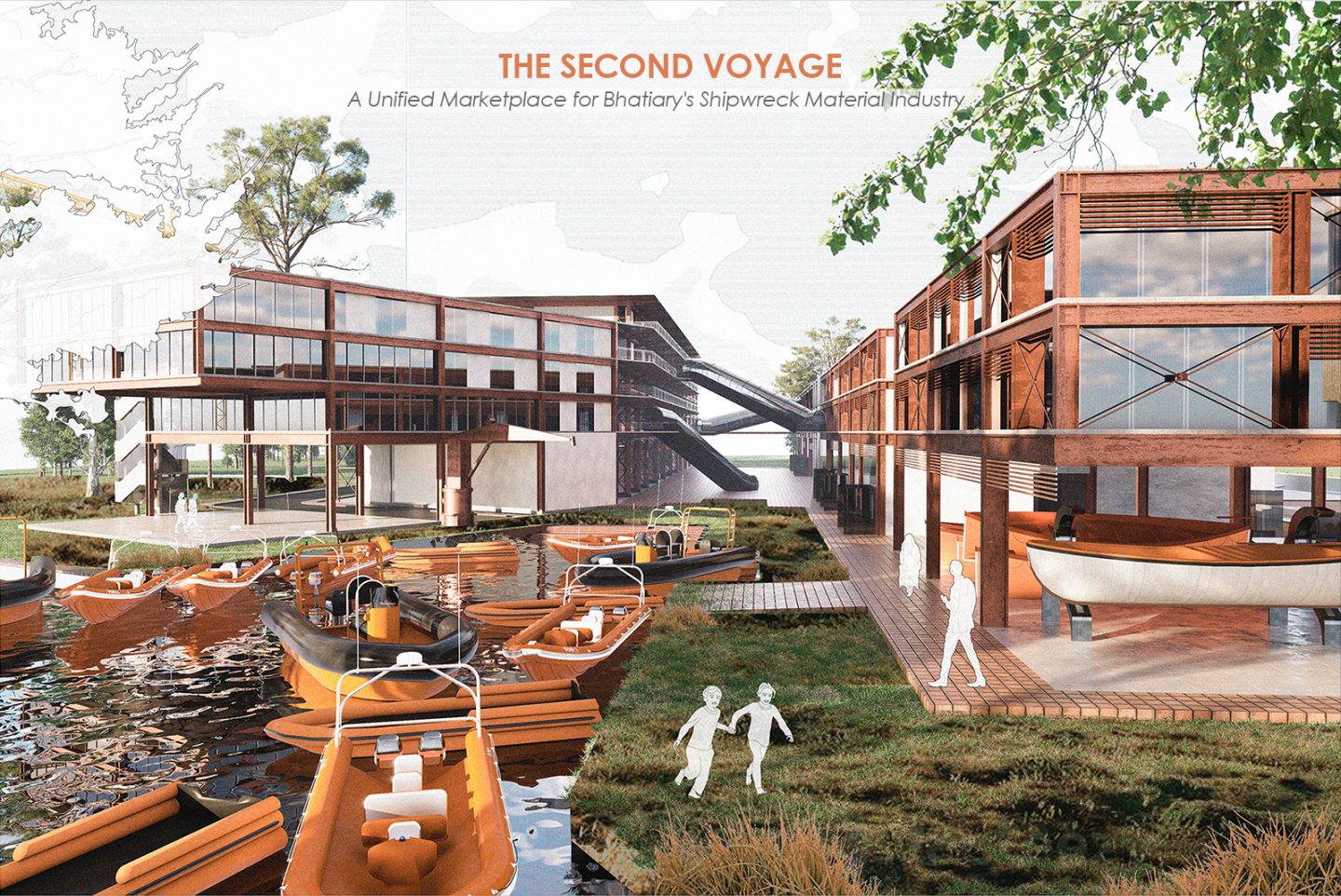
The design follows the logic of the place itself, a linear form that mirrors the roadside market, but reorganized with clarity and care. Two parallel blocks run along the site, connected by bridges across multiple levels. Between them emerges an open plaza, a pause within the industrial flow, where people can meet, rest, and reclaim a sense of public life.
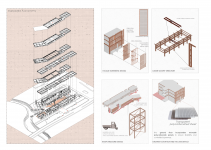
The marketplace is structured vertically. Heavy mechanical goods settle at the base, supported by double-height spaces and overhead crane systems for safe handling, while lighter products rise above in layered zones. Circulation is rethought through separate entries for customers, services, and administration, allowing movement to become intuitive rather than chaotic.
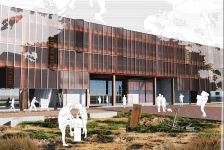
The master plan integrates the marketplace with its surrounding landscape to create a cohesive and inviting environment. The front landscape enhances the customer experience by providing outdoor spaces for relaxation, recreation, and public gatherings.
Through this vision, the project does not attempt to romanticize industry, nor erase its rawness. Instead, it seeks to reorganize the existing condition with empathy and purpose. In this proposal, Bhatiary becomes more than a marketplace. It transforms into a shared civic space shaped by work and people—where the end of one journey, that of a ship, gives rise to another rooted in livelihood, community, and continuity.
2025
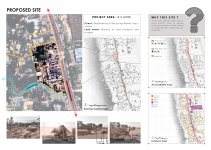
Proposed site : Here the chosen 8.3 acre site sits within the existing stretch, close to salvage yards and transport routes, making it accessible and contextually appropriate.
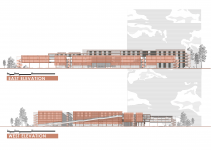
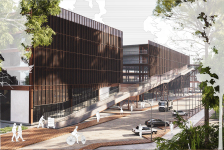
Materially, the project remains rooted in its context. Repurposed ship metal mesh wraps the east and west façades, carrying the memory of dismantled vessels while suggesting a quieter form of sustainability reuse as continuity rather than novelty.
Special provisions are made for large mechanical equipment such as boilers, compressors, and generators, which require greater spatial capacity. These zones are designed with double-height spaces and equipped with overhead crane systems for safe handling, supported by double steel columns and X-bracing to resist lateral loads.
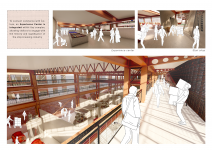
Beyond trade, the project also introduces an experience center that tells the visitors about the history and human stories of ship-breaking, bridging the gap between industry and public awareness. Landscaped edges soften the highway’s harshness, creating spaces where people can gather, breathe, and linger.
Author : Fouzia Afrose Bushra
Design Studio Mentor : Kanu Kumar Das, Sarah Binte Haque
Thesis Supervisor : Amit Imtiaz
Fouzia Afrose Bushra