Living Inside a Brasserie: A Home That Is a World of Culture and Hospitality
On a village in the southern part of Israel, on a generous plot spanning 2,000 sqm / ~21,500 sqft with long, narrow proportions, architects Sarah and Nirit Frenkel designed and built a private home of approximately 400 sqm for a couple in their third chapter of life — their children have left the nest, but continue to visit frequently with their own children. The couple, who work as consultants from home, wanted to create a home that combines a high quality of life, generous hospitality, professional workspaces, and at the same time reflects their love of art, music, and European culture. The concept was defined clearly from the outset: a home inspired by a French brasserie, combined with a European farmhouse design language. This concept dictated the architectural and design language of the entire home — from the façades and built volumes down to the joinery details, lighting, and materials.
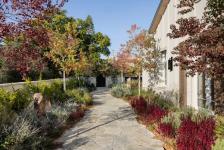
The home was designed as a composition of architectural volumes, spread across a single floor and divided into a public wing and a private wing. This division allowed each zone its own independent character while maintaining a connection between them. The narrow street-facing façade is clad in brick applied using a technique that mimics an aged appearance, as though it had always been there. A path runs alongside the house along its long edge, accompanying the private zone and leading to the entrance foyer, positioned between the two volumes of the house — a point of both separation and connection at once.
Entry to the home is through an internal patio — a central architectural element of the project. The patio serves as a transitional space between outside and inside: on one side the garden is visible through a glass façade, and on the other the interior of the home is revealed. The entrance door, with its European character and metal canopy, leads into a foyer paved in brick set within a herringbone-patterned frame — a direct nod to the brasserie language and its attention to detail.
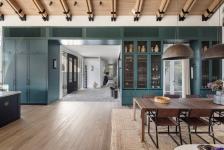
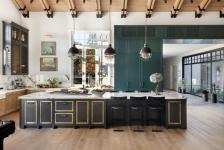
From the foyer, the public wing unfolds. One of its central elements is a continuous joinery unit in a turquoise-green tone that runs the full length of the wall bordering the patio and forms a significant architectural element in its own right. This unit continues to become the central spine of the L-shaped kitchen. The kitchen features a dominant central island approximately five meters long, serving both as a work surface and as a place for seating and entertaining. The joinery design is particularly complex, combining tall units in turquoise-green, lower units in natural oak, and upper cabinets in graphite blue-grey. The upper cabinets are not solid but feature brass mesh fronts, allowing the entertaining ware to be displayed as a decorative element. Brass recurs in the handles, frames, and other details, lending a jewel-like quality throughout. The stone countertop features a distinctive profile that emphasizes its thickness and the quality of its execution, with additional small details that deepen the sense of richness.
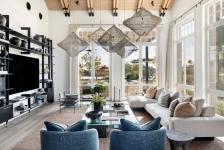
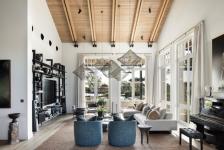
The entire public space is characterized by an exceptional ceiling height of approximately 7.5 meters. The sloped roof rests on exposed steel beams, with decorative steel clamps integrated at the connection points, reinforcing the industrial-European design language. On the exterior, the roof is clad in zinc — a material characteristic of European construction. Windows standing 3.6 meters high open toward the garden and bring in abundant natural light. To maintain correct proportions, the joinery units were also designed in response to the height of the space.
The dining area is positioned as a direct continuation of the kitchen, defined by three sides: a turquoise joinery unit with entertaining storage, a large vitrine facing the garden, and a brasserie bar that serves for storage, display, and service during entertaining. The bar also acts as a divider between the public space and the master suite. The dining table, with its refined and slender design, is surrounded by chairs with slim frames in a leather finish, and the space is anchored by a rug that provides intimacy within the larger volume.
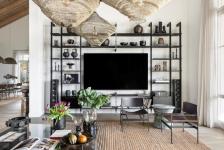
The generous living room faces the long pool and the open view of the fields. The space includes a high-quality sound system — an integral part of the owners' passion for music — as well as a piano and a minimalist metal unit designed specifically to display their art collection. Art was an inseparable part of the planning process, and the units were designed to serve the presentation of the works. Light fixtures hanging from the tall ceiling, some with industrial fishing-net closures, help define the human scale of the space and reinforce the industrial language.
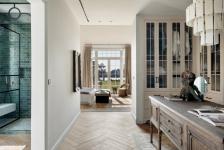
Behind the brasserie zone sits the master suite, designed as a longitudinal sequence facing the pool. The suite includes a walk-in wardrobe with a central island in oak and cabinets in a powdery rose tone with glass fronts, reflecting the owners' organized nature. The bathroom features parquet flooring, fan-patterned turquoise ceramic tiles, wallpaper, and brass details. The shower and toilet are separated by striped glass partitions, with storage joinery units alongside. The bedroom itself includes a custom-made bed and bedside tables, mosaic side tables, a bench at the foot of the bed, a lounge armchair, and artwork, with the exposed steel roof beam continuing here as well.
The guest bathroom was designed as one of the home's most striking spaces, with herringbone-framed brick flooring, wood cladding in graphite halfway up the walls, and a bold wallpaper above. The sink surface was custom-designed with delicate brass legs, with brass recurring in the mirrors and additional details.
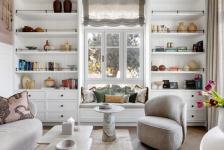
Opposite the guest bathroom is the husband's study, designed as a hybrid space combining a professional work environment with a personal space for his hobbies — an intimate man cave of sorts. The room serves both for work and for playing music, with a piano and saxophone as integral parts of the space. Alongside the work area sits a comfortable lounge armchair that also serves for Zoom meetings, underscoring the blend of work and personal life. A custom joinery unit integrates books, art, and storage. The walls were painted in a smoky blue tone, chosen to create a sense of depth and intimacy and to move away from a standard office atmosphere. An ethnic rug in red tones adds warmth, and the dark-toned furniture completes the enveloping feeling. As throughout the rest of the house, a direct connection to the garden is maintained here as well.
The wife's clinic features a separate entrance, a kitchenette, seating areas, a work desk, joinery in smoked oak, and a bold pink wallpaper that recurs in the textile details. The clinic's bathroom continues the pastel language in green tones.
The guest wing includes a grandchildren's room with bunk beds, an additional bed, and a creative corner, as well as a further guest room. Their bathroom features a black-and-white floral mosaic, joinery in smoky blue, and ample storage. The laundry room features original Moroccan floor tiles, a work surface, and generous storage.
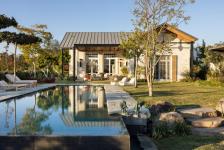
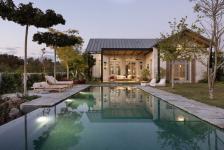
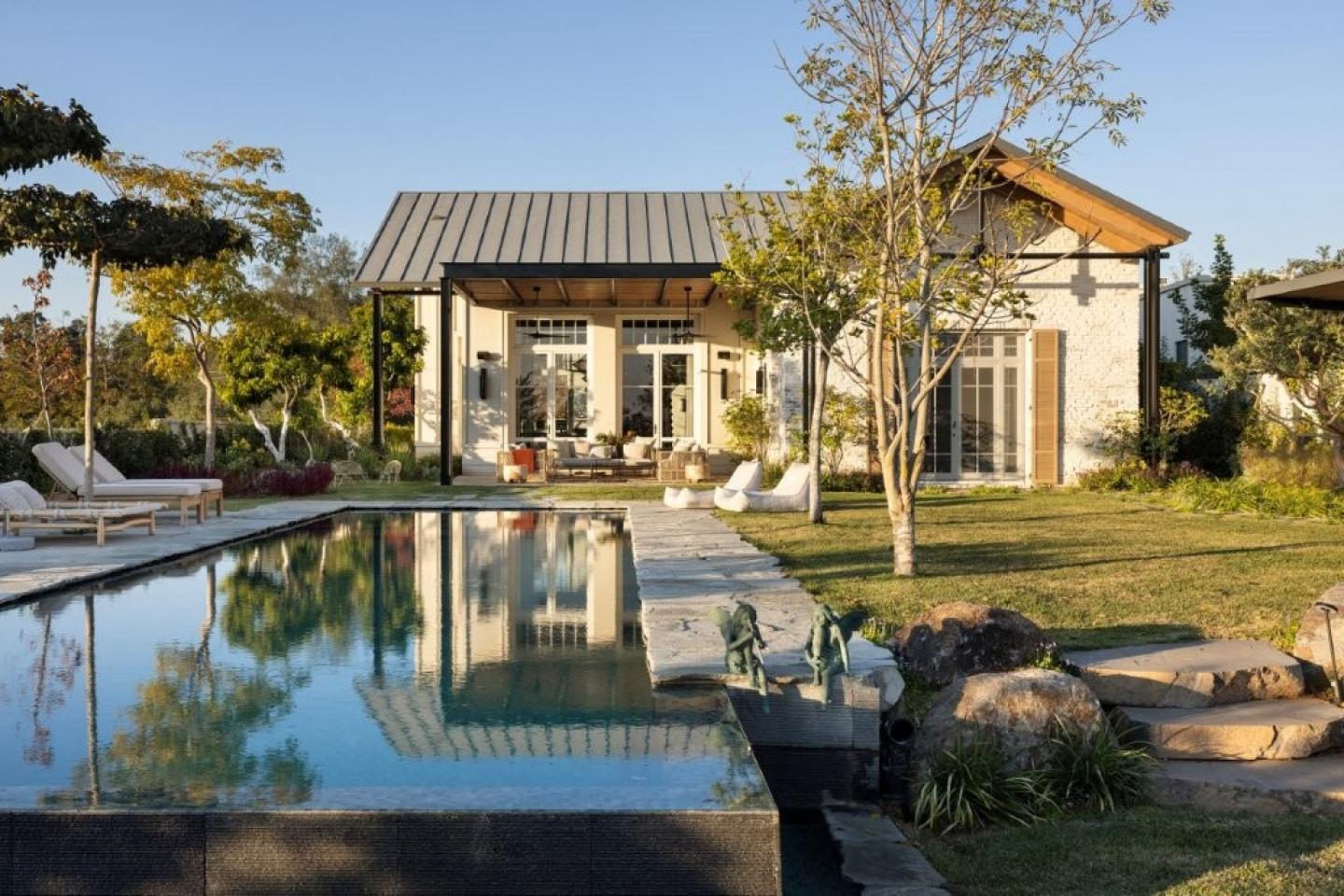
The garden was designed as a direct continuation of the home, and includes a covered outdoor living room, a long pool with a waterfall at one end, and a direct exit from the master suite. The home's façades combine brick, decorative profiles, wooden windows and shutters in a cappuccino tone, and sloped zinc roofs — all reinforcing the European character.
2025
2026
On a village in the southern part of Israel, on a generous plot spanning 2,000 sqm / ~21,500 sqft with long, narrow proportions, architects Sarah and Nirit Frenkel designed and built a private home of approximately 400 sqm for a couple in their third chapter of life
Architecture and interior design: Sarah and Nirit Frenkel
Itay Benit