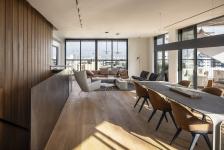
In the heart of Tel Aviv’s dense urban fabric, a triplex apartment was designed to offer a different interpretation of city living. Architect Ronnie Alroy planned the home for a family of six — a couple and four children — spanning the three uppermost floors of a new residential building, with the ambition of creating a living experience that, in many respects, evokes a private villa, despite its location within a multi-story apartment block.
The starting point of the design was the desire to blur the boundary between urban apartment and private house. Rather than enclosing itself within a sealed interior, the apartment opens outward and generates a system of terraces, openings, and spaces that maintain a continuous dialogue with the urban landscape. The result is a living experience in which the city is not merely a backdrop to domestic life, but an active participant in the everyday.
Three Levels, Three Roles
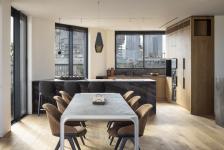
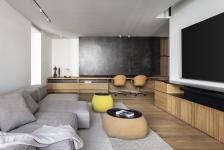
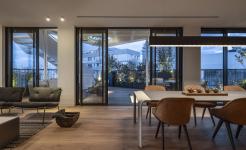
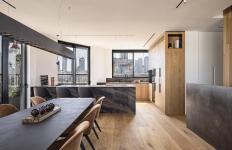
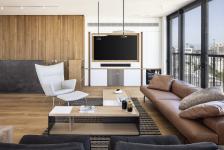
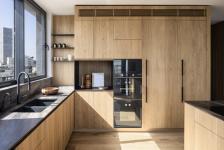
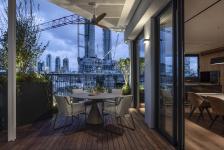
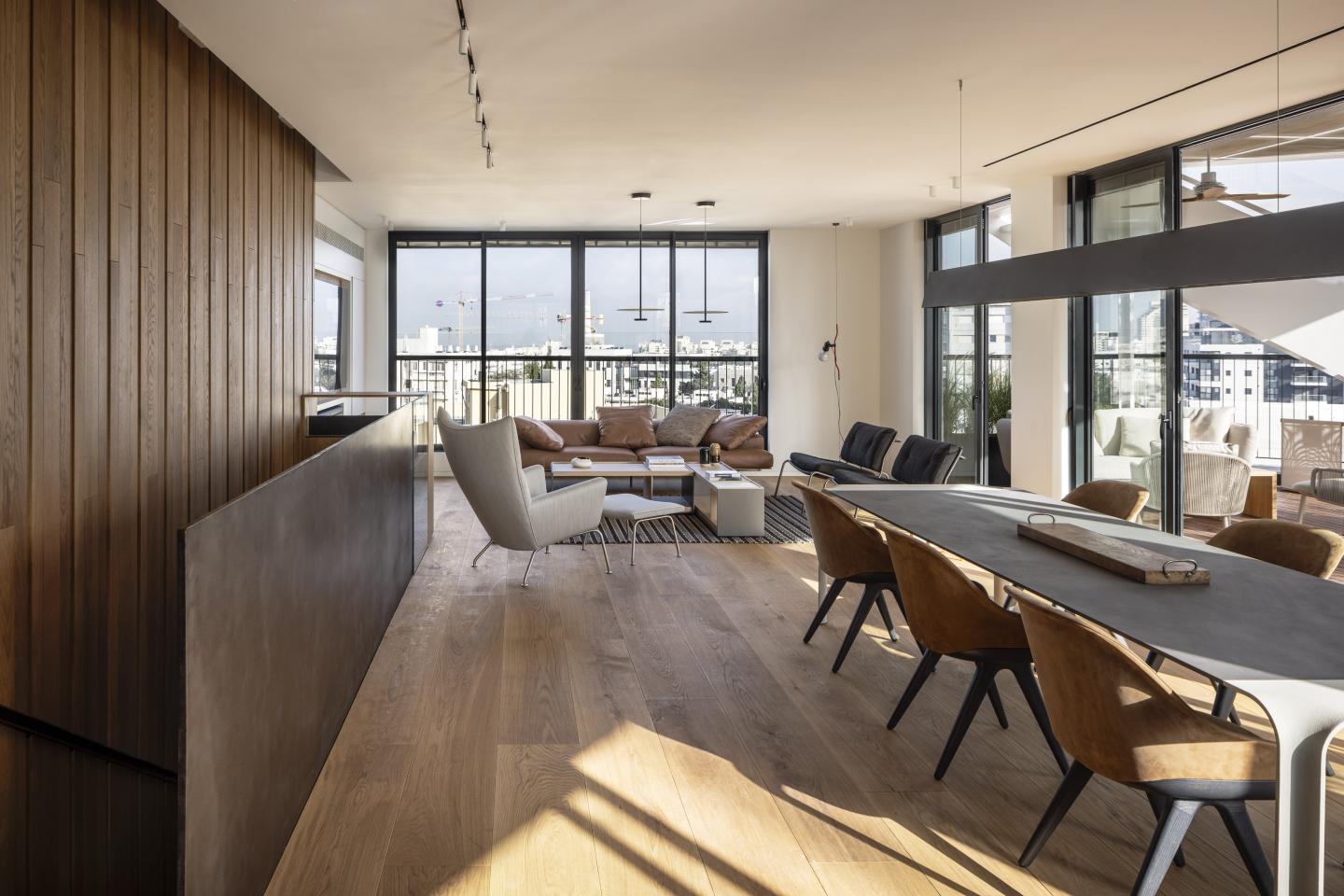
The apartment is divided into three levels, each serving a distinct function in family life. The central level — where the entrance is located — functions as the home’s entertaining zone: kitchen, dining area, living room, and the master suite. The space was designed as an open sequence in which interior and exterior coexist: large doors allow the living area to open fully onto the terrace, and when open, the boundary dissolves into a single expansive hospitality space that extends outdoors.
The terrace is conceived not as a peripheral addition but as an integral part of the home. The interior kitchen continues outward to an external work surface equipped for cooking and baking, so that during gatherings, activity can spread fluidly between inside and out. This connection enables flexible use of the space and creates an open, airy hosting experience.
Movement as Experience
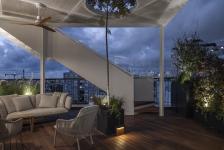
One of the most significant design decisions concerns the way movement through the home is choreographed. A key move was relocating the staircase — originally planned as an internal element — to the exterior, running from the terrace of the central level up to the roof and pool. This created a continuity of movement between interior and exterior spaces, relieved the interior entertaining level, and allowed hospitality to flow freely from the indoor living areas directly up to the rooftop and pool.
Part of the movement between levels passes through the terraces, so circulation between floors includes stepping outside and returning in. This choice brings open air and the urban panorama into the rhythms of daily life, transforming what might otherwise be a purely functional transition into a moment of re-exposure to Tel Aviv’s skyline and the surrounding urban texture.
The Lower Level: Children’s Domain
The lower level is dedicated to the children’s rooms. Alongside the private bedrooms, a shared family space was designed here, allowing the children to gather, watch a screen together, work at a computer, or simply spend time together. The communal area creates a central activity hub, while each bedroom retains its own character through distinct colors and bespoke joinery details.
The Upper Level: Rooftop and Pool
The upper level opens onto the rooftop, where a small pool was designed overlooking the city skyline. The roof functions as an additional leisure space for the family — a place to relax, entertain, or simply observe the city from above. This quality of height and open view is not a given in dense urban environments. For the family, the rooftop is a gathering spot: a place to unwind, to host, or to look out over Tel Aviv.
The Vertical Spine: Slat Wall and Skylight
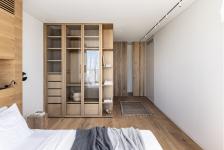
The vertical sequence of the interior staircase is emphasized throughout its full height by a wall of wooden slats in varying widths, rising to an upper skylight and continuing as exterior timber cladding at the pool level. The slat wall connects the public living spaces to the bedrooms on the central floor and wraps the master suite, opening through a double sliding system to create a wide threshold into the room.
Materials: Urban and Warm
The material palette of the home combines industrial and natural elements. Various components — stairs, metalwork details — are rendered in black iron that underlines the apartment’s urban character. These are balanced by extensive use of natural oak joinery, which introduces warmth and domesticity and tempers the presence of metal.
Interior finishes combine solid wood and natural iron, creating a warm and residential atmosphere. In the exterior spaces, the natural iron gives way to white-painted iron and white perforated sheet metal, producing a lighter, more luminous environment. An opening in the pergola on the central terrace allows a tree to grow through it, reinforcing the connection between the terrace, the roof, and the pool.
An iron railing follows the path of movement both inside and out — transitioning from a suspended natural iron railing on the interior stair to a white-painted iron railing on the exterior stair, supporting the continuity of movement between inside and outside.
Bespoke Joinery as Architecture
Custom joinery plays a central role throughout the design. Beyond its functional role as furniture, it serves as a tool for defining zones and creating soft boundaries between open spaces. Wardrobes, partitions, and joinery details integrate as an inseparable part of the architectural language, emphasizing the relationship between design and planning.
Planting is also woven into the concept of the urban villa. In the central terrace, a tree was planted and designed to grow through an opening in the pergola and continue upward toward the rooftop level. This green presence connects the different levels and introduces a natural element that softens the urban environment.
Ultimately, the apartment proposes an alternative reading of urban dwelling. Rather than retreating behind a built envelope, it uses terraces, levels, and openings to create a home that feels open, connected to the landscape, and alive with movement between inside and out. The result is a sense of living that recalls a private house — only here, the garden happens to sit above the city.
2025
2026
Project: LIP Apt.
Size: 270 m² (2,906 sq ft)
Location: Tel Aviv, Israel
Triplex Apt
Architect in charge | Yael Landesman
Photography | Amit Geron
Project manager | Kedem Projects
Woodwork | Anton Woodwork
Landscape design | Itai Salem
Audio & Smart electricity | Sound Ideas
Contractor | MTR
Wood flooring | Metropark
Doors | Rimadesio by Tollman’s
Stone surfaces | Fervital
Stone for wet rooms | Salvatori
Pool | Tzalul
Glass railing and showers | Glass House
3D Modeling | Benyo
Furnishing | Arredamenti Santiccioli
Deck | Yaron Gal Hadad
Metalwork | Prolenco
Amit Geron