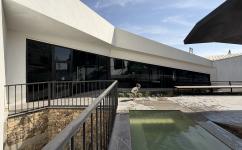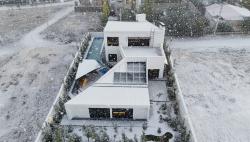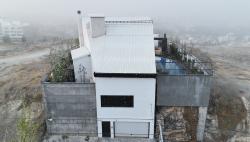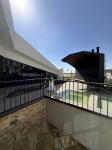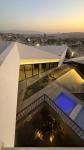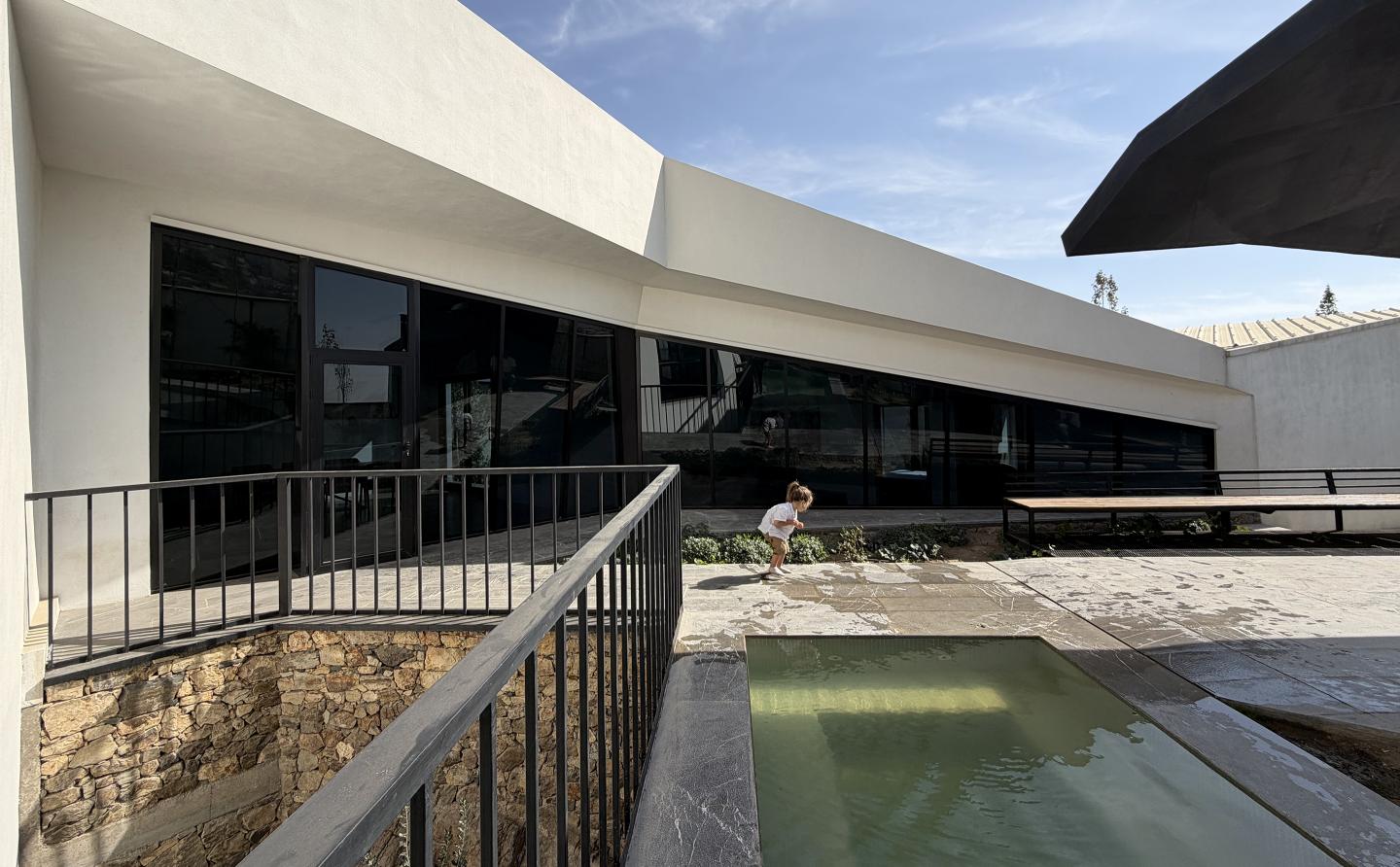
Rock Villa is conceived not as an object placed on the land, but as a spatial dialogue with the mountain itself. The project is rooted in humility toward the site, its topography, and the existing skyline. Rather than imposing form, the architecture seeks coexistence, minimizing excavation and aligning with the natural slope to preserve the integrity of the terrain.
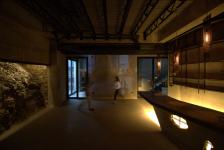
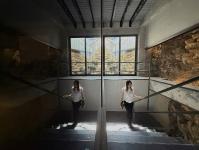
Lower levels are gently embedded within the rock mass, where exposed stone becomes an active part of interior spaces, dissolving the boundary between shelter and nature. Upper levels rest lightly on the rock shoulders, inclining toward the site’s center through sloped surfaces that maintain visual and environmental continuity. This restrained formal language ensures uninterrupted airflow, daylight, and ecological balance.
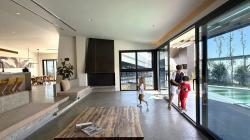
Spatial organization is guided by a calibrated balance between privacy and openness. Introspective functions such as the TV room and party spaces are placed deeper within the mass, while living areas and bedrooms are oriented to receive maximum natural light and ventilation. Movement through the villa unfolds as a gradual ascent, from carved stone passages to framed vistas, shaped by light, shadow, and material contrast.
The architecture operates as a carved calm within the mountain, minimal, tactile, and experiential. Landscape elements, sunken gardens, water surfaces, and native planting extend nature into the building, reinforcing a continuous relationship between human habitation and the natural environment.
2024
2025
Rock Villa employs a hybrid structural and environmental strategy tailored to its mountainous context. The ground and first floors are constructed with a reinforced concrete skeleton to achieve optimal structural balance with the rocky substrate, while the two upper floors utilize prefabricated steel structures to reduce overall weight and construction time.
Load bearing walls are primarily composed of AAC blocks, providing high thermal insulation, fire resistance, and reduced seismic mass. In the lower levels, natural rock walls are preserved and integrated wherever possible, eliminating unnecessary masonry and strengthening the earth sheltered concept.
Sloped roofs feature lightweight PVC finishing with a total weight of less than 20 kg per square meter. A continuous layer of sprayed polyurethane foam beneath the roofing creates an effective thermal envelope, significantly reducing energy loss. Delta steel beams combined with Roofix slabs further decrease dead loads, eliminate debris risk in critical conditions, and allow efficient routing of mechanical systems while reducing floor to floor height.
Environmental performance is enhanced through integrated solar panels, heat recovery water heaters, and systems for rainwater harvesting and greywater recycling, resulting in annual savings of over 336 cubic meters of water and a reduction of more than 53 tons of carbon dioxide emissions. Passive cooling strategies, including a central sunken garden and airflow over water surfaces, work in tandem with planted landscapes to lower ambient temperatures and reduce reliance on mechanical ventilation.
Together, these systems position Rock Villa as a resilient, energy efficient, and environmentally responsive architectural model, deeply integrated with its natural setting.
Lead Architects: Babak Abnar
Renderings credits: Shafa Shakerirad
Video link: Shadi Farhadi
Additional Credits
Design Team: Mahshad Farhadi, Shadi Farhadi, Sima Abdollahi, Pardis Ahmadi
Engineering: Mohammad Kalanaki, Amirhosein Kalanaki, Amirhesam Kalanaki
Landscape: Raad Group
Consultants: Raad Group
Collaborators: Sharif Shakerirad, Shafa Shakerirad
Photo : Shadi Farhadi
Shadi Farhadi