
Beyond Rediscovery: Reclaiming Alijan Jute Mill as a Living Productive Landscape
Project Statement
Abandoned industrial heritage sites in Bangladesh often face two extremes: erasure through redevelopment or fossilization as static monuments. The Alijan Jute Mill, located along the Meghna River, embodies both risks- caught between ecological vulnerability, economic decline, and social displacement.
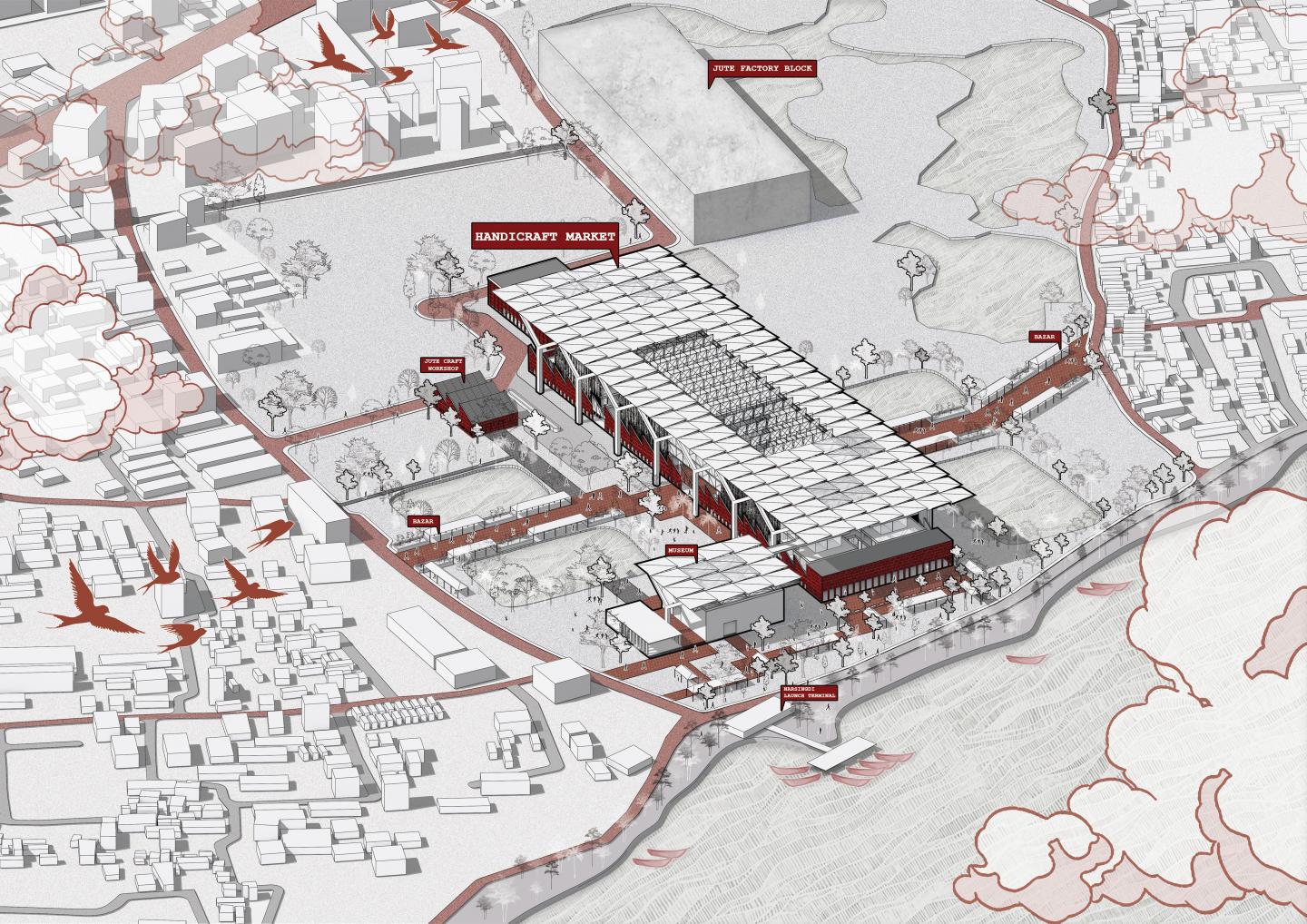
This project proposes the transformation of Alijan Jute Mill into a worker-centered, river-resilient, and economically productive heritage district, where industry, culture, housing, and landscape are re-integrated through the principles of New Contextualism. Rather than treating context as background, the project reads it as a layered field of relationships- ecological, social, economic, political, and cultural- from which design decisions emerge.
Design Methodology: Ten Layers → Ten Design Decisions
The project follows a ten-layer New Contextual analysis, where each contextual layer generates a specific spatial or programmatic decision.
1. Social Layer
Issue: Marginalization of jute artisans and loss of stable living conditions for workers.
Decision: Integration of on-site worker housing, shared amenities, and walkable access to workplaces to restore dignity, security, and social cohesion.
2. Economic Layer
Issue: Collapse of the jute economy due to outdated factories and middlemen-controlled supply chains.
Decision: Introduction of a modern jute factory and handicraft market enabling direct producer-to-consumer exchange, cutting out exploitative intermediaries.
3. Political Layer
Issue: Post-1971 dependency and economic exploitation that weakened Bangladesh’s jute self-reliance.
Decision: Reclaiming industrial autonomy through locally governed production, cooperative market systems, and national-scale value creation.
4. Historical Layer
Issue: Risk of erasure of colonial-era industrial heritage and the legacy of the Golden Fibre.
Decision: Preservation and adaptive reuse of the original mill structures to keep material memory, labor history, and industrial identity visible.
5. Ecological Layer
Issue: River-edge vulnerability, and ecological degradation along the Meghna River.
Decision: Enforcement of a 150-ft river setback transformed into green commons, buffer landscapes, and ecologically responsive public spaces.
6. Scientific / Technological Layer
Issue: Conventional jute processing techniques fail to meet contemporary efficiency, quality, and market demands.
Decision: Integration of advanced, clean jute production technologies and development of a replicable adaptive-reuse framework applicable to post-industrial sites across Bangladesh.
7. Geographical Layer
Issue: Underutilization of Narsingdi’s strategic location along the Meghna River as a historic trade and textile corridor.
Decision: Repositioning the site as a regional production and exchange hub, reconnecting river, industry, and settlement networks.
8. Cultural Layer
Issue: Decline of local craft traditions and industrial labor identity in national consciousness.
Decision: Framing jute craftsmanship and industrial heritage as living culture through markets, exhibitions, and everyday public engagement.
9. Architectural Layer
Issue: Obsolete factory forms unable to support new programs and climate demands.
Decision: Adaptive reuse of existing structures paired with new modular roof systems that reinterpret industrial language while enabling flexibility.
10. Urban Layer
Issue: Fragmented industrial land disconnected from civic life and surrounding communities.
Decision: Transformation of the 41-acre site into a heritage-led civic hub, integrating production, culture, housing, and public landscapes into a continuous urban fabric.
Programmatic Structure
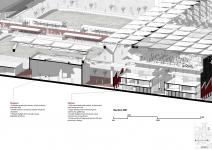
The masterplan is organized around three interdependent zones, stitched together by landscape and pedestrian networks:
• Production Zone:
A modern, low-impact jute processing and manufacturing facility that re-establishes Alijan as a productive site rather than a symbolic relic.
• Culture & Exchange Zone:
The adaptive reuse of the historic mill into a museum, craft market, and learning hub where production, exhibition, and commerce overlap.
• Living Zone:
Worker housing for approximately 250 residents, supported by social infrastructure, ensuring that those who sustain the industry also inhabit the place.
River as Infrastructure, Not Boundary
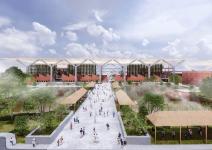
The Meghna River is treated not as an edge, but as a dynamic ecological partner. The riverfront is designed as a multi-layered system of protection, access, and learning- absorbing floods during monsoon seasons while functioning as public open space during dry months. Elevated walkways, floodable parks, and river-facing community spaces ensure resilience without retreat.
Governance and Equity Framework
To prevent gentrification and displacement, the project proposes a cooperative stewardship model:
Workers manage production and market stalls
Local authorities oversee environmental compliance
Community trusts reinvest revenue into housing, maintenance, and training
This governance structure ensures that revitalization benefits remain local and long-term.
Impact and Metrics
Existing structure retained: 95%
River buffer landscape: ~150 ft continuous ecological zone
Employment generated: direct and indirect opportunities across production, crafts, and tourism
Housing capacity: ~250 residents
Public access: year-round riverfront, museum, and market spaces
Conclusion
Beyond Rediscovery reframes industrial heritage not as a frozen past, but as a living system-where ecology, labor, memory, and economy co-evolve. Through New Contextualism, the project demonstrates that design does not create belonging; it reveals whether belonging has been understood.
By aligning heritage preservation with environmental resilience and social justice, the Alijan Jute Mill is reimagined as a model for post-industrial regeneration in riverine South Asia.
2025
Site Location: Kewriapara, Narsingdi, Bangladesh
Site Area- 41 Acres
Project type: Industrial, Adaptive Re-use, Mixed use development
Design- Fatiha Tanjim Oni
Project Supervisor’s Names: Dr. Mohammad Faruk, Dr. Iftekhar Ahmed, Mohammad Zillur Rahman, Bayejid M. Khondoker
Head of the Department Name: Dr. Zainab Faruqui Ali
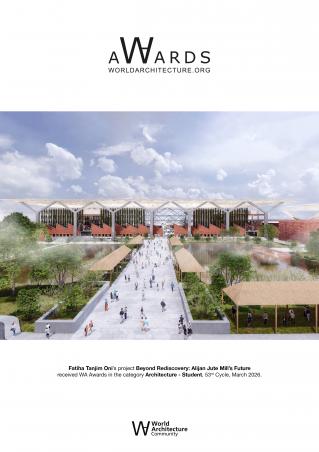
BEYOND REDISCOVERY: Alijan Jute Mill's Future by Fatiha Tanjim Oni in Bangladesh won the WA Award Cycle 53. Please find below the WA Award poster for this project.
Downloaded 0 times.

Fatiha Tanjim Oni




Favorited 2 times