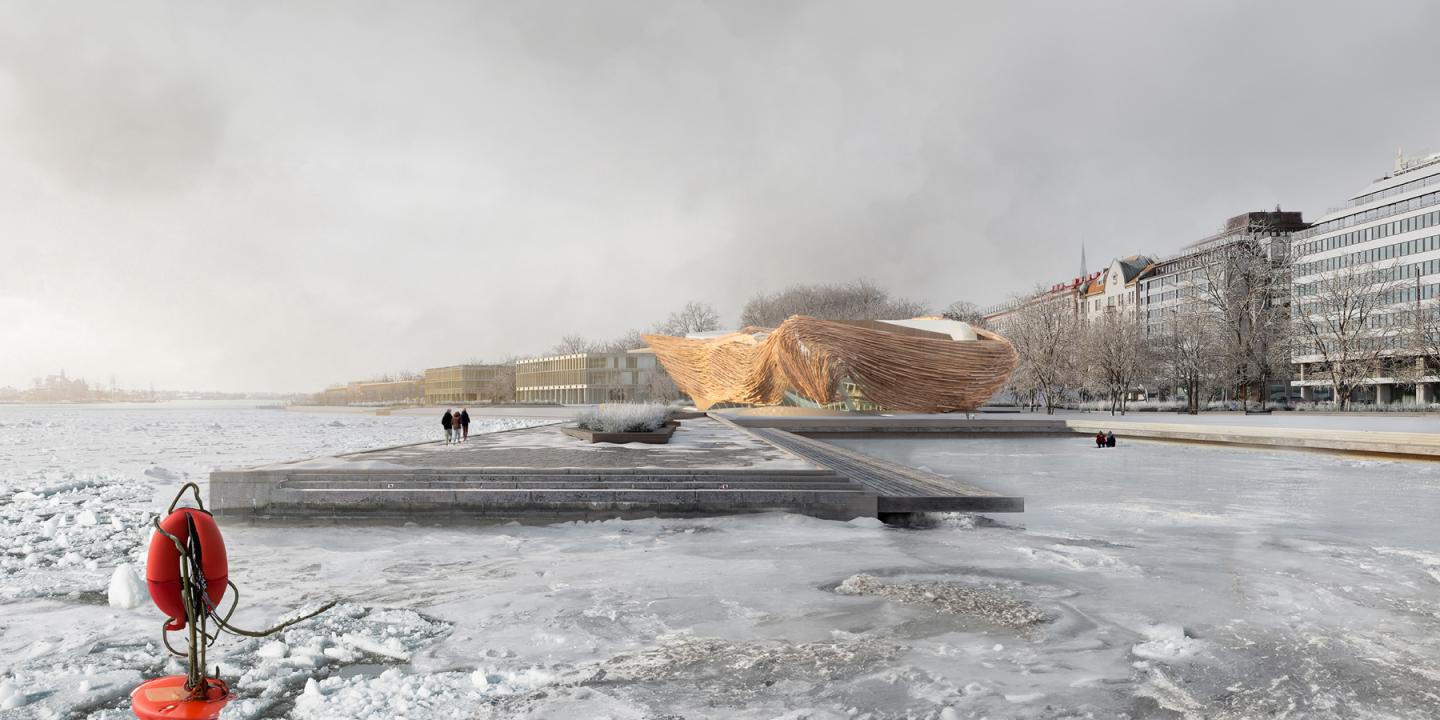
Many urban spaces today suffer from a disconnect between cultural landmarks and their surrounding environments, often leading to underutilised public areas and isolated institutions. Traditional museums, while culturally rich, fail to engage with their surroundings dynamically. This project aims to dissolve these boundaries, rethinking how museums interact with the city and its residents.
As Helsinki evolves, there is a growing need for a landmark that reflects the city’s cultural richness while embracing global perspectives. A project like this, blending traditional Finnish design with contemporary architecture, will provide a vibrant space where locals and visitors can engage with art, culture, and the urban environment in an innovative, accessible way, fostering creativity and enhancing community connections for all.
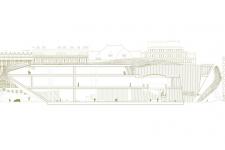
This entry proposes an architectural solution that merges nature, culture, and innovation to create a dynamic new museum for Helsinki. By drawing inspiration from natural elements like flowing water and schools of fish, alongside traditional Finnish weaving techniques, the design embodies movement and fluidity. The building’s facade, composed of 20,000 recyclable wooden pieces, mimics these organic forms. With a focus on sustainability and adaptability, the museum will blur the boundaries between public and private spaces, becoming a living part of the city’s landscape.
The building’s exterior is inspired by the beautiful, flowing motion of a school of fish, which is then translated into a sophisticated architectural shape. The wooden panels are meticulously stacked, emulating nature’s dynamic movement and producing a continuous, flowing pattern that gives the facade a sense of life and motion.
The undulating patterns of the wooden pieces provide the appearance of movement, as if the structure were softly swaying. These organic features not only improve the building’s visual appeal, but they also help to integrate it into the environment. By incorporating natural materials into a modern setting, the design merges architecture and nature, allowing the structure to fit effortlessly with its environment.
The stacked wooden panels also serve a functional purpose by shading, controlling light, and adding texture and depth to the building’s façade. The warm wood tones contrast with the structure’s sleek, modern forms, resulting in a well-balanced and visually appealing composition. This design approach honours nature’s aesthetics while promoting architectural innovation and making the structure feel like an organic extension of its surroundings, combining art, function, and sustainability.
2024
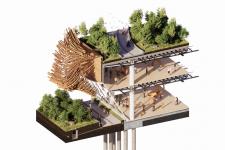
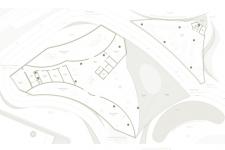
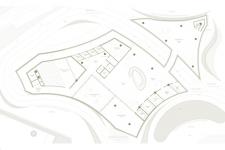
With the collaboration of our European historians and LEED AP, the entire building design adheres to the rigorous standards of LEED Platinum certification. This commitment to sustainability was realised through close cooperation with construction specialists and local stakeholders, ensuring maximum performance with minimal environmental impact.The building features extensive green spaces, with 35% of the area covered by green roofs or flood-resistant zones. The design maximizes the utility of exterior spaces by weaving and reverberating with the surrounding landscape. Anticipating a rise in sea levels by several centimeters over the next 50 years, we incorporated varying elevation levels to protect not only the project site but also the surrounding area.
We design green roofs as multi-layered systems to enhance sustainability by incorporating vegetation and specialized components. The lightweight engineered soil supports plant growth while balancing water retention and drainage to prevent waterlogging. Drought-resistant plants, selected for the local climate, minimize irrigation needs and help reduce the heat island effect while improving air quality and biodiversity. A filter fabric beneath the planting layer keeps fine soil particles from entering the drainage system. Additionally, a moisture-retention layer stores water to hydrate plants during dry periods. Together, these layers improve building performance and provide environmental and aesthetic benefits.
Tsz Kiu Felix Wong, Luan Fontes, Andreas Palfinger, Aryaman Garg, Ana Cyano, Nele Herrmann
Tsz Kiu (Felix) Wong



Favorited 1 times