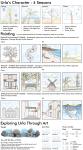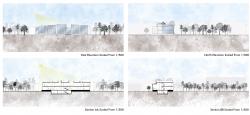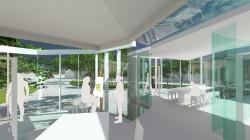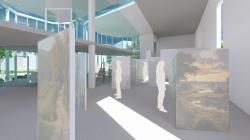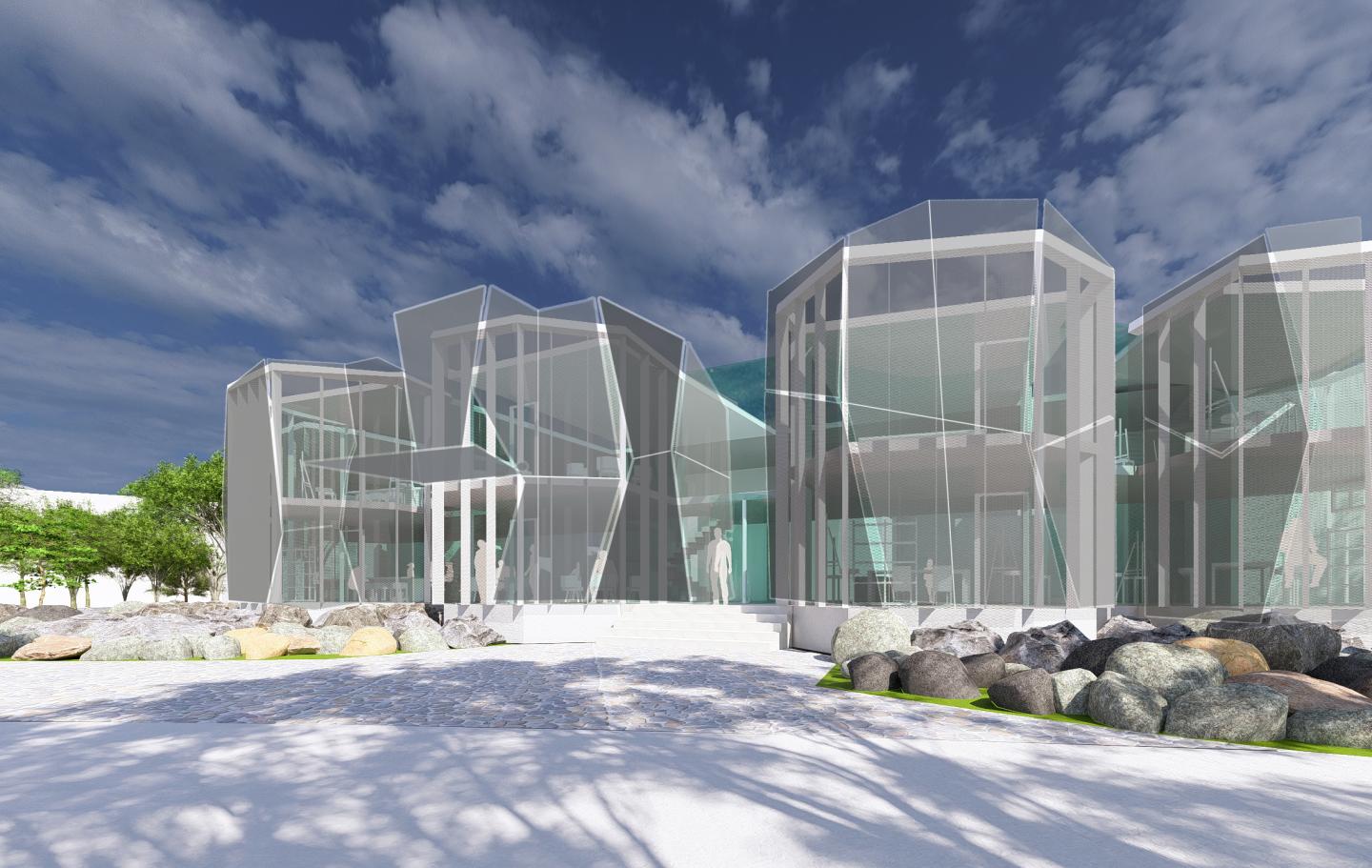
The Fractura Art Center project in Urla aims to make the city’s natural and artificial beauty visible through the act of painting. The project proposes an art center where visitors can participate in guided tours, painting workshops, exhibitions, and open-air activities. Through this sequence, art becomes not only a final product, but also a way of observing, understanding, and experiencing the city.
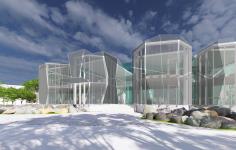
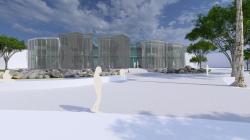
The starting point of the project is the fractured rock formation found on the surface of the Virgin Mary Sanctuary in Urla. These cracks are interpreted as a spatial and architectural language. The façade is designed through fragmented surfaces, mesh layers, and controlled openings that allow light to filter into the interior. In this way, the building reflects the idea of fracture not as a break, but as a generator of light, movement, and perception.
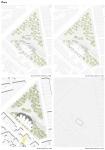
The project also establishes a strong relationship with its surrounding park. Existing trees, pedestrian paths, seating areas, and landscape elements are integrated into the design to create a calm and accessible cultural environment. By combining painting, landscape, and community interaction, Fractura Art Center becomes a contemporary cultural landmark that reflects the layered identity of Urla.
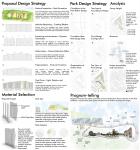
Proposal Design Strategy
Natural Inspiration: Rock Formation
The design process begins with the fractured rock formations of the Virgin Mary Sanctuary. These cracks reveal irregular patterns, depth, and texture, becoming the conceptual basis for the project’s fragmented architectural language.
Modular Beginning: Creating Rhythm
The natural form is first simplified into a modular system. This creates an initial rhythm for the façade and allows the fractured geometry to be translated into an architectural structure.
Fracturing and Movement: Dynamic Orientation
The modules are shifted, rotated, and displaced to create movement across the façade. This process gives the building a dynamic expression and reflects the irregular character of natural cracks.
Deformation: Natural Distortion Effect
The geometry is gradually deformed to avoid a rigid or repetitive façade. Subtle distortions create depth, shadow, and variation, making the structure feel more organic and connected to the landscape.
Fragmentation: Fractura Formation
The façade is divided into fragmented surfaces, where solid and void interact. These cracks allow light to enter the building and create moments of filtered illumination.
Final Form: Light, Shadow, and Fracture
The final façade becomes a layered surface where fractured geometry, mesh panels, and light work together. It gives the art center a strong identity while maintaining a soft relationship with the surrounding park.
2024
Project Name: Fractura - Art Center
Location: Urla, İzmir, Türkiye
Project Type: Cultural Building / Art Center
Project Status: Academic Project
Year: 2024
Main Functions: Exhibition spaces, painting workshops, guided art route, outdoor activity areas, social interaction spaces
Structural System: Reinforced concrete structure with metal façade supports
Façade System: Fragmented panels, transparent mesh layers, and filtered light openings
Main Materials: Reinforced concrete, metal mesh, glass, natural stone, and landscape materials
Designer Student: Aleyna KURT
Instructors: Dr. Can GÜNDÜZ, Assoc. Prof. Dr. Işıl UÇMAN, Research Assistant Dr. Özge Deniz TOKÖZ, Research Assistant Ceren ERGÜLER.
Aleyna Kurt