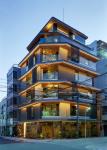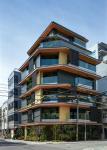
The challenge was how to architecturally interpret the request for a design evoking Japanese aesthetics.
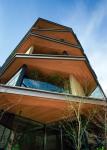
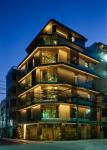
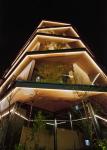
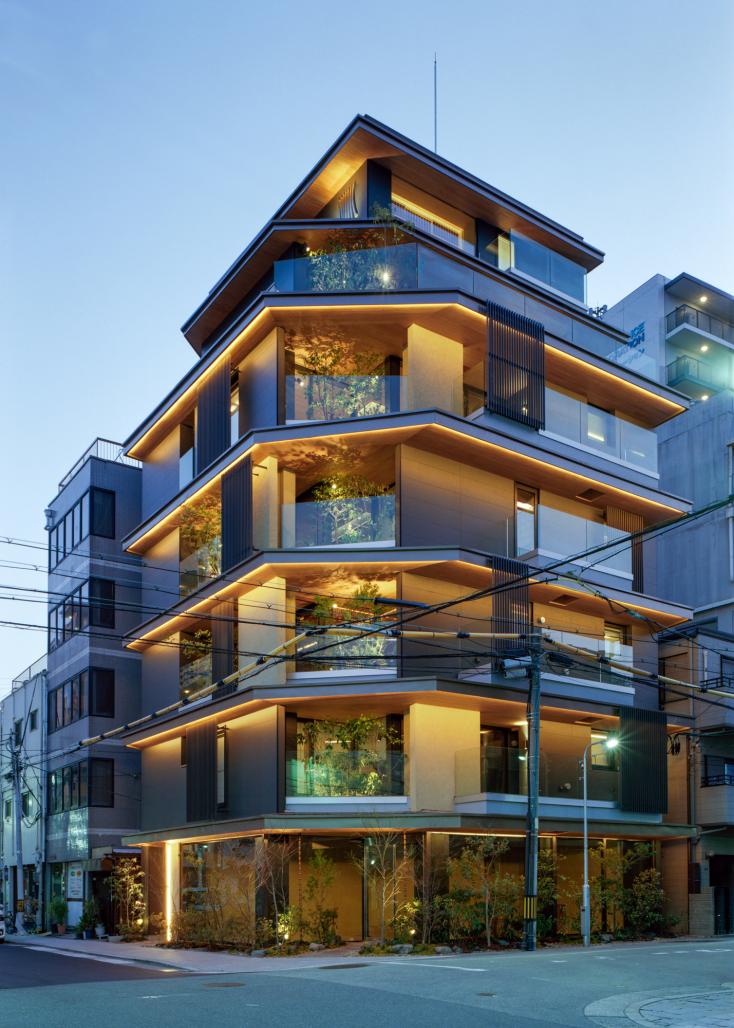
Given the corner lot, the eaves extending toward three directions—two roads and an intersection—became a defining exterior feature. By stacking these eaves across each floor,
we expressed Japanese design through the sense of depth seems traditional Japanese architecture.
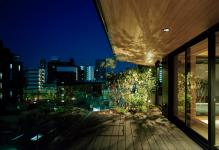
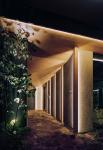
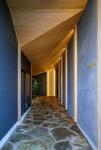
Another request was to create a garden with plantings on each floor. To achieve this, the wooden ceiling extends seamlessly from the interior to the garden, creating a unified sense of space between indoors and outdoors. While the overall architecture follows the concept of a continuous cypress-clad soffit extending from interior to exterior, each floor's residential unit features distinct finishes, creating diverse interior designs.
Material selections evoke wabi-sabi aesthetics, utilizing Japanese-inspired lustrous finishes like brass and copper, along with straw-mixed paint applied with a trowel and exposed base materials.
Concept of residence floor on 2nd to 7th floor level are below
Second Floor: Concept: “Sheltering”or" confin to room oneslf "
A dark tone is achieved with black paint as the base, while the garden, designed like a dry landscape garden with stones as the main feature, highlights contrasting materials and effects such as the brass joints and the reflections from the glossy flooring.
Third Floor: The concept is “framing”
It attempts a modern reinterpretation of copper, a material also used in traditional Japanese architecture. Frames coated with a special paint that mimics copper's lustrous, mottled finish are placed throughout the space, framing views of the garden, the outside scenery, and other interior spaces. These frames act as picture frames, creating a space where one can experience special vistas.
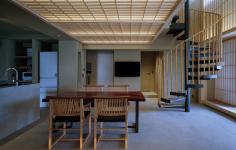
4th Floor: The concept is creating a hermitage within a room.
Tiles are laid like an alleyway, creating psychological distance to form a space reminiscent of a Japanese garden with a tea room and a garden. Materials typically used as base layers are employed as wall and ceiling finishes, creating a space evoking wabi-sabi.
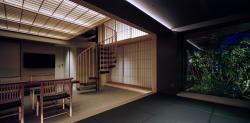
Floor 5: The concept is “Pure”
While incorporating quintessentially Japanese elements like shoji screens and gardens, the space aims for simplicity by reducing these elements. The height above ground level allows for views without concern for neighboring buildings, creating a sense of openness and liberation.
Floors 6 & 7: Concept: “Looking Up.” As the top-floor rooms, the balconies offer expansive views of the sky. The size and placement of windows, along with the accompanying fixtures, create varied perceptions of the external space.
Sliding doors leading to the main deck incorporate shoji screens. Normally, they allow gentle light to enter, but when fully opened, the deck feels even more expansive. The raised seating area features a large window offering views of the tree-lined garden, a low window allowing a sense of the garden's ground cover, and an opening at the top of the double-height space where the sky and eaves can be gazed upon.
While Japanese architecture is characterized by various types of fittings associated with openings, this room incorporates harmony as design by allowing the enjoyment of external spaces through openings of several shapes and arrangements.
2023
2026
Katsuya Taira