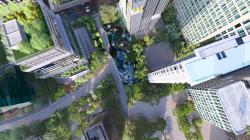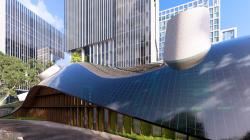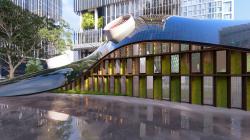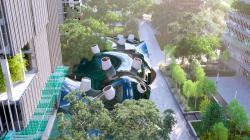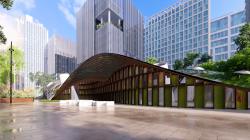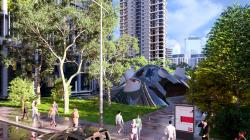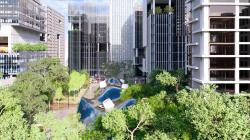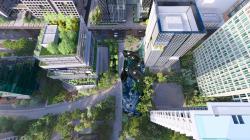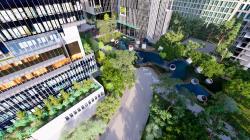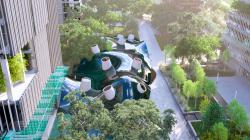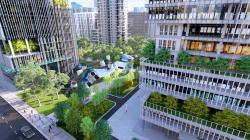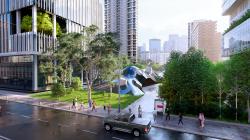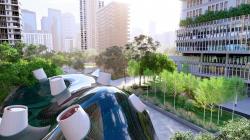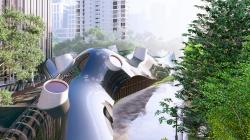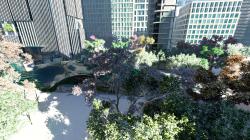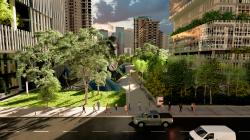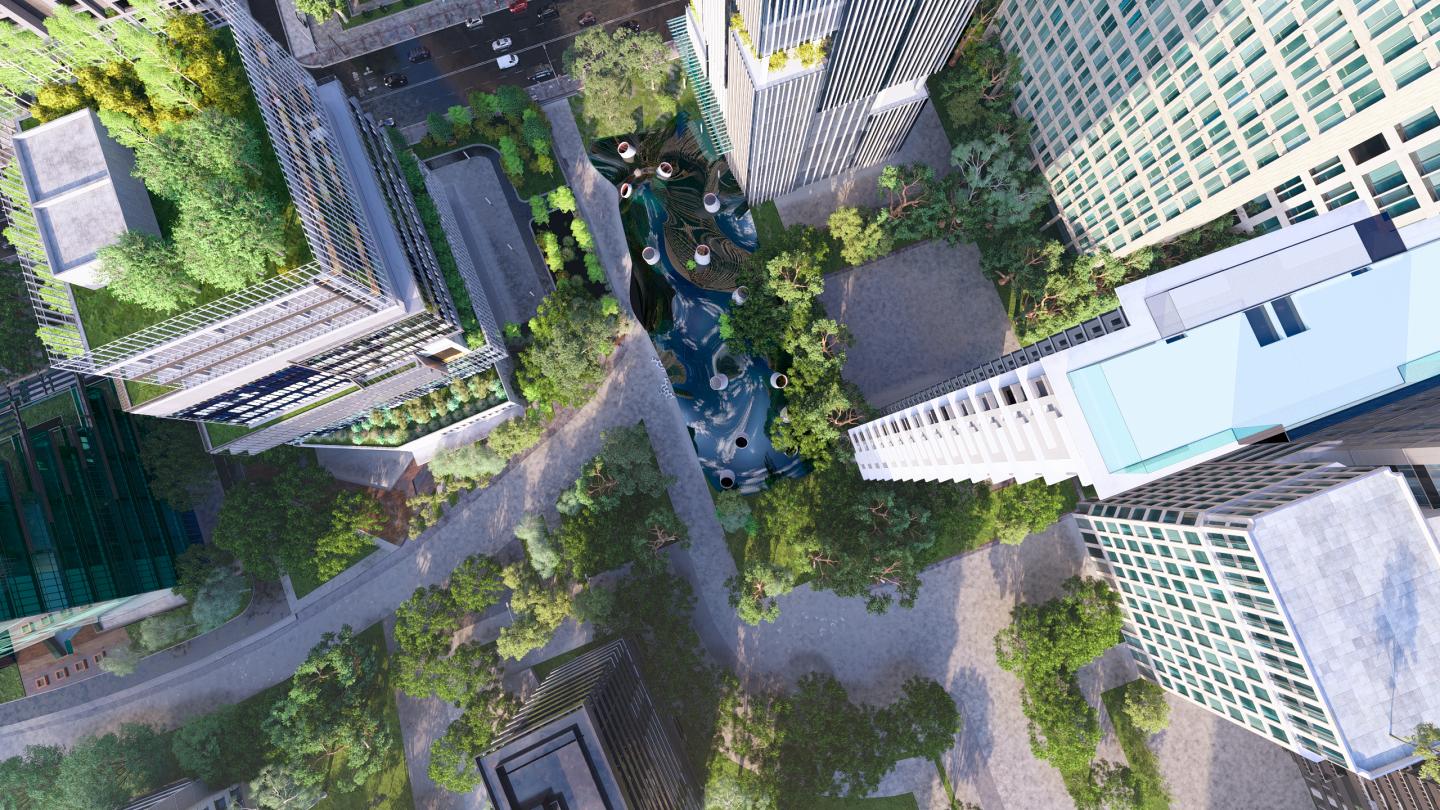
Rizoma originates as a necessary response to the massive development of residential and commercial complexes in the core of Toronto. In an environment where human habitat has expanded under a logic of vertical occupation and extreme climates, this project is inserted not as a conventional building, but as an organic extension that sprouts from the earth. Its conception is based on the idea of a root emerging from a linear green space corridor to enter into a direct, and at times disruptive, dialogue with the orthogonality of the housing and office towers that surround it.
Convergence and Root Morphology
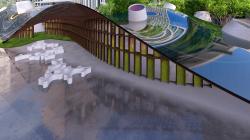
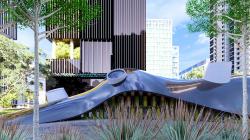
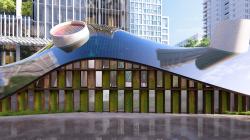
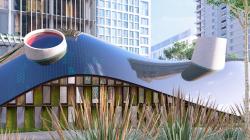
The morphology of Rizoma is born from the observation of natural systems seeking a path through urban rigidity. The project utilizes the figure of the root to colonize the sector, creating a transition where the scale of the skyscraper meets the scale of the ground. This structure does not attempt to compete in height, but in systemic complexity: it begins to converge with the city's order spontaneously, offering a refuge where nature is not a mere ornament, but the backbone. The skylights and the curves of the roof are the external manifestations of this living system that seeks light and air, breaking the monotony of concrete.
The New Dilemma of Green Space: Conservation and Participation
The project proposes a paradigm shift in the concept of the urban park. Rizoma introduces the dilemma of coexistence: how to provide a space of strict protection for local wildlife in one of Canada's densest cities while simultaneously allowing for human participation. It is not a contemplative garden, but an Urban Conservation Observatory. The design allows wildlife to remain in place, respecting their cycles under an envelope that acts as a climatic filter. Architecture here serves as an instrument of exploration that educates the citizen on the importance of preserving the site's original ecosystem. It is an invitation to participate in a space where nature and architecture are no longer separate entities, but a single entity that breathes and evolves together.
2026
2026
The execution of Rizoma is based on the use of high-resistance materials and advanced construction technologies to materialize its parametric design.
Envelope and Glazing System: The roof surface is composed of tempered safety glass panels. This material has been heat-curved to adapt to the organic geometry of the structure. Double glazing with an argon chamber and a solar control layer (Low-E) is used. The glass incorporates a high-visibility silk-screen treatment for birds.
Laminated Wood Load-Bearing Structure: The main structural support consists of a glued laminated timber (Glulam) mesh. This gridshell system allows for large spans without the need for constant intermediate supports, maintaining the integrity of the curved forms.
Concrete Components and Vegetated Facade: The upper skylights are manufactured in glass fiber reinforced concrete (GRC). Vertical walls integrate hydroponic green wall systems that contribute to thermal inertia.
Paving and Sustainability: The flooring utilizes a combination of interior technical pavements and permeable surfaces on the perimeter for efficient stormwater runoff management.
Architect: Víctor Alfonso Montañez
Teacher: Architect P. Cook
Victor Alfonso Montañez