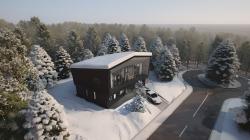
The project is situated within the sought-after Odin Hills development, a premium 92-plot residential enclave offering shared onsen and pool amenities in the international ski resort of Niseko, Hokkaido, Japan. Located just five minutes by car from the Hanazono ski hills, the site enjoys both immediate access to winter recreation and a tranquil setting and expansive views toward Mount Yotei.
Conceived as a contemporary alpine residence, the design responds directly to its site, climate, and long-distance views, translating environmental conditions into form, space, and material expression.
Rather than adopting a conventional orthogonal layout, the building is structured around a pentagonal geometric plan. This geometry is not an abstract gesture, but a spatial tool—allowing the architecture to orient itself simultaneously toward multiple key vistas while maintaining privacy, compactness, and efficient circulation.
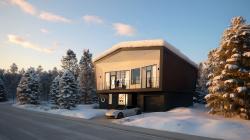
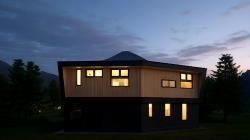
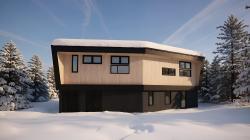
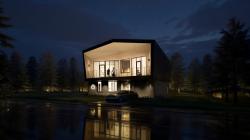
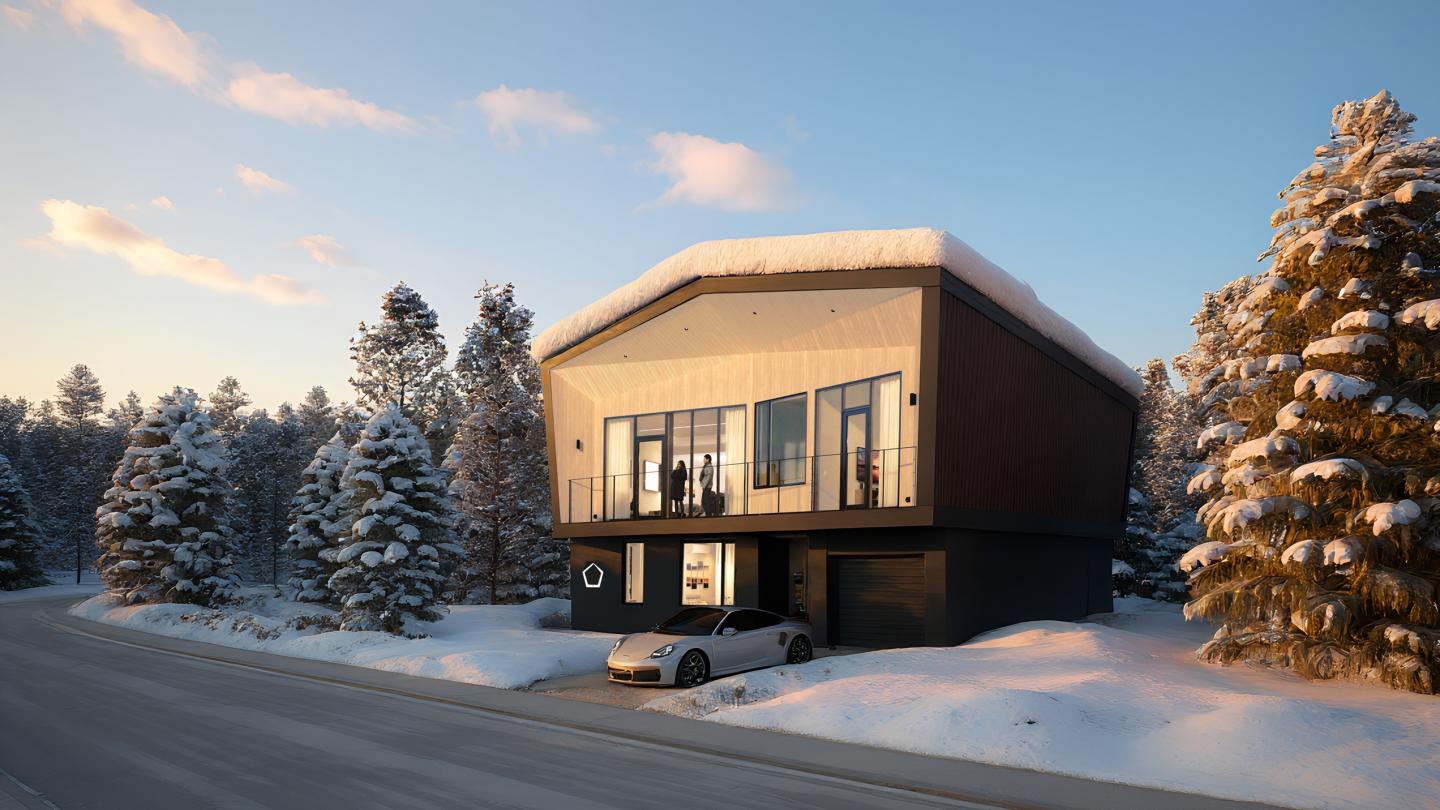
This property is designed around a distinctive pentagonal concept, shaped to capture the site’s two key views: the iconic volcano Mt. Yotei directly across the road, and the picturesque local town of Kutchan. By introducing a subtle angle to the building’s façade, the design opens toward these vistas; the pentagonal shape is completed in the horizontal plane by the continuous balcony and the cantilevered roof along the front façade. Vertically, the pentagonal concept is reinforced on the front façade through a continuous metal outline formed by the roof edge, extended slanted side walls, and balcony edge, framing the second floor and further emphasized by expansive glazing.
Taking advantage of the pentagon shape, the central stair situated in the back corner of the polygon creates a compact and efficient layout, while creating dynamic internal visual connections between levels.
Upon arrival, the house welcomes guests with a neatly proportioned porch that offers discreet shelter from the snow and a smooth transition from outdoors to indoors. Inside, the ground floor is thoughtfully arranged to meet the practical demands of a refined ski rental. A single-car garage with integrated ski racks, a traditional genkan with dedicated storage for boots and coats, a functional laundry room, a multipurpose space, and a shared bathroom ensure comfort and functionality. Two well-appointed bedrooms with built-in closets complete the layout, offering a warm and restful retreat after time spent on the slopes.
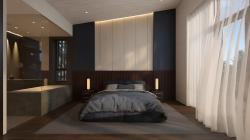
The upper floor serves as the home’s main living space and is thoughtfully divided into three distinct areas, each enhancing comfort, efficiency, and the experience of the surroundings and vistas. On one side, the master suite is oriented toward Mount Yotei, with elevated windows and a slanted ceiling enhancing both the view and the quality of natural light. It features a generous walk-in closet, a private powder room, and an elegant ensuite bathroom with a double sink and premium sanitaryware, separated from the bedroom by a glazed wall that brightens the bathroom and increases the space of the bedroom.
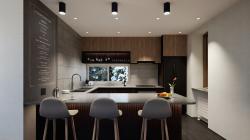
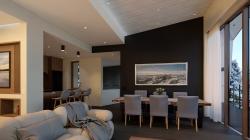
On the opposite side, similarly elevated windows and a slanted ceiling bathe the living–dining area in natural light while opening sweeping views toward the distant town and Mount Yotei, creating a welcoming environment for both relaxation and social gatherings. The open-concept kitchen – fully equipped and elegantly integrated – supports a seamless flow between cooking, dining, and entertaining. On the same level, the media room adds flexibility for movie nights, gaming, or quiet reading. A continuous and spacious balcony on the front façade connects the living space and the master bedroom to the outdoors, offering elevated perspectives and unobstructed views of Mount Yotei.
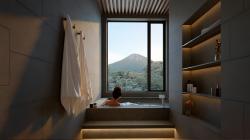
Positioned between the living spaces and the master suite, a traditional Japanese tiled bath completes the upper floor. Framed by natural textures and softly filtered light, the space is oriented toward a picture window that opens directly onto Mount Yotei. More than a functional amenity, it offers a quiet, meditative retreat—an intimate moment of restoration after a day spent on the slopes.
The architecture is defined by a clear vertical stratification, with a grounded base that provides stability and protection against Niseko’s harsh winter climate, and a lighter, more expressive upper volume that projects outward to engage with the surrounding landscape. Extended roof overhangs and carefully calibrated openings respond to seasonal conditions, managing snow accumulation, solar gain, and shading throughout the year.
The pentagonally articulated upper floor appears to gently hover above the ground level, its lightness reinforced by locally sourced light-toned cedar cladding contrasted with bold black metal accents. Slanted louvers made from recycled timber extend from the angled façades, continuing the geometric language while filtering natural light and preserving privacy. Below, the lower level is clad in black Japanese stucco with fine horizontal striations, anchoring the building to its alpine context through a sense of weight, permanence, and durability.
2025
2 story timber structure with metal roofing, timber louvers, timber cladding and stucco facades.
Pierre Biard, Architect
Pierre Biard