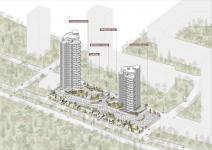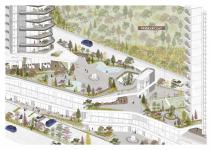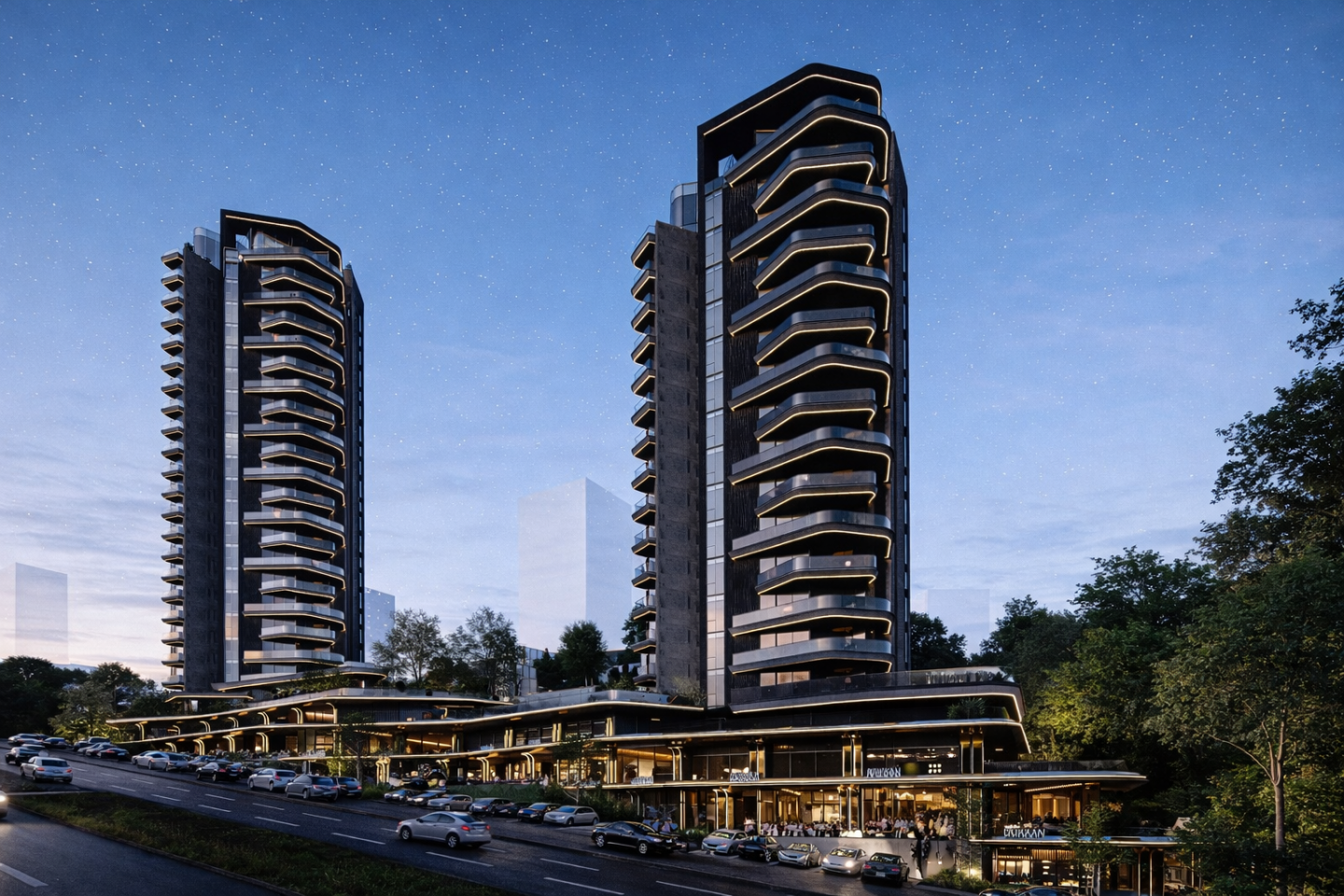
Located on Kanuni Sultan Süleyman Boulevard in Ankara’s Beytepe district, the project approaches the existing sloped topography not as a constraint, but as a primary design input that generates spatial diversity. Commercial units, stepping along the natural gradient of the site, transform level differences into an opportunity, forming a multi-layered public ground. This ground plane is conceived not merely as a retail platform, but as a continuous urban terrace that encourages social encounters, everyday interaction, and open-air experiences. The topography becomes an active agent in shaping spatial continuity and layered public life.
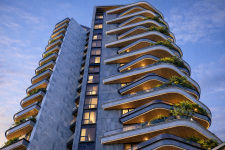
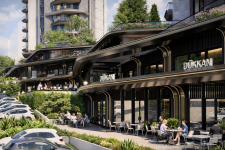
The development consists of two high-rise residential blocks and a commercial-social platform that connects them. Rather than adopting a rigid and orthogonal configuration, the composition deliberately embraces fluidity. The architectural language avoids sharp edges and static geometries, favoring instead soft transitions and curvilinear façade movements. Particularly within the commercial areas, the curved façade system establishes a distinctive identity that diverges from conventional retail typologies. At pedestrian scale, this fluid expression creates a welcoming and dynamic atmosphere, while contributing a vibrant silhouette to the boulevard frontage.
Continuous canopies, gallery voids, and layered terraces extend along the façade, activating the ground level and strengthening the relationship between interior and exterior spaces. Outdoor seating areas positioned in front of the retail units enhance the social character of the commercial zone, transforming it into a lively urban interface rather than a closed shopping environment. The project thus redefines the boundary between building and street, offering a permeable and interactive threshold.
Above the commercial units, a roof terrace introduces an additional social layer to the project, elevating it beyond a conventional mixed-use scheme. This elevated platform accommodates a coffee bar, a padel court, and various recreational areas, creating a shared amenity space for residents. Accessed via a dedicated vertical circulation core connected to the social facilities, the terrace operates as a semi-public gathering zone exclusively for site inhabitants. At the same time, it establishes a direct spatial relationship with the duplex apartments, forming a transitional threshold between private living spaces and collective social areas. The roof is therefore not conceived as a passive cover, but as an active extension of communal life.
The residential towers assert a strong vertical presence within the urban fabric while prioritizing privacy and spatial quality in their internal organization. Each typical floor accommodates a single 6 1 apartment, allowing four-sided exposure and panoramic views. Generous balconies and terraces, shaped in alignment with the curved façade language, reinforce the continuity between interior and exterior living spaces. The duplex units, directly connected to the roof level, benefit from an enhanced spatial relationship with the shared terrace, creating a balanced dialogue between individual and collective domains.
Circulation and access strategies have been carefully designed to minimize the impact of the busy boulevard. The main residential entrance is deliberately located on the secondary street at the rear of the site, ensuring a controlled and secure arrival sequence. From this level, residents gain direct access to underground parking areas, the residence lounge, and pedestrian entrances to the towers. Commercial and residential entries are intentionally separated, clearly distinguishing public and private circulation flows. This spatial hierarchy enhances both functional clarity and user comfort.
Ultimately, the project proposes a layered living environment shaped by topography. It redefines the boundaries between public and private, commerce and residence, ground and roof. Through its fluid formal language and multi-level public realm, the design aspires to become more than a building complex: it offers a living architectural framework that engages continuously with its urban context and evolving patterns of contemporary life.
2025
Technical data
Site Area: 9449,00 m²
Gross Floor Area: 4853.229 m²
Orçun Ersan, Esra Toygar, Neslihan Asena Can, Aybüke Öztürk Gözükara, Esra Akın, Melis Ezgi Uygun, Yılmaz Gökdemir, Ece Elmas Kolçak, Beyza Yağlı