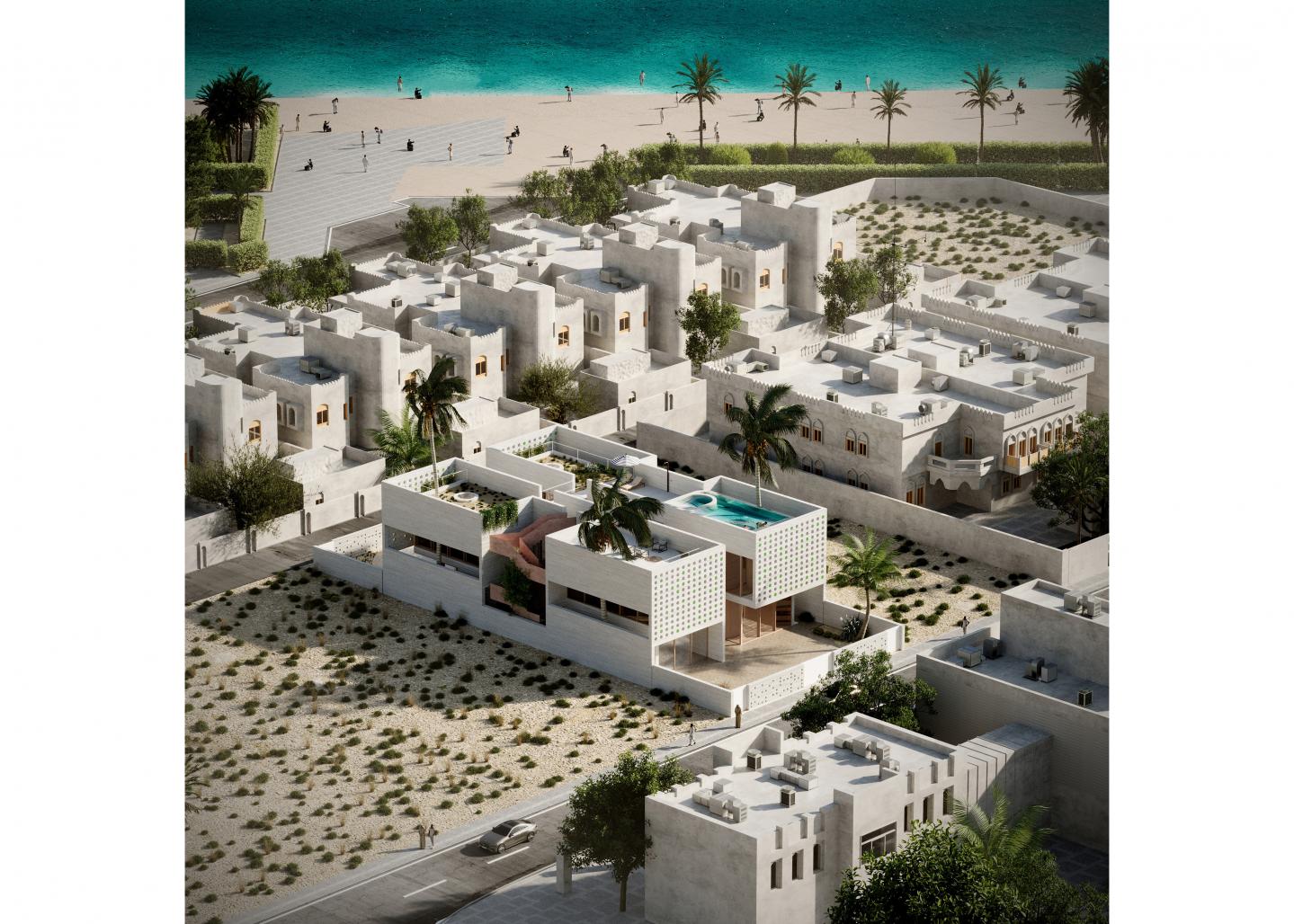
"Everything we have contemplated in this house ultimately returns to its context — to the land it stands on, to the sun that shines upon it, to the breeze that passes through it, and to the human being who inhabits it."
Through studying Oman, and specifically the city of Muscat, one realizes that despite all the elements this society has been affected by the contemporary world, many of its cultural and social values remain deeply preserved. An exploration of contemporary Omani architecture—particularly residential architecture—reveals that the spatial diagram of dwelling in this city is often a reproduction of a modernist diagram that has spread globally. Consequently, there exists a contradiction between the lifestyle of the people and the architectural container that defines it. We are witnessing an architecture that addresses the socio-cultural needs of its users merely through surface treatments and ornamentation.
This raises an essential question:
How can we envision a model of dwelling in Oman that genuinely responds to the needs of the contemporary Omani man?
We approached this house through three interrelated layers: Climate, Culture, and Life.
1. Climate
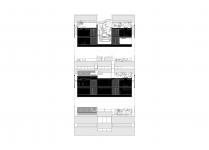
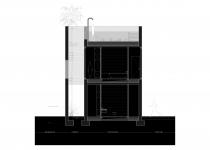
Situated in a hot climate, the design strategy departed from the conventionally compact massing typical of Muscat’s contemporary architecture. Instead, we proposed a porous massing, allowing the intense sunlight to be filtered through a network of courtyards and layered envelopes, softly reaching the interior spaces and lending them a timeless, poetic quality.
By interweaving mass and void, we sought to draw the sea breeze into the house, creating an internal current of air—a spatial artery of life that animates the dwelling.
2. Culture
At the outset, by studying the region’s traditional architecture, we observed how cultural structures once manifested spatially through introversion, hierarchy, and privacy. A closer look at contemporary Omani architecture, however, revealed an absence of spatial responses to these cultural dimensions. Therefore, we aimed to reintroduce these qualities by designing with introversion, spatial hierarchy, layered sequencing, and a secondary skin, crafting an architecture that meaningfully resonates with the user’s cultural and traditional needs.
3. Life
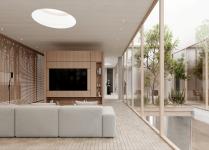
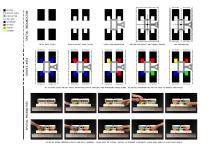
If we consider architecture as a vessel for living, then that vessel must be responsive to its inhabitants’ evolving needs—needs that transform over time as people and lifestyles change; yet structure of architecture remains static and rigid. We explored how a house might enable its user not merely to consume space but to act within it—to participate in the ongoing organization of their dwelling.
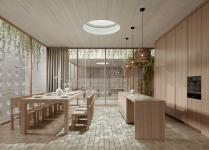
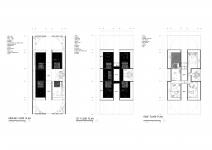
The spatial organization of the house is structured across three levels of privacy—public, semi-private, and private—distributed respectively across the ground floor, first floor, and roof terrace. By situating service and wet areas within fixed spatial envelopes and introducing raised floors, we created opportunities for the users to actively reconfigure their living environment based on their needs. In essence, we did not design predefined spaces labeled as “bedroom,” “living room,” or “kitchen.” Instead, we designed a possibility within which modes of living could unfold.
2025
In this house, we tried to create a flexible space by using a raised floor so that the user can organize the space according to their needs. Also, the main material of this house is exposed concrete, which makes it belong to the present time and makes it more beautiful. We also tried to have appropriate thermal comfort and privacy for these spaces by using portable shades in the interior architecture.
Maryam Mahdavieh Studio Implicit Space Studio
Architects: Maryam Mahdavieh, Mostafa Sadeghi
Design Team: Parisa Rasaie, Homa Salimi
Physical Model: Parisa Rasaie
Presentation: Mostafa Sadeghi, Parisa Rasaie, Parinaz Torkian
Visualization: Mohammad Salehi
Mohammad Salehi



Favorited 4 times