Ekali Residence: A Modernist Palimpsest Reimagined by Panos Nikolaidis
The Ekali residence is more than a home, it’s a story of rebirth. First designed in 1968 by Michalis Fotiades, the house was once a celebrated example of Athenian modernism. Over time, renovations blurred its identity, but architect Panos Nikolaidis has given it new life through a radical reimagining.
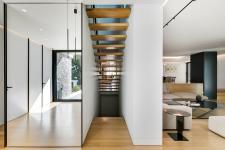
Today, the residence unfolds across three levels, balancing practicality with elegance: a basement for support spaces, a ground floor for vibrant social life, and an upper floor for private retreats. Movement through the house is guided by a rhythm of vertical lines, metal, wood, and light, that choreograph the experience from entrance to garden.
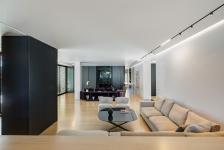
Inside, luminous white surfaces create a serene backdrop, punctuated by sculptural black accents and curated furniture that transform the interiors into a gallery-like environment. Stone and wood unify past and present, grounding the house in memory while offering warmth and texture.
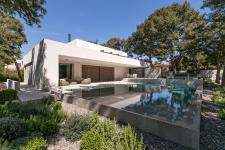
With its landscaped garden and turquoise pool, the residence extends living into nature, embodying the Mediterranean ethos of openness and harmony. It is at once nostalgic and contemporary, a modernist palimpsest redefined for today’s lifestyle.
In the northern suburb of Ekali, Athens, a residence first conceived in 1968 has undergone a remarkable transformation. Originally designed by Michalis Fotiades, the house was celebrated in Structures magazine as a representative example of Athenian modernism. Its clean lines, rational organization, and luminous openness embodied the optimism of the 1960s—a time when Greek architecture was confidently engaging with international modernist currents while retaining its own cultural identity.
Yet architecture, like life, is never static. Over the decades, the house experienced changes that diluted its original clarity. A renovation in the 1980s stripped away many of its defining features, leaving behind a shell that no longer spoke with the same conviction. What remained was a structure with potential, but one that had lost its voice.
The third and final phase of its evolution, led by architect Panos Nikolaidis, sought to restore that voice—not through nostalgic replication, but through a radical reimagining. The project pays tribute to the tradition of Athenian modernism while embracing contemporary sensibilities. It is both a homage and a reinvention, a palimpsest where memory and modernity coexist.
A House of Layers and Journeys
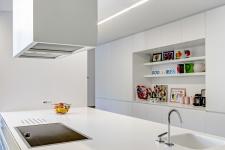
The residence unfolds across three levels, each carefully choreographed to balance function and experience. The basement houses auxiliary spaces, discreetly tucked away to support daily life without intruding upon it. The ground floor is the heart of the home, where public life unfolds: living room, dining area, kitchen, and playroom form a constellation of spaces designed for gathering, conversation, and leisure. Above, the private quarters offer retreat and repose, with bedrooms that frame views of the surrounding greenery.
This vertical stratification is not merely practical—it is narrative. Moving through the house is akin to moving through chapters of a story, each level offering a different rhythm, a different mood. The architecture guides inhabitants seamlessly from the bustle of shared life to the quiet of solitude.
The Barcode Rhythm
One of the most striking conceptual devices in the renovation is the use of barcode-like vertical elements. These rhythms of metal and wood orchestrate movement and perception, transforming circulation into an experience.
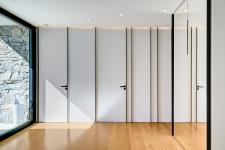
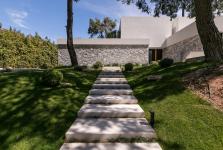
Approaching the plot, visitors encounter a metal fence whose alternating thicknesses establish a visual tempo. This rhythm directs the eye and the body toward the entrance, where it pauses—framed, interrupted, and reconfigured into a welcoming metal door. Inside, the motif continues as black vertical elements trace a path through the corridor, accentuated by linear lighting fixtures that reinforce the sense of progression.
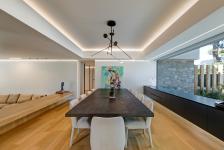
The choreography extends outward into the garden. From the dining room window, vertical wooden beams emerge and traverse the landscape, guiding visitors through outdoor space. What might otherwise be a simple passage becomes a journey, a dance of light, shadow, and material.
White as Canvas, Black as Accent
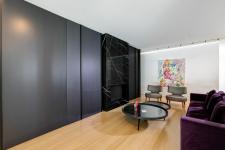
Inside, white dominates. It is not a sterile white, but a luminous one—an atmosphere of clarity and openness. Against this backdrop, black elements punctuate the space with sculptural presence. The marble fireplace, the mobile TV furniture, and other custom pieces act as dividers, articulating zones within the open-plan layout.
The effect is gallery-like. Minimal, movable elements acquire the status of artworks, curated within the domestic realm. In the office, antique handmade furniture is framed with bespoke structures that highlight their presence, transforming them into exhibits. The house becomes not just a place to live, but a place to experience objects as art, to inhabit a gallery of everyday life.
Stone and Wood: Threads of Continuity
Two materials serve as unifying threads throughout the project: stone and wood.
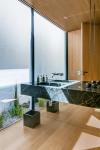
The wooden floor flows seamlessly across all levels, including the staircase, and is selectively employed in architect-designed furniture. Its warmth softens the clarity of the white surfaces, grounding the house in tactile comfort.
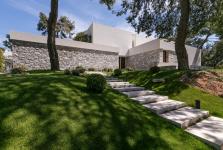
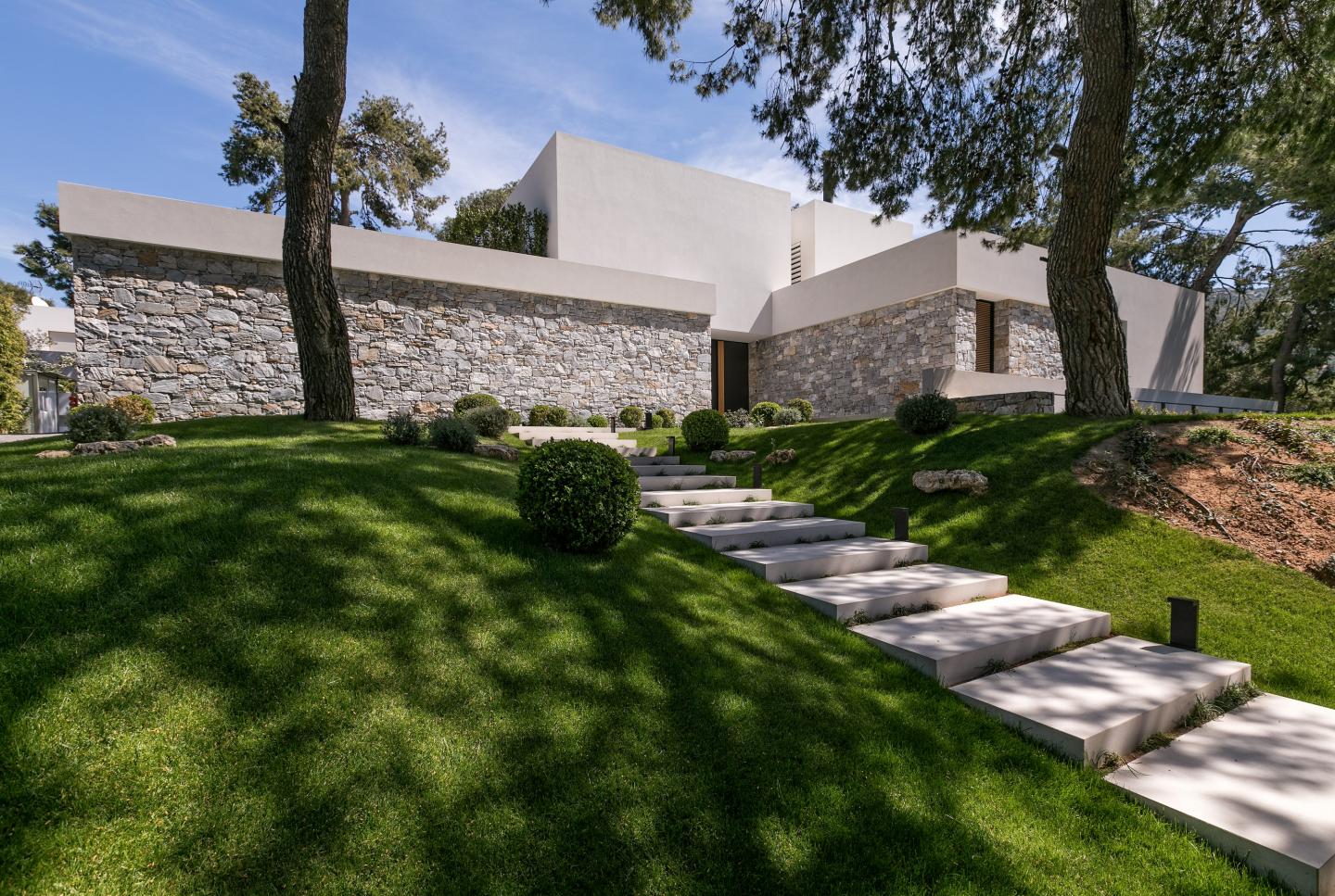
Stone, by contrast, is a memory of the past. It embraces the house perimetrically, anchoring it to its site and history. The tactile presence of stone recalls the solidity of the original design, while its contemporary application reinterprets that solidity as a frame for modern living.
Outside, beige floor tiles introduce a new rhythm, inviting a journey into the landscaped garden and pool area. The materials are not merely decorative—they are narrative devices, telling a story of continuity and transformation.
The Garden and Pool: Living with Nature
The outdoor spaces are integral to the lifestyle the house promotes. The garden is not an afterthought but a carefully choreographed extension of the interior. Vertical wooden beams guide movement, while landscaping defines zones for activity and repose.
The pool, with its turquoise clarity, becomes both a visual anchor and a social hub. It reflects the sky, the trees, and the architecture itself, creating a dialogue between built form and natural environment. The garden and pool together embody the Mediterranean ethos of living with nature—of blurring the boundaries between inside and outside, between architecture and landscape.
A Lifestyle of Memory and Modernity
For a lifestyle magazine audience, what matters most is how architecture shapes experience. The Ekali residence is not just a building—it is a way of living.
It offers spaces that are luminous yet grounded, open yet intimate. It transforms circulation into choreography, furniture into art, and materials into memory. It invites inhabitants to live among objects and spaces that are curated, intentional, and resonant.
At the same time, it is deeply practical. The stratification of spaces ensures functionality, while the open-plan layout fosters flexibility. The house is designed not only to be admired but to be lived in—to host gatherings, to offer retreat, to accommodate the rhythms of daily life.
A Modernist Palimpsest
The concept of the palimpsest is central to understanding the Ekali residence. Like a manuscript that has been written, erased, and rewritten, the house bears the traces of its history. The original design of 1968, the renovation of the 1980s, and the radical reimagining of today coexist within its walls.
This coexistence is not conflict but harmony. The house remembers its past while embracing its present. It pays tribute to the optimism of the 1960s while speaking to the sensibilities of contemporary living. It is both nostalgic and modern, both rooted and forward-looking.
Conclusion: Living Among Art, Architecture, and Nature
The Ekali residence is more than a renovation. It is a reinvention, a reawakening, a redefinition. It honors the tradition of Athenian modernism while offering a contemporary lifestyle of clarity, openness, and connection.
For its inhabitants, it is a home that transforms daily life into an experience of art and architecture. For visitors, it is a testament to the enduring relevance of modernist principles. For the broader architectural community, it is a case study in how memory and modernity can coexist, how a house can be both a tribute and a transformation.
In the end, the Ekali residence is not just a building. It is a story—a story of design, of memory, of lifestyle. It is a place where architecture becomes life, and life becomes architecture.
2018
Location: Ekali, Attiki, Greece
Architect: Panos Nikolaidis
Interior design: Panos Nikolaidis
Photography: George Fakaros
Status: Completed
Building area: 1.200m² (12.900ft²)
Plot area: 6.000m² (1.5 Acre)
Principal Architect: Panos Nikolaidis
George Fakaros