CALUMENO FAMILY MAUSOLEUM: A DESIGN APPROACH ON SPACE, MATERIAL, AND MEANING
FERIKÖY LATIN CATHOLIC CEMETERY
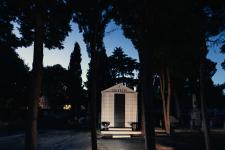
The Feriköy Latin Catholic Cemetery has served as the primary burial ground for Istanbul’s Latin Catholic community since the 19th century. Due to the post-Ottoman modernization process, economic contractions, population decline, and changing burial cultures, no new mausoleum has been constructed here for nearly a century. The mausoleum we designed is not only an individual monument but also a contemporary reinterpretation of an interrupted tradition.
Within Istanbul’s multi-cultural landscape, mausoleums in the cemeteries of Greek Orthodox, Armenian, Jewish, and Latin Catholic communities have historically functioned as sites where identity and belonging were expressed through stone. This project seeks to reassert the visibility of the Latin Catholic community within urban and cultural memory, while carrying the typology of the monumental tomb into contemporary architecture with a unique formal language.
DESIGN PRINCIPLES
The design process involved a detailed analysis of existing mausoleums in the Pangaltı Latin Catholic Cemetery. Formal characteristics of the Rossi, Medovich, Carminati, Scotto, Castelli, Barozzi, Collaro, and Mratovich family mausoleums were studied, and a new interpretation was developed while preserving the typological continuity observed in the cemetery.
White Marmara Marble
Material selection was guided by the search for harmony with the cemetery’s fabric. White Marmara marble, widely used in the mausoleums and tombstones of Feriköy, was adopted as the primary structural and aesthetic element for reasons of both continuity and expression.
With its homogeneous texture and balanced hardness, Marmara marble has long been a preferred material in architecture and sculpture. Its medium density makes it suitable for polishing and durable in outdoor conditions, while its fine veining allows for precise inscriptions and carvings. When polished, it enhances both legibility and aesthetic value.
Over time, Marmara marble develops a natural patina and subtle tonal shifts, which are among the defining features of the cemetery’s identity. Its selection was therefore not merely an aesthetic choice but also a conscious decision to reinforce spatial continuity.
The proximity of Marmara Island to Istanbul historically ensured the accessibility of the stone, making it a material that has carried both personal memory and collective urban history for centuries. Quarries that have been in continuous operation since antiquity turn this marble into a “geological continuity.” Known as Proconnesian marble during the Roman period, it was used in sarcophagi and monuments; in the Byzantine era, in churches and tombs, including Hagia Sophia; during the Ottoman period, in mosques, tombs, fountains, and gravestones; and in the modern era, it continues to appear in cemeteries such as Eyüp, Karacaahmet, and Zincirlikuyu.
This unbroken chain has made White Marmara marble a shared stone of memory for four civilizations. In our project, this continuity was directly referenced: the marble was carefully selected on-site from the quarries of Marmara Island and transported to the mausoleum. Thus, the structure carries both the historical continuity of the material and the layered urban memory into the present.
STRUCTURAL FRAMEWORK
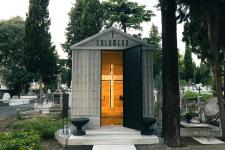
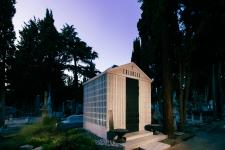
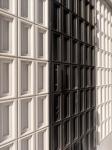
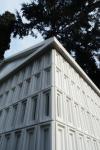
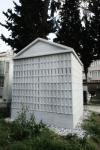
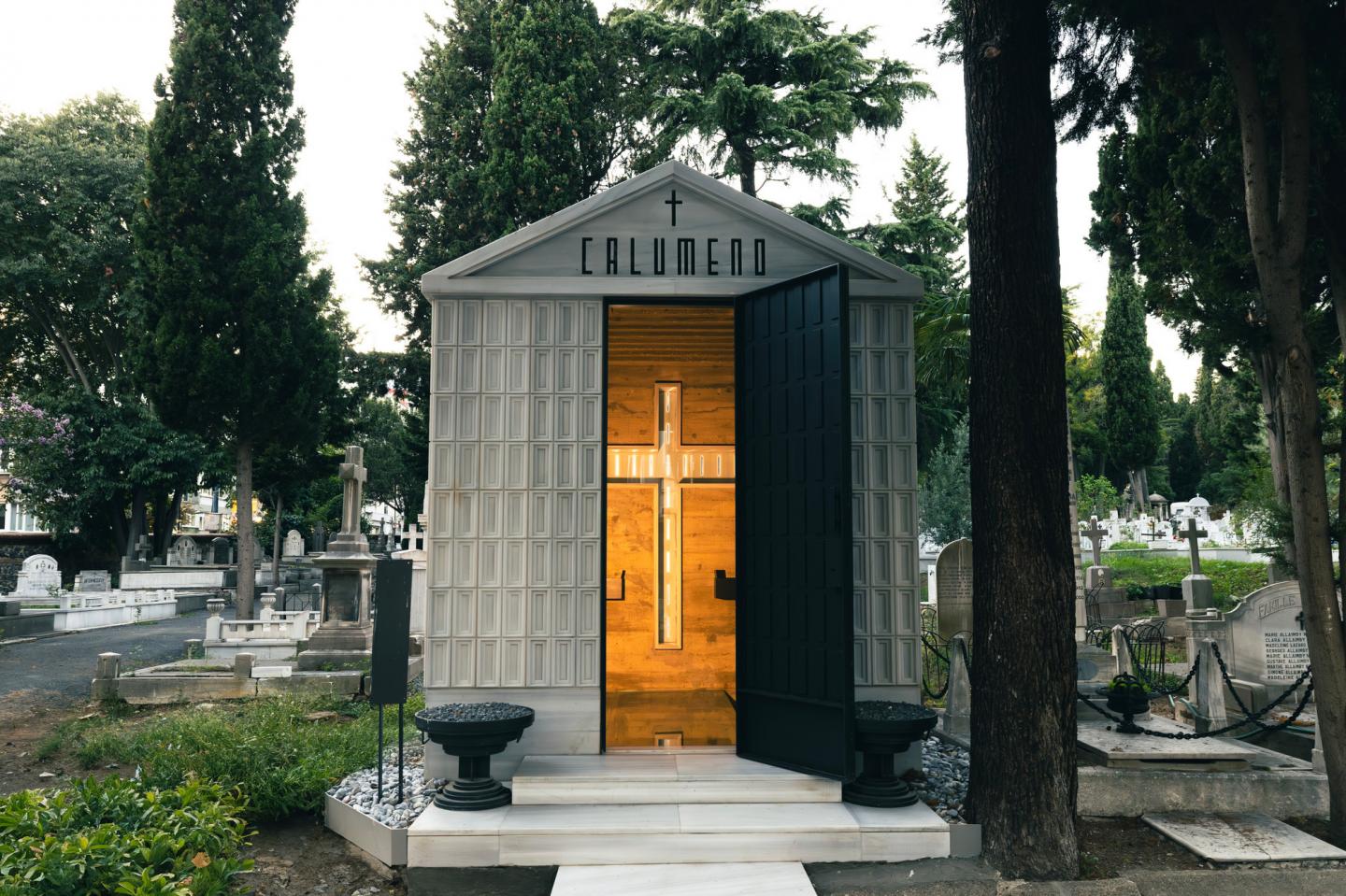
Designed for the Levantine-origin Calumeno family, the mausoleum sits on a 3 x 3 meter footprint and rises to 4 meters in height. Its main load-bearing system consists of reinforced concrete walls, while the exterior cladding—40 mm-thick Marmara marble—follows the logic described above. These marble panels, deeply carved into a cassette pattern, provide the structure with a lightened yet monumental expression.
A burial chamber was constructed in the subterranean level of the mausoleum, designed to hold coffins. This required a 3-meter-deep excavation.
CRAFTSMANSHIP IN THE MODERN AGE: REINTERPRETING HANDWORK IN MONUMENTAL ARCHITECTURE
The Feriköy Cemetery is home to gravestones, columns, frescoes, and sculptures shaped with meticulous craftsmanship nearly a century ago. These works reflect the artisanal spirit of their time and the attention given to architectural detail. Today, however, achieving the same refinement is rarely possible through traditional means, requiring reinterpretation via contemporary methods.
Our project sought to address the question: “How can a mausoleum be designed within the context of Feriköy Cemetery using today’s construction technologies?” The aim was to merge craftsmanship with contemporary production techniques. The mausoleum is designed to be harmonious with the cemetery fabric yet more restrained, solid, and geometric in its order.
The modular stone units on the façade constitute a prototype that reinterprets the classical understanding of the mausoleum. Using a 3-axis CNC milling machine with water-assisted carving, the 40 mm-thick marble cassettes were gradually thinned toward the center—first reduced to 25 mm and ultimately to 10 mm at the innermost point. Due to the angled nature of these gradations, the V-carving technique was employed. Throughout the production process, no marble waste was generated, demonstrating the suitability of Marmara marble for this carving technique.
To overcome the difficulty of installing individual units, the 30x15 cm cassettes were fabricated as larger panels measuring 30x120 cm, each composed of 12 cassettes. With 10x10 mm joints left between them, the visual effect of single cassettes was preserved while the seams between larger modules were concealed. The diamond milling marks that appeared after the water-assisted carving were subsequently sanded down by hand in the workshop, resulting in a perfectly smooth surface.
This cassette detail guided not only the facade but also the door design. The question of how the stepped carving language of marble could be reinterpreted in metal turned the mausoleum into a design laboratory. Layered 10 mm steel laths were crafted to echo the marble language, while the cut-off pieces were used on the reverse side of the door to ensure structural and visual integrity.
A SPATIAL READING ON VERTICAL AND HORIZONTAL AXES
The conceptual framework of the mausoleum relies on a dialogue between vertical and horizontal axes. The horizontal axis symbolizes daily life, mortality, and the transient nature of human existence; the vertical axis represents a metaphysical connection between earth and sky.
The vertically emphasized marble panels on the exterior enhance the monument’s verticality, making it appear taller and evoking transcendence. The tall cypress trees in the cemetery serve as natural extensions of this vertical composition.
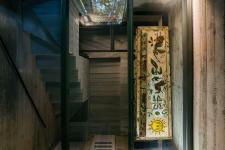
Inside, verticality is emphasized through a skylight and a glass floor. The glass floor allows visitors to look both upward and downward simultaneously, uniting sky and earth in one reflective plane, thereby reinforcing the sense of infinity.
ARCHITECTURAL CONCEPTUALIZATIONS
1. Cassette Module and Structural Lightness
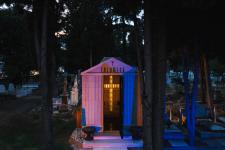
The defining element of the design is the cassette module. Developed not as a figurative symbol but as a universal reference, it echoes the coffered ceilings of the Pantheon and conveys structural lightness. At different times of the day, shifting shadows enrich spatial perception, while the grid serves as a temporal metaphor for the inevitability of death.
2. Stepped Dome
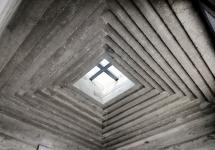
Carlo Scarpa’s Brion Cemetery inspired the stepped transitions in the mausoleum ceiling, leading up to the skylight. These details consciously reference modern and classical Italian architecture, directly linked to the Levantine identity of the Calumeno family.
3. Luminous Cross
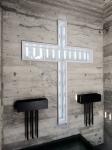
Natural light was minimized in the interior, but thin fissures were left within the marble cassettes to allow filtered daylight. In the apse, a cruciform light gap—an homage to Tadao Ando’s Church of the Light (1999)—invites visitors into a spiritual and emotional experience through the abstraction of light.
4. Glass Floor and Altered Perception
In traditional mausoleums, coffins are stored underground in dark, inaccessible chambers. Inspired by Bernard Tschumi’s use of glass floors in the Acropolis Museum, the subterranean level here is revealed through glass, transforming the descent into a visible and experiential element.
CALUMENO TYPEFACE
The proportions of the mausoleum’s facade and marble cassettes guided the design of the family’s inscription. Based on the internal ratios of the 30x15 cm cassettes, the letters of “CALUMENO” were developed and later expanded into a complete typeface. All inscriptions—family name, tomb texts, prayers—were carved using this custom type. Beyond the mausoleum, the “Calumeno” typeface was also applied in graphic materials and presentations, integrating architecture and typography into a cohesive identity.
In conclusion, the Calumeno Family Mausoleum offers a contemporary reinterpretation of a long-interrupted tradition, harmonizing with the historical fabric of the Feriköy Latin Catholic Cemetery. The use of White Marmara marble, with its historical continuity from Roman, Byzantine, and Ottoman periods, sustains the cemetery’s patina and layered identity while projecting it into the present. The proportional system of the cassette module and the conceptual strategies derived from it grant the project a distinctive character, positioning the mausoleum not only as a family monument but also as a contemporary addition to the multilayered urban memory.
2023
2024
Site Area (m²) 9 m²
Total Construction Area (m²) 14 m²
Architectural Office : KO-Arch
Design Team : Evren Öztürk
Architectural Project Team : Öykü Öztekin
Assistants : Edanur Varol, Ecem Büyüktaş
Client : Orlando Carlo Calumeno
Main Contractor : Oğuz Utkan
Reinforced Concrete and Formwork Works : Ömer Kuzu
Marble CNC and Handcraft Works : Cengiz Üstündağ – Üstündağ Marble
Marble Installation : İlhan Gençoğlu
Metal Works : Mustafa Demir
Photography : Mustafa Seven, Evren Öztürk
3D Visualization : Ozan Kağan Altunbaş
Evren Ozturk