Ayodhya Ram Dhunn Project — A Landmark in Cultural and Sustainable Architecture
The Ayodhya Ram Dhunn Project at Naya Ghat Chauraha, near Lata Mangeshkar Chowk, is a visionary urban design initiative by Varenyam Architecture and Design for the Ayodhya Development Authority. The project reimagines the spiritual heart of Ayodhya through architecture, art, water design, and environmental sustainability.
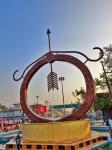
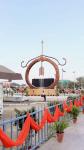
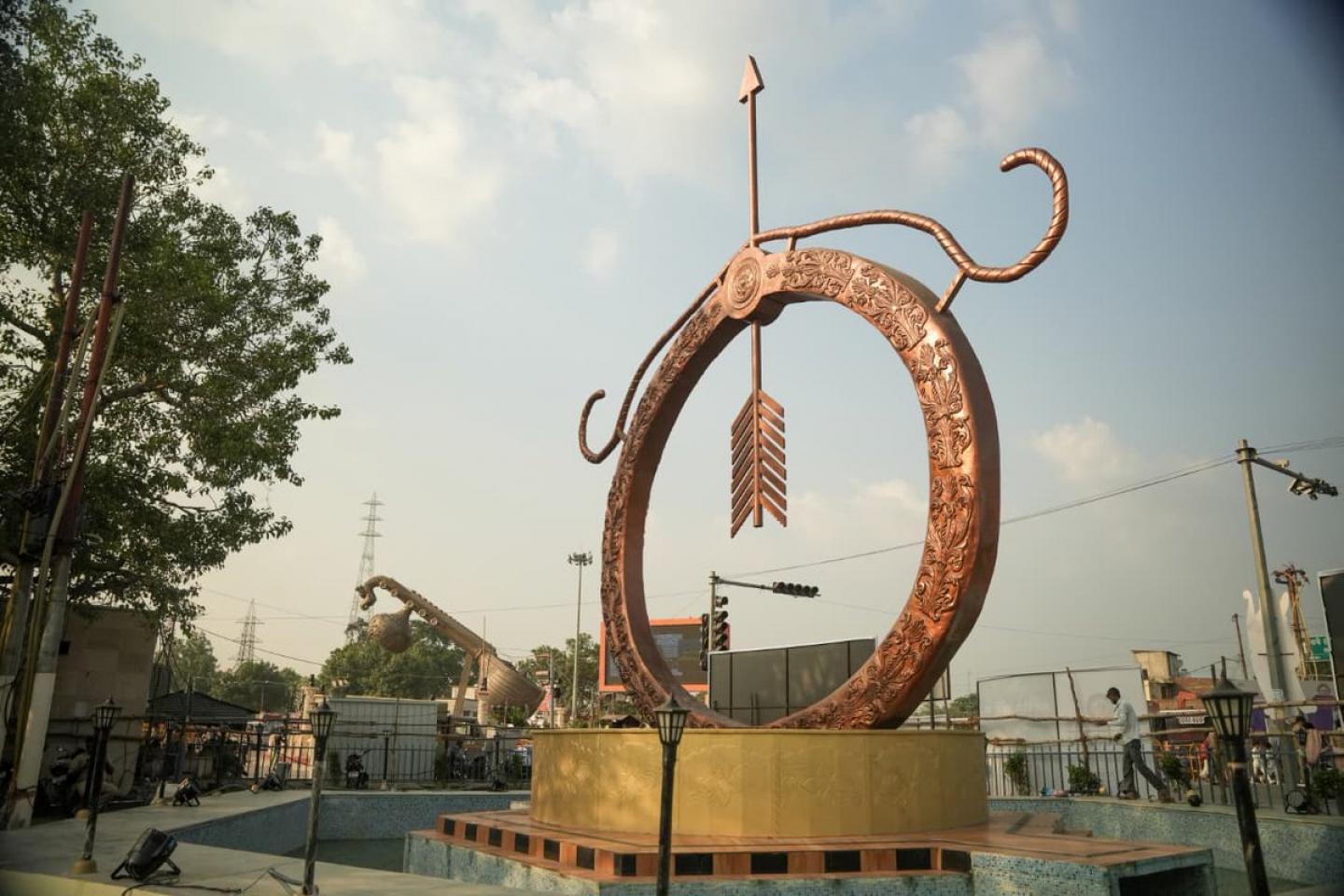
At its core lies a monumental water fountain installation, inspired by the divine bow (Dhanush) of Lord Rama — a symbol of strength, grace, and righteousness. By fusing mythology with modern architecture, the project transforms a civic junction into an experiential public realm that unites spirituality, design, and community life.
Design Concept and Vision
Envisioned as a public art installation and urban landmark, the Ram Dhanush Project interprets Ayodhya’s mythology through contemporary design. Located near Lata Mangeshkar Chowk, the site connects culture, faith, and modern infrastructure. The fountain, modeled after the celestial Dhanush, forms the focal point — a sculptural gesture that celebrates Ayodhya’s spiritual identity and its proximity to the Saryu River.
The design concept emphasizes fluidity, rhythm, and reverence, using water and light as storytelling media. The cascading jets represent divine energy, while the circular basin symbolizes cosmic continuity — themes deeply embedded in Indian architecture and Vedic geometry.
Architectural Design and Material Expression
The project uses a tri-material palette combining strength, durability, and elegance:
MS Structural Frame: Provides structural integrity and adaptability, supporting pumps, lighting, and decorative cladding.
Kota Stone Flooring: Adds timeless texture and cultural relevance, rooted in traditional Indian building craft.
Fiber Cladding: Offers modern finesse and weather resistance, blending the fountain into Ayodhya’s evolving skyline.
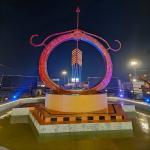
The architectural lighting design employs LED illumination to create choreographed color sequences that transform the fountain by night. The interplay of water, light, and sound results in a multisensory urban experience, positioning the site among the most beautiful public architecture projects in India.
Urban Landscape and Spatial Experience
The landscape architecture integrates pedestrian pathways, native planting, and contemplative seating zones, encouraging interaction and community engagement. The design fosters inclusivity through universal accessibility features such as ramps, tactile paving, and barrier-free circulation.
By day, the space functions as a shaded retreat where locals and visitors connect; by night, it becomes a glowing civic centerpiece symbolizing Ayodhya’s cultural revival and modern transformation.
Engineering, Systems, and Sustainability
Technically, the Ram Dhanush Project is built upon integrated water, mechanical, and electrical systems designed for sustainability:
Closed-Loop Water Circulation with filtration and UV treatment ensures minimal wastage.
Energy-Efficient Pumps and LEDs reduce the project’s carbon footprint.
Automated Control Systems (PLC-based) synchronize water jets and light choreography.
Stormwater and Overflow Management protect surrounding areas from flooding.
Native Landscape Planting supports biodiversity and reduces irrigation demand.
These innovations make the installation a model of sustainable civic infrastructure and a benchmark for green public architecture in India.
Cultural Impact and Civic Value
Beyond its visual appeal, the Ayodhya Ram Dhanush Fountain is an act of cultural storytelling — an homage to the city’s heritage and a celebration of India’s timeless design philosophy.
It serves multiple roles: a civic icon, a tourism anchor, and a community gathering space. Positioned near Lata Mangeshkar Chowk, it aligns with Ayodhya’s broader urban renewal program, complementing nearby religious, artistic, and commercial developments.
For residents, it instills civic pride. For visitors, it becomes a lens through which they experience the fusion of mythology and modern design. The project reflects the broader narrative of India’s urban renaissance, where ancient wisdom informs future-ready architecture.
Implementation and Execution
Total Cost: ₹35 lakh
Total Timeline: 10 months
Phases:
Design & Approvals – 2 months
Construction & Framing – 6 months
Finishing & Landscaping – 2 months
The design process adhered to rigorous standards of quality control, safety, and stakeholder coordination. Every component — from the MS framing to the lighting systems — was tested for durability, weather resistance, and performance consistency.
A comprehensive maintenance plan ensures the fountain’s longevity through routine cleaning, inspection, and water quality monitoring.
Symbolism, Heritage, and Future Legacy
The Ram Dhanush Project transcends its physical boundaries. It is not just a water fountain — it is a bridge between divinity and design, between ancient storytelling and contemporary urbanism. The arc of water mirrors the arc of faith that defines Ayodhya itself.
Its success lies in its synthesis of architecture, technology, and culture, reflecting how modern India can reinterpret tradition for a global audience. As Ayodhya emerges as a world spiritual capital, this project stands as a model of context-sensitive and culturally rooted architecture — sustainable, inclusive, and inspiring.
Conclusion
The Ayodhya Ram Dhanush Project by Varenyam Architecture and Design exemplifies the evolving dialogue between urban development and spiritual design. It reaffirms that public architecture can be both environmentally responsible and emotionally resonant — capable of uplifting communities while preserving the essence of place.
Through its seamless integration of art, engineering, and mythology, the project transforms Naya Ghat Chauraha into more than a site — into an experience that defines the soul of modern Ayodhya.
2024
2025
Project: Water Fountain — Naya Ghat Chauraha, Ayodhya
Location: Near Lata Mangeshkar Chowk, Ayodhya, Uttar Pradesh.
Implementing Agency / Consultant: Ayodhya Development Authority (ADA) & Varenyam Architecture & Design (Design Consultant)
Total Estimated Cost: ~ ₹ 35 lakhs.
Key Technical Specifications
Structural Frame: Mild Steel (MS) structural framing for the fountain super-structure to support water jets, lighting and cladding.
Flooring & Cladding Materials: Kota stone flooring in the public zone; fibre‐cladding panels for feature elements.
Water Display System: Dynamic water-jet system with adjustable cascades; programmable LED lighting integrated into the jets/edges for night visual performance.
Water Management: Closed-loop water-recycling system (recirculation pump, filtration treatment, storage basin) for the fountain.
Landscape & Hardscape: Surrounding pedestrian pathways, seating zones, and native plantation. The hardscape integrates with Kota stone and concrete surfaces, with allowances made for accessibility (ramps, level access).
Lighting & Electrical: Energy-efficient LED illumination throughout; lighting to highlight fountain elements, pedestrian paths, and surrounding landscaping. Provision for control panel and automation of sequences (water & light synchronisation).
Accessibility & Safety: Design to accommodate universal access (ramps, handrails) and code-compliant safety (guardrails, anti-slip flooring, safe electrical installations).
Timeline (as per DPR):
Planning & Design Phase: ~2 months
Construction Phase: ~6 months
Finishing & Landscaping Phase: ~2 months
Total project duration: ~10 months
Budget Breakdown (indicative from DPR):
Civil & Structural Works: major share
M&E (Mechanical & Electrical) – water‐jet systems, pumps, lighting
Finishes & Landscaping
Contingency, mobilisation & provisional sums
Design Performance Targets & Standards
Surface finish: Kota stone to achieve durable finish under outdoor use (weathered region of Ayodhya).
Structural design: MS framing to account for dynamic loads (water jets, pump vibration, wind loads) and ensure long-term serviceability.
Water system: Recirculation to minimise water wastage; filtration to maintain clarity and hygiene of water display.
Lighting: LED system to meet outdoor luminance levels for aesthetic and safety purposes; control system for light-water synchronisation.
Sustainability: Use of native trees/planting, minimal water wastage, energy-efficient lighting, materials selected for local durability and maintenance ease.
Outstanding / To-be-confirmed Details
Exact flow rate, pressure and jet height specifications for the fountain (e.g., litres per minute, max jet height in metres)
Pump power, motor ratings and system redundancy
Filtration/reservoir capacity for the water re-use loop
Structural load calculations, wind/earthquake design criteria (e.g., IS codes used)
Detailed Bill of Quantities (BOQ) for civil, mechanical & electrical works
O&M (Operation & Maintenance) regime: lifecycle cost, service intervals
Lighting lux levels, control system type (DMX, PLC) and automation logic
Accessibility compliance details (ramp gradients, signage)
Environmental impact mitigation measures (noise, water spillage, drainage)
Shreyanshi Dubey - Principal Designer
Baldeep kaur - Architect
Tanuj Bhardwaj - Supervisor
Vanshika Jain- 3D Designer
Rohit Adhikari