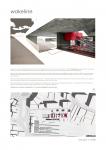
Project Concept: Metro Space, Control, and Mental Awareness
Urban transportation systems are not just tools for spatial connection; they also function as control mechanisms where people move, are observed, and exist within continuous flows. In this context, our project “wakeline”, developed around Basmane Metro Station, aims to break the mental “sleep mode” that ordinary metro use can create. It invites users to become aware of the space around them and their movement within it.
Foucault’s theory of the “panopticon” and disciplinary society offers a critical perspective on such transportation spaces. According to Foucault, modern control in society is no longer just about visible punishment or surveillance; it works through the sense that one might always be watched. Architecture and spatial design allow the body and movement to be continuously observable, which encourages self-regulation.
Metro stations—with moving trains, dense flows of people, and visual and digital surveillance systems—are places full of control mechanisms. In these spaces, human movement, time pressure, and spatial continuity are subject to invisible but effective forms of regulation. Our project makes this hidden control visible, transforming users from routine passengers into aware, thinking subjects.
The logic behind the project can be read as follows:
Metro use becomes a repetitive, habitual action; the body and mind enter a “sleep mode” within the flow.
This ordinary flow functions as a control environment: continuous movement, visual monitoring, and spatial uncertainty involve the user in a protection-control system without their conscious awareness.
The project interrupts this routine; it pauses and directs the user, offering spaces and architectural breaks that alter perception.
In this way, the transportation space stops being only a passageway and becomes a site of intellectual and emotional experience.
Through this approach, architecture rethinks transit spaces not only in terms of function but also in terms of body, perception, emotion, and control relations. The metro, as a control space, is transformed into a stage where the user is both observed and observing, removed from habitual flow.
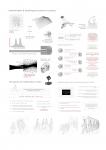
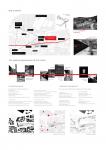
Spatial Scenario and Diagrammatic Choreography
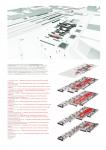
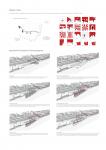
The spatial design of the project follows a choreographic order that takes the user on a journey without leaving the theoretical foundation. The design progresses through stages, each offering perceptual breaks, mental pauses, or sensory intensity. The stages are described below with architectural terms and their theoretical context:
Threshold and “Subtract” Stage
The journey begins with a threshold that detaches from the urban ground. By deliberately “removing” (subtracting) part of the city surface, the user steps out of the routine metro flow and is invited to a new spatial perception. This threshold break makes the user aware of the ordinary control mechanisms, creating a sense of exit from both mental and physical control flow. Architecturally, this stage starts with a ramp or gap that separates from the urban ground, offering a change in direction and continuity.
Ramp & Amphitheater
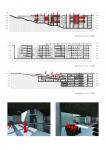
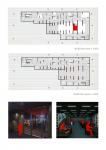
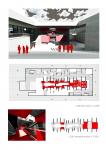
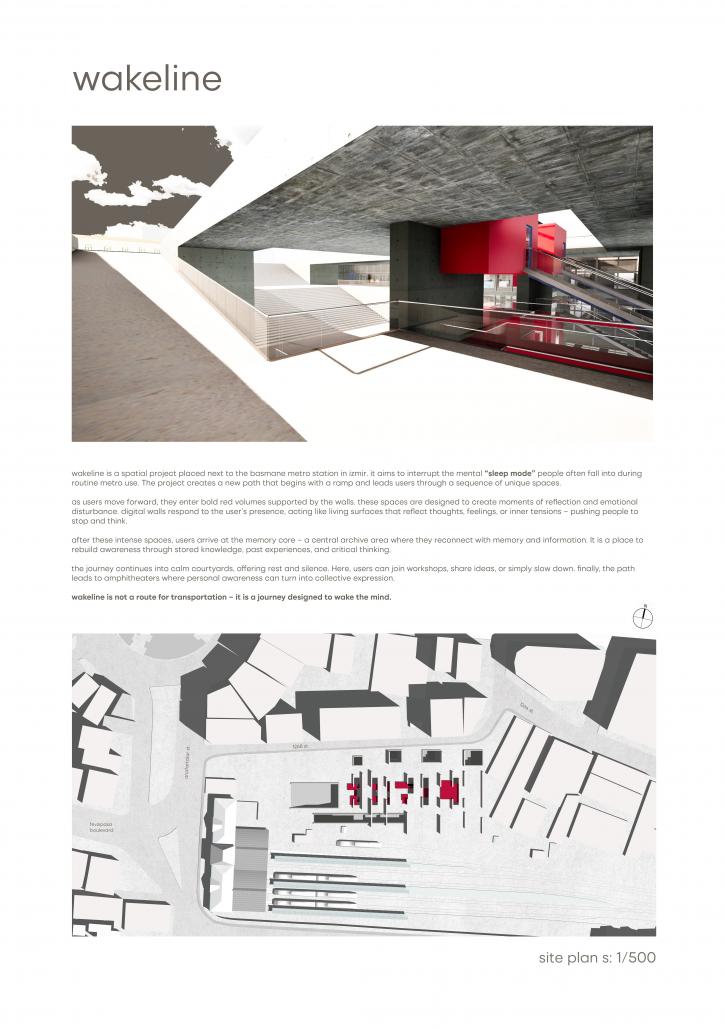
Here, the user moves down a ramp, which slows the rhythm and emphasizes detachment from the ground. Amphitheater-shaped spaces place the user in the position of an observer or active participant, allowing them to feel the weight and effect of the space. Suspended red masses appear at this stage, acting as visually dominant, hard-to-reach elements. These intense colors and forms increase awareness of the control field and prompt the user to think about their own movement.
Structural Walls and Surface Cuts
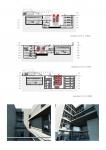
Structural walls guide circulation, define spatial rhythm, and control light and air. Surface cuts aligned with the walls create linear openings that manipulate light and shadow. These architectural interventions break perception; the user continuously re-reads the ground and spatial structure. Conceptually, this stage reveals the invisible nature of control mechanisms, making the body, movement, and surveillance processes perceivable.
Suspended Red Masses
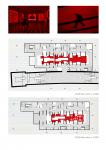
Hanging red volumes bring dramatic spatial intensity. They are visually dominant and physically unreachable, creating tension. Users perceive them as something to avoid rather than reach, which metaphorically represents surveillance and control. The choice of red as a color is both alerting and stopping, inviting conscious awareness. Architecturally, these masses encourage reflection, analysis, and questioning of one’s position in the space.
Courtyards and Collective Expression Areas
At the end of the journey, users reach calmer, open, and socially shared spaces: courtyards, collective amphitheaters, and gathering areas. Architecturally, this stage represents a shift from “closed system” to “open system”. From structural elements like walls, ramps, and volumes, the continuity is transformed into shared spatial experience. This phase overturns control and surveillance: users can choose their own actions, pause, and participate collectively. Thus, architecture and spatial structure become tools for transforming the control mechanism rather than simply enforcing it.
2025
Project Area: Basmane -Izmir (Turkey) ~8,000–10.000 m² (includes ramp, amphitheatre, hanging volumes)
Suspended Volumes: safe structure, visually striking, unreachable
Floor Material: durable for high-traffic use
User Capacity: amphitheatre and shared spaces for ~600-700 people at once
Accessibility: ramps and paths for all users, tactile guidance where needed
Lighting & Openings: mix of daylight and artificial light to enhance perception
Spatial Flow: designed to guide, pause, and engage users through different stages
Studio Supervisors: Assoc. Prof. Dr. Ülkü İnceköse İzmir Institute of Technology
Assoc. Prof. Dr. Ebru Yılmaz İzmir Institute of Technology
Project: Burak Özcan