Nestled amid the landscapes of Hangzhou lies a villa known as "Moon House". It does not draw attention with ostentatious forms nor stand out through luxury; instead, it resides quietly in the embrace of nature with a restrained presence. No grand architectural statements are pursued here; rather, it returns to the essence of living—allowing space to be an extension of life, and making home a haven for the soul.
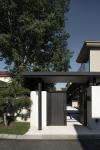
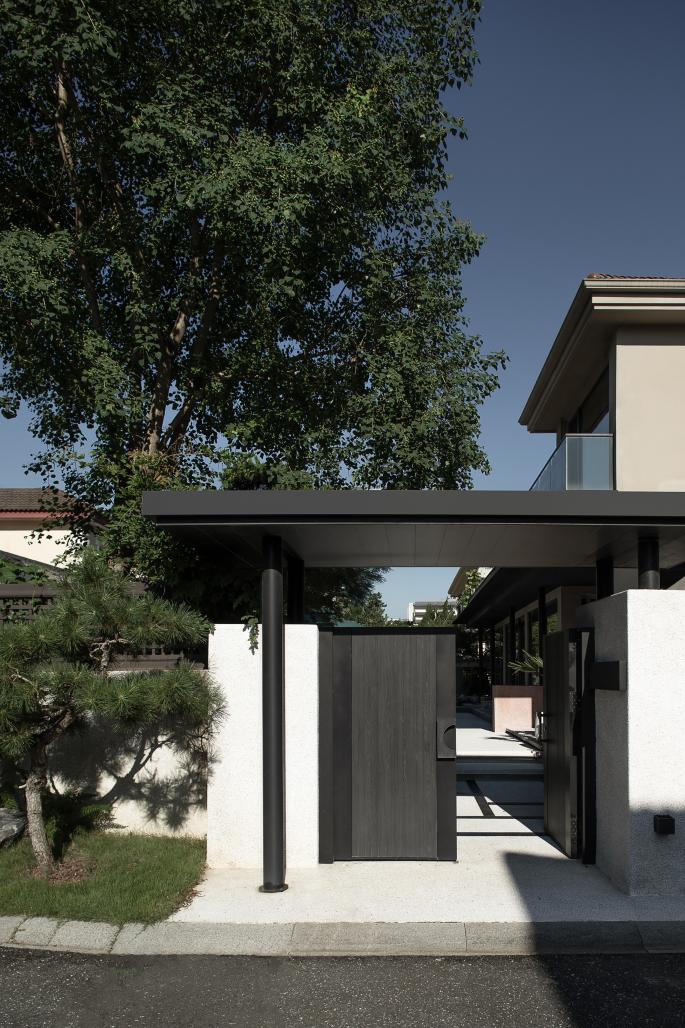
The designer believes that a home is not a cold container, but a presence gently wrapped in time. Stepping into the courtyard, time seems to slow down. Winding stone steps intersect with the veranda, and light and shadow filter through the branches and leaves, as if whispering the secrets of the seasons. The courtyard walls are covered with climbing vines, a few decorative stones adorn the covered walkway that shelters from wind and rain, and an ancient pine tree stands quietly, creating a delightful contrast with the logs. The air is filled with the fresh scent of soil, flowers and plants; fish glide gently in the pond, while sunlight dances on the water's surface.
Gather around the fire to brew tea and sit closely chatting with friends—this courtyard is not merely a decorative landscape, but an integral part of life, an extension of the intimate coexistence between humans and nature. As the four seasons cycle and plants wither and flourish, one finds inner tranquility while being in this space. This represents the deepest respect for nature—not to conquer it, but to listen to it and coexist with it.
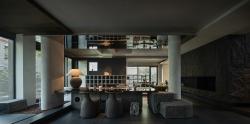
The living room and tea lounge inside the house are like a poem about light and shadow. Large floor-to-ceiling windows draw the greenery of the courtyard into the interior; sunlight filters through the wooden lattice windows, falling on the dark-toned floor and casting layered patterns that seem to flow. The furniture, with dark wood as its frame and gray tones as its finish, exudes a sense of calmness while retaining a warm touch. Light and shadow glide softly across the walls, as if nature were humming a gentle melody.
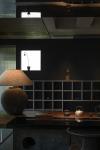
The tea lounge frames the view with its windows, turning the courtyard scenery into a three-dimensional painting. A few antique tea sets are displayed on the wooden tea table; light filters through the aroma of tea, leaving traces of time. The green plants by the window echo the Zen-style ornaments inside the house, forming a serene scene. When one is in this space, time seems to stretch, the hustle and bustle are cut off, and only the resonance between the heart and nature remains.
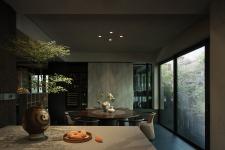
The dark-hued walls and stone steps speak of the profound weight of time, while the wooden tables and chairs interweave with light and shadow to create a gentle rhythm. The kitchen and dining space is like a poem murmured softly: light streams in through the windows, falling on the countertops as if they were the tender ripples of time. A few green plants adorn the corners, infusing the space with the breath of life.
There is no deliberate decoration nor cold order here—only the warmth of life. The designer uses light as a brush and materials as ink to depict a space that is both modern and filled with natural poetry. Amid a cup of tea, a lamp, and a sound of laughter, the essence of home flows quietly.
The study is the soulful corner of Moon House. The black bookshelves stand like silent spines of books, bearing the weight of thoughts. On the wooden desk, a potted green plant grows quietly, as if borrowing a breath from nature. The shadow of the courtyard outside the window is gently cast on the wall, where light and leaves interweave—quiet yet not lifeless.
The flow of light and shadow is like the soft murmur of time, urging people to slow down and listen again to the voice within. The scent of books mingles with the breath of the wind; thoughts wander between the pages, and the soul gradually settles in the embrace of nature.
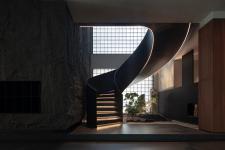
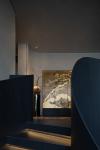
Ascending the spiral staircase, one finds lights embedded in the steps along the way, like a flowing river of stars. Curves unfold in the direction of the light, tracing infinite arcs within the space, and before one’s eyes unfolds a haven where the family rests in peaceful tranquility, as if in a gentle dream.
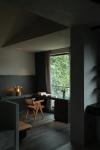
The bedroom is the quietest place in the entire villa. Dark wooden floors interweave with black feature walls to create a profound, serene atmosphere. Soft light filters in through the windows, spilling between the bed and the desk. Wooden textures, gray bedding, yellow flowers, and a teacup together depict the gentle, tender moments of daily life.
There is no unnecessary decoration here—only purity and restraint. The space returns to its truest state: light and shadow "breathe", air flows, and the heart finds its peace. As night falls, moonlight filters through the window screens and rests on the pages of a book, wrapping everything in quiet beauty.
From the courtyard to the bedroom, from light and shadow to state of mind, the space is constantly evolving while also engaging in quiet introspection. It leads people to rediscover the true meaning of home—not being surrounded by the world, but integrating with it. Here, the wind takes on a tangible form, light carries a perceptible sound, and life is filled with warm warmth. And it is within this realm where light and shadow intertwine that people finally find a place for their hearts to settle.
2024
2024
Building area丨400 ㎡
Design Team|Chen Yuhong, Cheng Qinrong, Xu Kaixiang, Su Wei
Project Owners|Wang Huaqiang, Chen Kezhi, Ms. Chen
Photography|Hanmo Vision - Yigao
Hanmo Vision Yigao