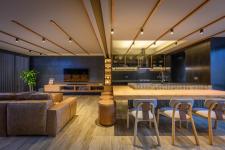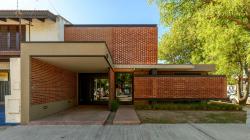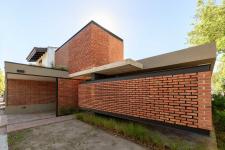
The project proposes the renovation and reprogramming of a 170 m² corner house built in 1954 in Villa María, a mid-sized city in the interior of Córdoba, Argentina. The intervention reorganizes the program into two continuous and interconnected functional blocks—public and private. Fixed uses are resolved through an autonomous monolithic module that concentrates services and frees the remaining space, allowing flexibility and reversibility over time.
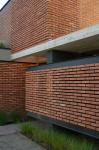
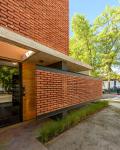
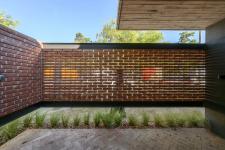
The use of accessible materials and local construction techniques reinforces a commitment to the Argentine context, understanding design as a situated act that responds to what is available and to the real conditions of the territory. Within this framework, brick—an element deeply rooted in Córdoba’s building culture—is reinterpreted through an alteration of its conventional logic. Suspended within an independent steel structure, the brick abandons its monolithic condition, separates from the load-bearing plane, and redefines the spatial boundary.
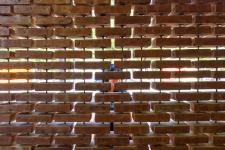
Void acquires the same importance as matter: the element ceases to be a wall and becomes an experience. Light passes through it, seasons modify its perceptual density, and the movement of the user activates a dynamic play of shadows and transparencies. In this way, a “space within a space” is constructed, where the spatial experience unfolds through successive layers of materiality.
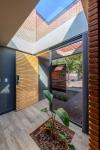
Exposed concrete, steel, stone, brick, and wood are presented without artifice, in an exercise of material honesty that reveals the constructive process. There are no claddings or simulations; each material expresses its structural and sensory nature.
The suspended brick element carries a sense of incompletion, almost provisional in character. It introduces tension.
Brick becomes ethereal, lightweight, mutable, and fluid, expanding its symbolic and spatial possibilities.
The project is a tribute to a deep understanding of the nature of materials, conceived in a state of permanent transition. It suggests that architecture is not a definitive state but a continuous negotiation between matter, time, inhabitation, and context.
There is a gesture of respect, but also of controlled irreverence.
The material itself is not changed; its will to be is altered. Innovation lies not in the object, but in the logic.
2025
2026
The project proposes the renovation and reprogramming of a 170 m² corner house built in 1954 in Villa María, a mid-sized city in the interior of Córdoba, Argentina. The intervention reorganizes the program into two continuous and interconnected functional blocks—public and private. Fixed uses are resolved through an autonomous monolithic module that concentrates services and frees the remaining space, allowing flexibility and reversibility over time.
The use of accessible materials and local construction techniques reinforces a commitment to the Argentine context, understanding design as a situated act that responds to what is available and to the real conditions of the territory. Within this framework, brick—an element deeply rooted in Córdoba’s building culture—is reinterpreted through an alteration of its conventional logic. Suspended within an independent steel structure, the brick abandons its monolithic condition, separates from the load-bearing plane, and redefines the spatial boundary.
Void acquires the same importance as matter: the element ceases to be a wall and becomes an experience. Light passes through it, seasons modify its perceptual density, and the movement of the user activates a dynamic play of shadows and transparencies. In this way, a “space within a space” is constructed, where the spatial experience unfolds through successive layers of materiality.
Exposed concrete, steel, stone, brick, and wood are presented without artifice, in an exercise of material honesty that reveals the constructive process. There are no claddings or simulations; each material expresses its structural and sensory nature.
The suspended brick element carries a sense of incompletion, almost provisional in character. It introduces tension.
Brick becomes ethereal, lightweight, mutable, and fluid, expanding its symbolic and spatial possibilities.
The project is a tribute to a deep understanding of the nature of materials, conceived in a state of permanent transition. It suggests that architecture is not a definitive state but a continuous negotiation between matter, time, inhabitation, and context.
There is a gesture of respect, but also of controlled irreverence.
The material itself is not changed; its will to be is altered. Innovation lies not in the object, but in the logic.
Architecture Office: EFEEME architects
Architects of the work: Flavio Diaz | Marina Alves Carneiro
Website: https://efeemearq.com.ar
Instagram: www.instagram.com/efeemearquitectos
Photography: Gonzalo Viramonte
Instagram: https://www.instagram.com/gonzaloviramonte/