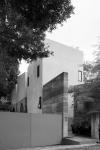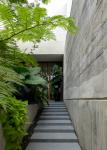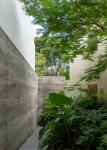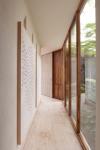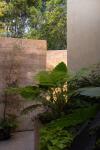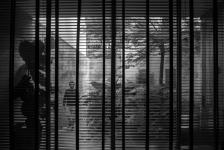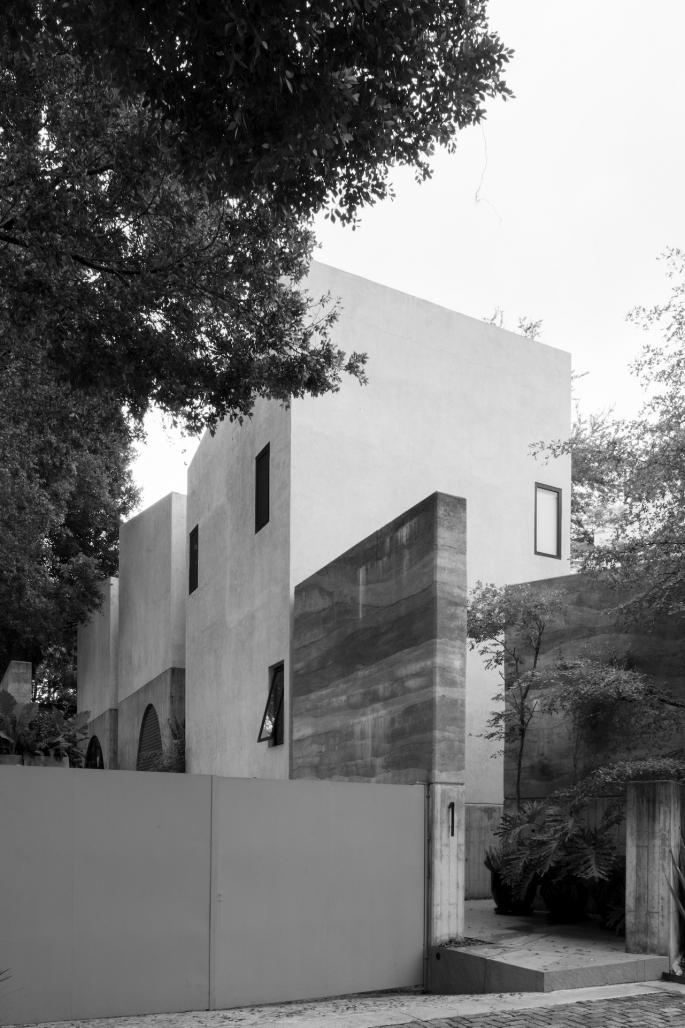
Casa Duraznos emerges from an urban context and from a site with a very particular shape, which made it possible to conceive and envision a project without a main façade. In this sense, the entrance becomes an experiential sequence that gradually dissolves the noise of the city into the silence of the home, through walls that guide and surround the user before revealing a garden.
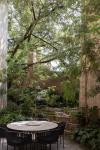
There is a Guamúchil tree on the site, and from the very beginning the design was focused on preserving it as the main actor within the project. An open and permeable space was conceived to allow the tree to continue growing as if it were part of a contemporary ruin.
Months later, when the owners changed, the house had to be altered, reshaping and adapting itself to the new needs. The new commission was to expand the space while always ensuring the preservation of the tree. The fragmented volumetric scheme easily accommodated this growth, enriching the experience of the intervened area.
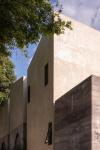
The project arises from the site, the program, and also from the clients’ intention to explore elements of the haciendas of Yucatán, seeking to achieve a timeless language. The house, in the manner of a hacienda, begins to fragment itself through spaces at different heights, allowing each area to have its own atmosphere.
The arch is revisited for its structural strength and for the weight it carries within collective memory as an immediate link to the past, reinterpreted through a contemporary material such as concrete. All these elements converge in Duraznos, where unexpected encounters with the landscape and vegetation are generated, similar to those that occur in Chiapas or the Huasteca Potosina, tropical regions of the country where humidity allows vegetation to appear in any available crevice.
On the ground floor, the project results in a play of volumes that generate unexpected encounters with the landscape. On the upper floor, by contrast, a more intimate and private experience is created, bringing in indirect light and seeking to surprise through vegetation.
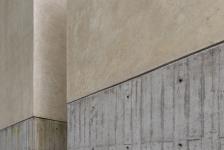
The arch is reinterpreted through a contemporary material, concrete. The walls, in turn, are clad in a stucco that recalls chukum, a tree-resin-based stucco traditionally used in Yucatecan haciendas.
From the outset, the design focused on preserving the Guamúchil tree as the main actor within the project. Both in the original conception and in the later expansion, special care was taken to ensure the tree remained intact.
2017
2018
Location: Zapopan, Jalisco, México
Year: 2018
Construction: Lorena Aguilar
Photography: Fernanda Leonel de Cervantes
Architects: Daniel Villanueva and Miguel Valverde
Project Team: Sergio Chávez and Alejandra Duarte
Fernanda Leonel de Cervantes