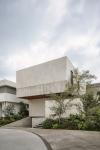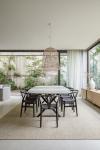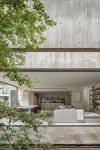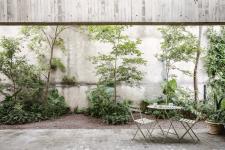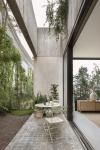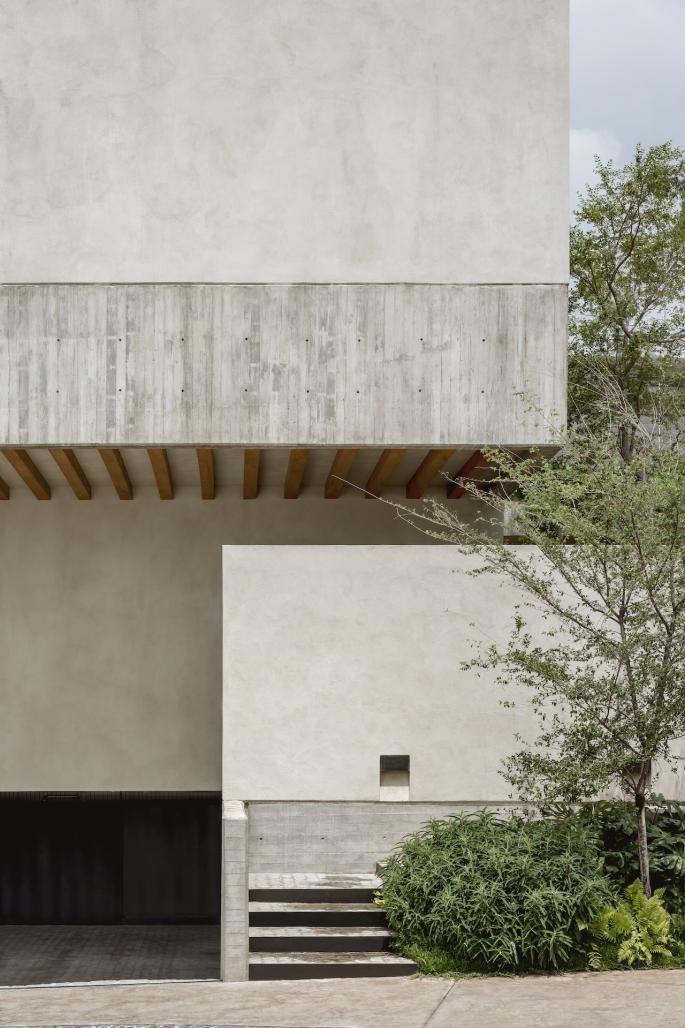
Casa Entrelomas is located within a densely urbanized residential area. The architectural proposal emerges as a response to a context defined by noise, close proximity between dwellings, and a limited presence of natural spaces. In this setting, the project proposes an introspective single-family residence, whose primary objective is to create an interior space of calm and shelter.
The house is inserted in a restrained manner into the urban fabric. Its main façade, closed and built in exposed concrete, acts as an acoustic and visual barrier to the immediate surroundings, allowing controlled exposure to the street while preserving the privacy of its inhabitants. This formal gesture also contributes to the thermal efficiency of the volume by reducing openings on unfavorable orientations.
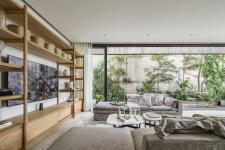
In contrast to the compactness of the front, the interior is organized through an open spatial scheme oriented toward patios and inner gardens. The ground floor accommodates the social areas, arranged in an open-plan configuration that allows visual and physical continuity with the rear garden. The connection between interior spaces and vegetation is achieved through large sliding openings that promote cross ventilation and the use of natural light.
The upper level contains the private spaces. Bedrooms are organized around a central courtyard that acts as a green lung and a source of zenithal light. This intermediate space allows the separation of functions without sacrificing spatial continuity. The design considers the privacy of each room while maintaining openness toward a controlled exterior.
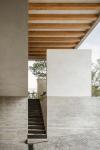
The structure is resolved through exposed concrete walls and beams. One of the main elements—a visible longitudinal beam—defines the project’s organizational axis and supports the roof, marking transitions between areas and reinforcing the linear reading of the house. The use of concrete as both structure and finish responds to criteria of durability, low maintenance, and thermal efficiency. Its natural texture is left exposed, generating an honest expression consistent with the project’s overall language.
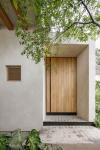
The material palette is sober and functional: concrete, steel, and neutral-toned carpentry, accompanied by vegetation selected for its resilience and low water requirements. The project incorporates passive sustainability strategies, including precise orientation, cross ventilation, interior patios, and solar control through overhangs and vegetation. Although it does not hold environmental certifications, its thermal and lighting performance was optimized from the design stage.
Casa Entrelomas was designed for a young couple. The layout adapts to their daily dynamics, balancing shared living areas with zones of privacy. The spatial organization, material choices, and technical decisions respond to a clear intention: to build an efficient, functional, and quiet home, in constant dialogue with its immediate urban and natural context.
2019
2020
Location: Zapopan, Jalisco, México
Year: 2020
Construction Management: Lorena Aguilar
Interior Design: SB Taller
Landscape Design: EntrePlantas
Photography: César Béjar Studio
Architects: Daniel Villanueva and Miguel Valverde
Project Team: Karina Ortega, Alejandra Duarte, and Sergio Chávez
César Béjar