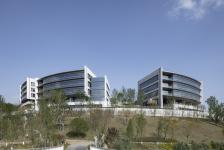
DuShe Design’s dialogue with Chongqing’s mountains started in 2018 with "Innovation Σ Space" at Liangjiang Coordinated Innovation Zone, where we proposed "Following the Terrain to Create" – redefining terrain as the origin of spatial order. Five years later, Fuling Huigu Lake Sci-Tech Innovation Town advances this into a methodology of "Rooted in Mountains and Rivers, Building Platforms to Create Landscapes".
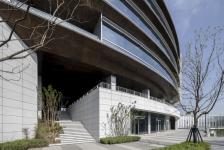
The core of mountain architecture is transforming height differences into spatial value rather than reducing their impact. Starting from the site’s contour lines, water catchment lines and vegetation, the design identifies and enhances inherent potential, realizing the logical coupling of construction and nature. Through terrain reconstruction, section control and "multi-first floors" value reconstruction, Fuling Huigu Lake builds a logical closed loop, offering an irreplicable solution for homogeneous industrial parks.
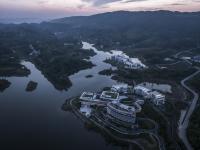
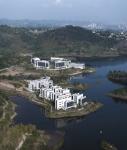
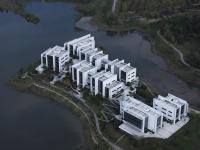
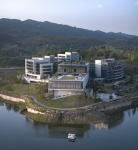
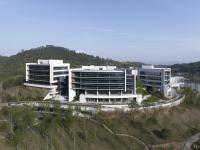
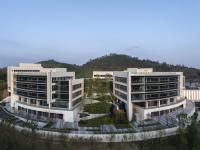
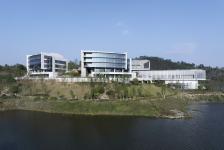
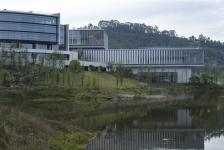
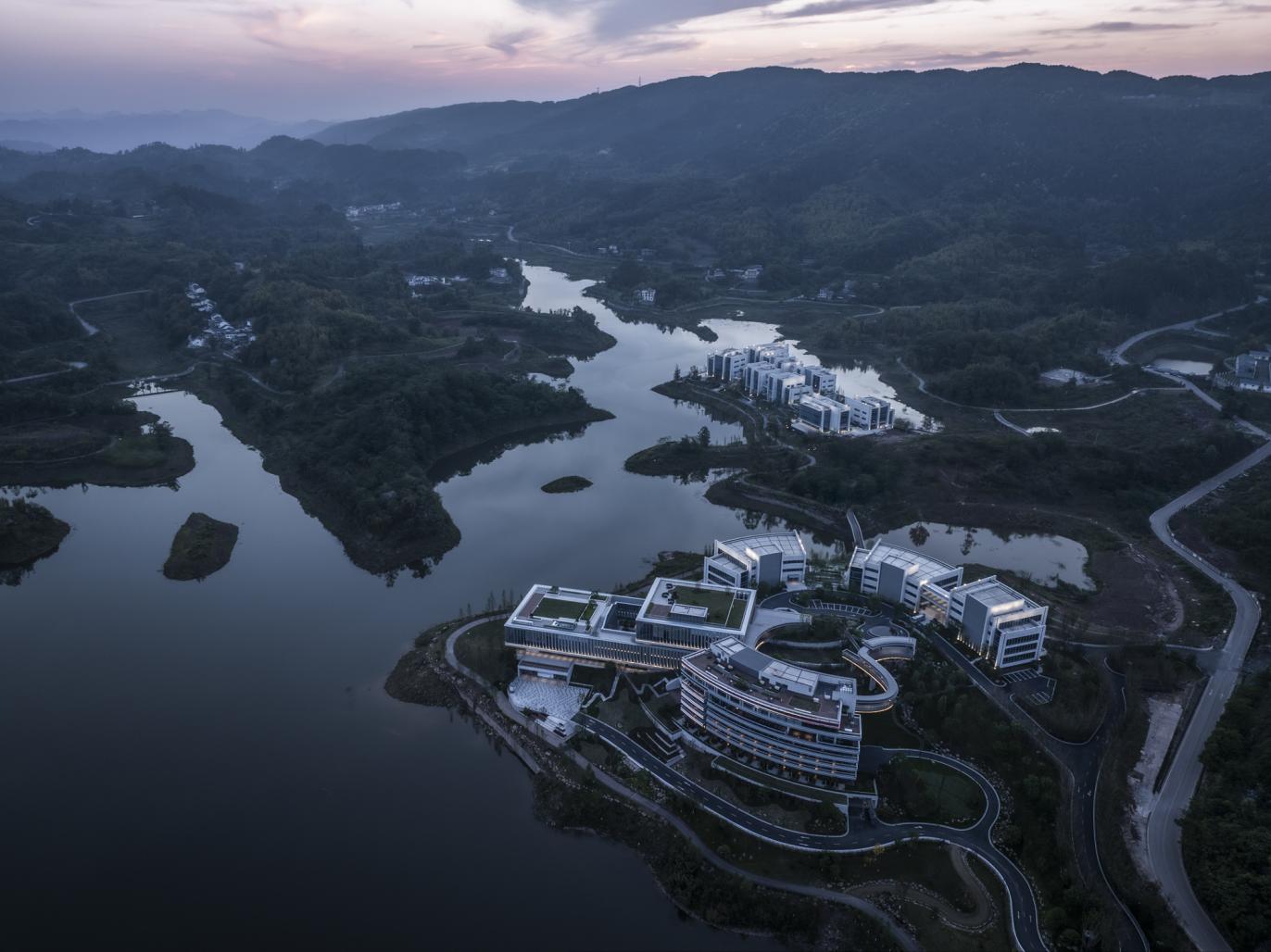
Huigu Lake is located in the northwest of Fuling, Chongqing, serving as a key node of the Fuling High-Tech Zone connecting the main urban area of Chongqing and the northeastern region of Chongqing. The lake features a winding shoreline and scattered islands and hills, forming a unique geographical pattern of “islands nested in the lake, and the lake embracing the islands”. The launch zone is situated on two peninsulas surrounded by water on three sides. Island 1 covers 28,000 square meters with a floor area of 42,000 square meters, integrating customized offices, conference and exhibition spaces, commercial facilities, and a four-star hotel. Island 2 covers 16,000 square meters with a floor area of 23,000 square meters, designed as a headquarters cluster for small and medium-sized enterprises. Connected by Wenxin Plaza, the two islands jointly form a prototype of a multi-functional and spatially continuous sci-tech innovation settlement.
The most prominent feature of Island 1 is a 33-meter elevation difference and an average slope of 20–30 degrees. Island 2 presents a typical eastern Chongqing hilly landscape, with ridges extending from northwest to southeast and forming a peninsula surrounded by water on three sides. In conventional development logic, these are regarded as negative conditions that require high earthwork costs to be “eliminated”. However, we have identified another dimension of these parameters: they serve as a natural coordinate system for vertical functional zoning, landscape distribution, and circulation organization. The core issue has shifted from “how to reduce earthwork” to “how to leverage elevation differences to generate spatial value”.
2022
2025
Completion Year: 2025.3
Island 1 - Gross Built Area: 41,353.01 ㎡ (Public buildings: 30,101.44 ㎡; Ancillary facilities: 420.72 ㎡; Garage: 10,830.85 ㎡)
Island 2 - Gross Built Area: 22,959.08 ㎡ (Public buildings: 15,369.35 ㎡; Ancillary facilities: 311.72 ㎡; Garage: 7,278.01 ㎡)
Photo credits: Arch-Exist Photography
Design Firm: DuShe Architectural Design Co. Ltd., Shanghai
Design Team: Ling Kege, Huang Ouhai, Yue Qiujun, Wang Limin, Liu Yijia, Ding Tianqi, Luo Danna, Sang Tian, Liu Mowen, Lin Sheng, Dai Jialu, Li Yanxin, Zhai Yujia, Shi Yingqi, Li Yang, et al.
Project Management Team: Xu Yanning, Li Ying
Client: The First Branch of Chongqing Fuling High-tech Industrial Development Group Co., Ltd.
Construction Drawing Firm: CCTEG Chongqing Engineering (Group) Co., Ltd.
Urban Design Firm: Architectural Design and Research Institute of South China University of Technology Co., Ltd.
Landscape Design Firm: Beijing Beilin Ecological Pastoral Landscape Planning and Design Co., Ltd.
Arch-Exist Photography