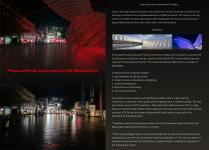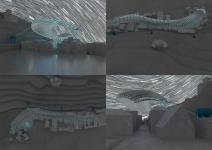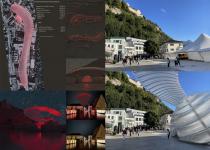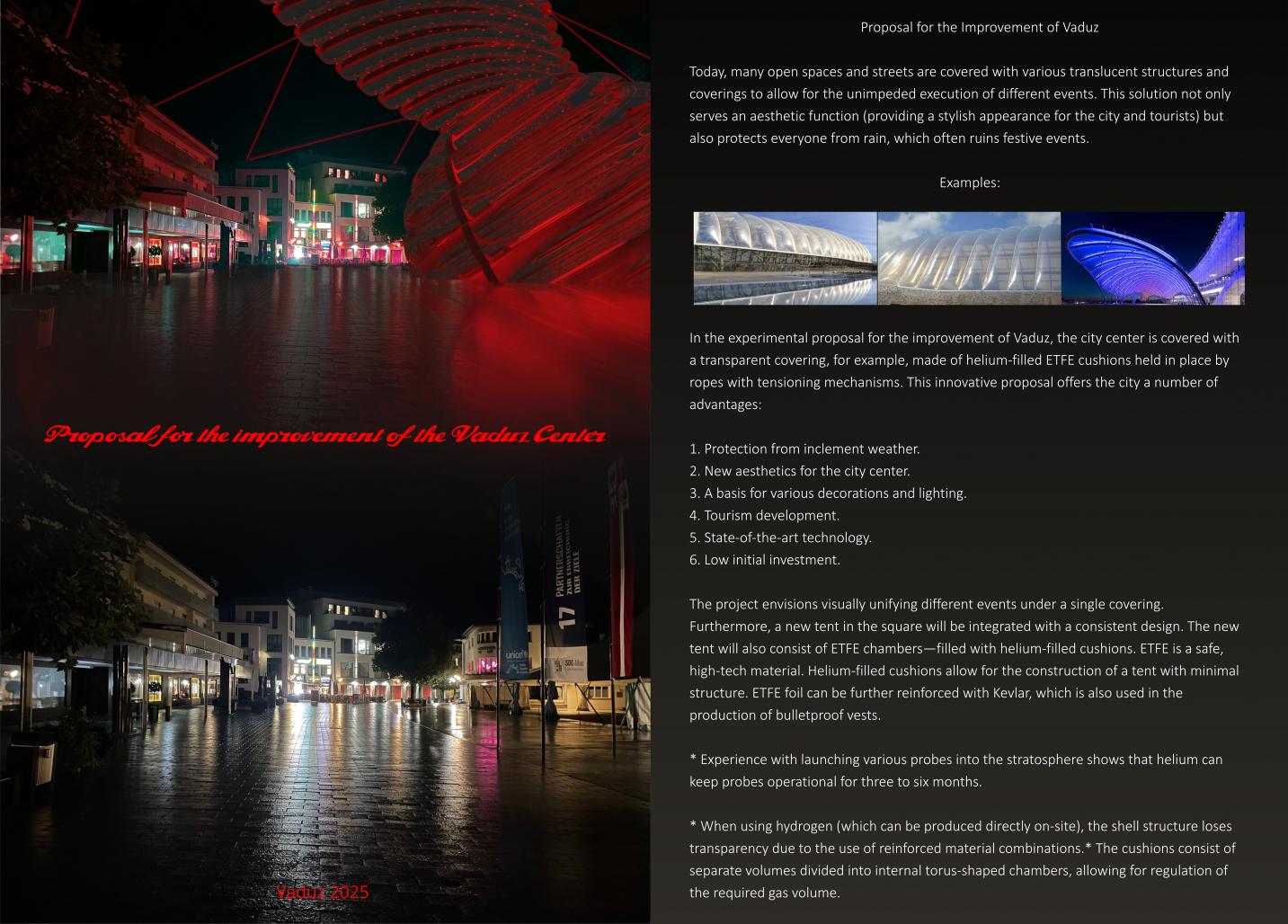
The Vaduz Center project consists of composite ETFE cushions made of toruses inflated with hydrogen or helium and reinforced with aramid.
The primary function is to protect the city center from inclement weather, allowing for various events to be held there year-round, in any weather. Programmable cable-stayed tensioners adjust the height of the cloud and its angle depending on wind direction. This also provides the basis for illumination and image projection onto the cloud's vault, providing a spectacular spectacle and ambiance for the Vaduz Center, in accordance with the event's code.
The concept of the protective cloud over the Vaduz Center perfectly reflects Liechtenstein's philosophy of exporting financial stability and sovereignty worldwide as one of Europe's most important financial and cultural centers.
The "floating" roof structure, made of hydrogen-filled ETFE cushions reinforced with modern Kevlar, will be the physical embodiment of these values. This is not just a roof, but a statement: a technologically self-sufficient system symbolizing both protection and freedom.
Economic Boost for Local Retail
We know how powerful the weather in the Alps can be on the market. This lightweight, transparent shell creates a microclimate year-round. For local retailers and market vendors, this means reliable planning and increased sales, regardless of rain or snow. Vaduz will become the world's most exclusive "outdoor living space."
Security through High Technology
Unlike traditional approaches, the combination of ETFE and aramid reinforcement (Kevlar) is completely safe. Even mechanical impacts do not result in sudden collapse, but rather in controlled dissipation. This "bulletproof cloud" combines the highest safety standards with visual lightness.
Interactive Lighting Design and Community
The shell offers the option of a milky-white, elegant appearance during the day and a spectacular spectacle at night. The app could allow citizens to use the "roof of the principality" for personal communications or national holidays.
2025
2025
Transparent / foil shell structures - 36 400 m2
Helium full volume - 34 600 m3
Area of inner chambers - 150 000 m2
Helium volume of inner chambers - 18 000 m3
Usable area - 9 000 m2
Rigging/slings - 1 900 lfm
Lighting - 962 pc
Tent:
Surface area of the tent - 3 800 m2
Volume of inner chambers - 1 900 m3
Usable area - 5600 m2
Gydey Valery Olga Fishchenko
Valeriu Gidei