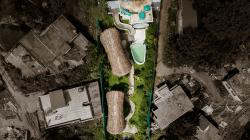
Kibbuts is a compact hillside hospitality project located in Kalpetta, set within the tourism landscape of Mayiladippara. The client’s primary requirement was to create a resort that offers expansive valley views while ensuring a high degree of privacy within a tightly packed residential context. The site, measuring 594 sq. m, with significant challenges, including a steep 45-degree slope, narrow width, and immediate proximity to neighboring structures. These constraints became the driving force behind the project’s spatial and architectural strategy.
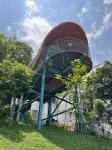
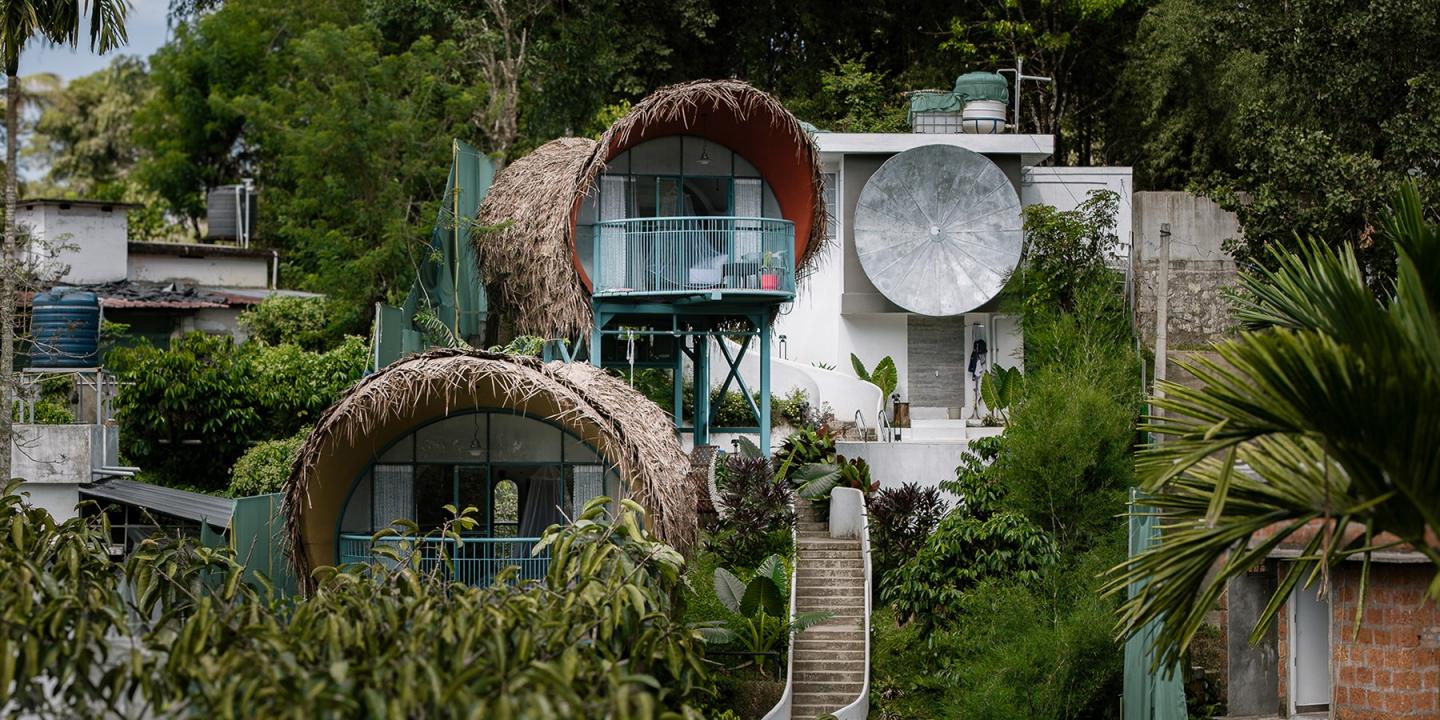
Rather than cutting into the terrain, the design adopts an approach of minimal site intervention, elevating the built form on a lightweight steel framework with the RCC foundation that follows the natural slope. This not only reduces excavation and construction impact but also enhances visual connectivity to the surrounding landscape. The built area of 77.6 sq. m is distributed across two cocoon-style villas and a small administrative unit, carefully positioned to maximize both privacy and views.
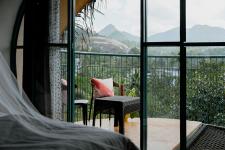
At the entry, a high boundary wall restricts immediate views, creating a sense of compression and privacy. As one moves through the site via a curved winding path the architecture gradually reveals itself. This culminates in elevated living spaces that open outward through a large arched facade, framing panoramic views of the valley while maintaining a sense of retreat.
The form of the villas is derived through a computational design process, informed by solar orientation, wind patterns, and structural efficiency. The resulting ferrocement shell structures are lightweight, material-efficient, and spatially expressive. Openings are strategically placed to allow light and ventilation while preventing visual intrusion from adjacent properties.
Landscape elements such as bamboo plantation along the boundary, the organic pathway, and a small pool further enhance privacy and environmental integration. The project ultimately demonstrates how a constrained site can be transformed into a layered spatial experience, balancing privacy, views, and ecological sensitivity through a minimal yet deliberate architectural intervention.
2023
2025
The structural system consists of steel framework of columns and beams supported by RCC plinth beam adapted to the natural gradient, supporting raised floor plates and minimizing ground disturbance. The villas are enclosed within lightweight ferrocement shell structures, shaped through a computational design process responding to solar orientation, wind flow, and structural efficiency.
Access is organized through a curved staired pathway at ground-level entry leading to a raised deck via a spiral staircase in steel, establishing a clear vertical transitional circulation system. The building envelope incorporates controlled perforations for natural light and ventilation, with a large arched opening frames outward views. The material palette includes lime plastered walls, red oxide and yellow oxide flooring and wall finish, and selective use of locally sourced pleated dry coconut leave, complemented by bamboo landscape elements for shading and screening. The project employs passive environmental strategies, reduced excavation, and locally responsive materials to ensure minimal ecological impact and long-term integration with the site.
Principal Architect : Ar. Rohit B Anandan
Team Design Credits: K Aparna , Prathyush Sathyan , Keerthi Lakshmi
Unsolved Comet