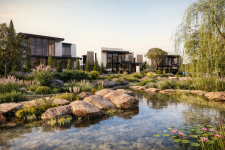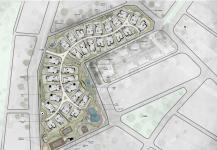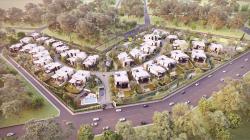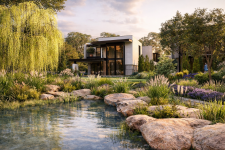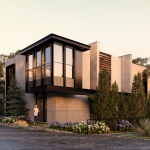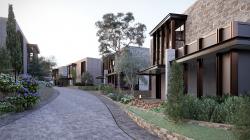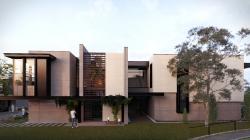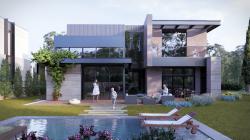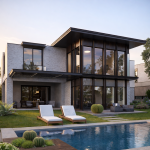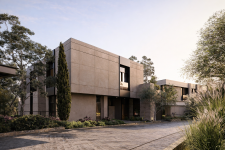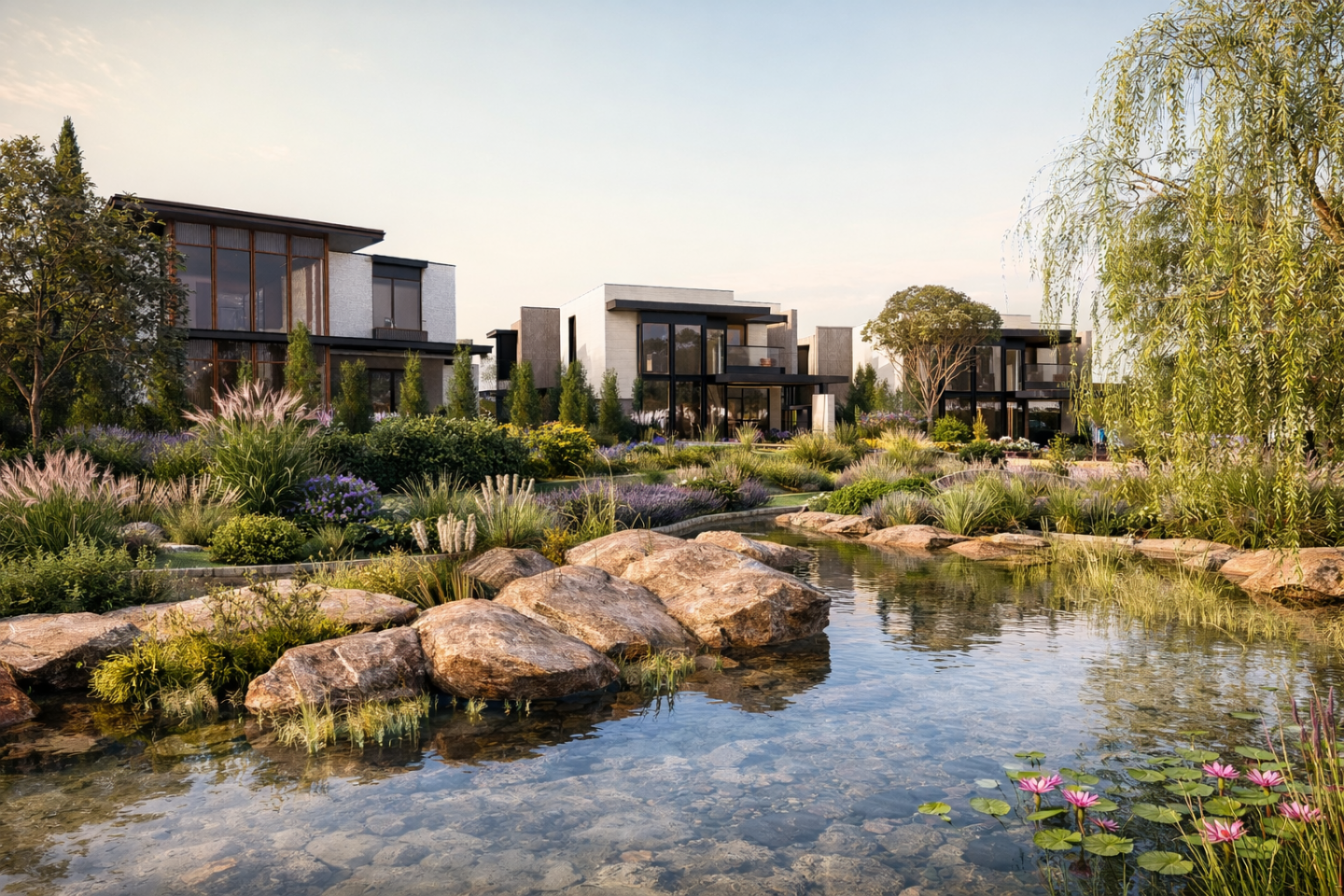
The project proposes a holistic settlement model that redefines contemporary living practices through its strong relationship with nature. The starting point of the design was the existing topographical character of the site, its natural thresholds, and landscape continuity. Rather than imposing an object onto the land, the development strategy follows the existing morphology and evolves with it. This approach establishes a continuous relationship between built masses and open spaces, creating a settlement structure in which the boundaries between natural and built environments become permeable.
In this context, the settlement is conceived not merely as a parcel containing residential units, but as a micro-community defined by its internal dynamics, articulated open spaces, and social focal points. Landscape operates not as a background element but as the primary organizer of the design, shaping spatial experience through squares, gardens, and pedestrian axes.
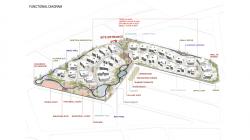
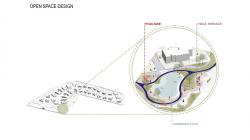
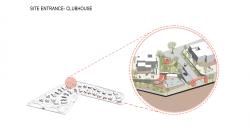
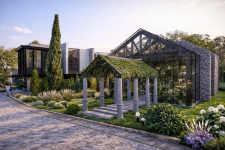
The social facility located along the main entrance axis is treated not only as a functional unit but as a threshold space that guides user experience and defines the public character of the settlement. Composed of programmatic elements such as the clubhouse, swimming pool, and yoga terrace, this structure forms a focal point that encourages social interaction and supports healthy living practices. Its positioning and spatial organization establish a strong visual and physical relationship with the landscape while also functioning as an orienting element within the overall layout.
The open space system shaped around the social facility is defined through named gathering areas such as Nefes Düzü Square, Itır Düzü Square, and Kuyu Düzü Square, reinforcing spatial memory and identity. These areas function not only as transition points but as social thresholds that enable encounters, pause, rest, and collective presence.
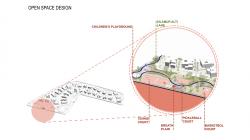
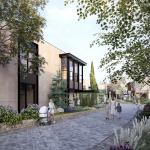
The open space network is conceived as an active spatial backbone that guides design decisions rather than a passive landscape surrounding the buildings. Designed for different age groups and usage scenarios, these open areas create an experiential network that supports interaction in addition to organizing circulation. Children’s playgrounds, multi-purpose sports courts, and pedestrian routes are structured as components of this continuity, establishing a balanced system between movement and pause, individual use and collective experience.
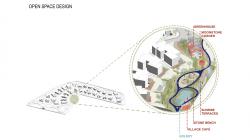
The existing greenhouse on the site, which contains endemic plant species, has been preserved, and the settlement layout has been shaped with respect to this productive landscape. In this way, the design does not impose a new order onto the land but develops in continuity with existing natural and local values. Lavender fields, small groves, stone seating elements, and defined resting pockets further create a sequence of open spaces offering experiences at different scales.
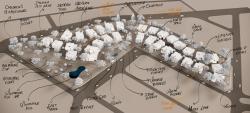
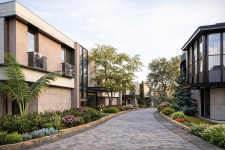
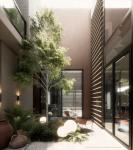
Residential units are positioned in accordance with the topography and orientation strategies to maximize daylight, natural ventilation, and views. Across different villa typologies, internal courtyards, stone-paved areas, and semi-private outdoor spaces complement the main gardens, strengthening spatial continuity. This approach defines housing not solely through enclosed interior organization, but through the relationship between indoor, semi-open, and open spaces, offering a dynamic living model.
Each unit ensures individual privacy, while the positioning of volumes and façade orientations carefully prevent direct visual intrusion between neighboring parcels. Thus, private living spaces are protected while a balanced relationship with collective life is maintained through semi-public open areas and a permeable landscape structure. Rather than sharply separating individual and communal life, the design produces a multi-layered spatial experience that defines transitions between them.
The project is not merely a physical settlement proposal, but a living model that redefines the relationship between nature, user, and space. Through spatial diversity, topography-sensitive placement strategies, and a landscape-oriented design approach, the settlement operates as a sustainable ecological and social system within itself. Within the intensity of contemporary urban life, it offers a secure and controlled framework while creating an inward-oriented world that strengthens social bonds and maintains a continuous connection with nature.
This holistic approach establishes a balanced relationship between the pace of urban life and the continuity of nature, providing users with an enriched living experience at both individual and collective scales.
2025
Site Area: 38909,00m²
Gross Floor Area: 22255,75m²
Orçun Ersan, Sedef Yıldız, İrem Ardıç, İlginay Akyol, Hilal Delibaş, Gökçe Yıldız, Oğuzhan Çelik, Feyza Nur Şimşek, Fethi Ahmet Çelik, Feyza Nur Tekdemir, Simge Nur Topuz, Simay Demirel, Aleyna Yüce, Berna Balçık
ACE Architecture