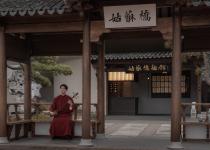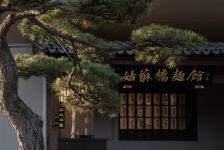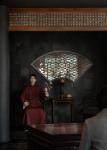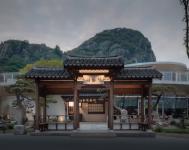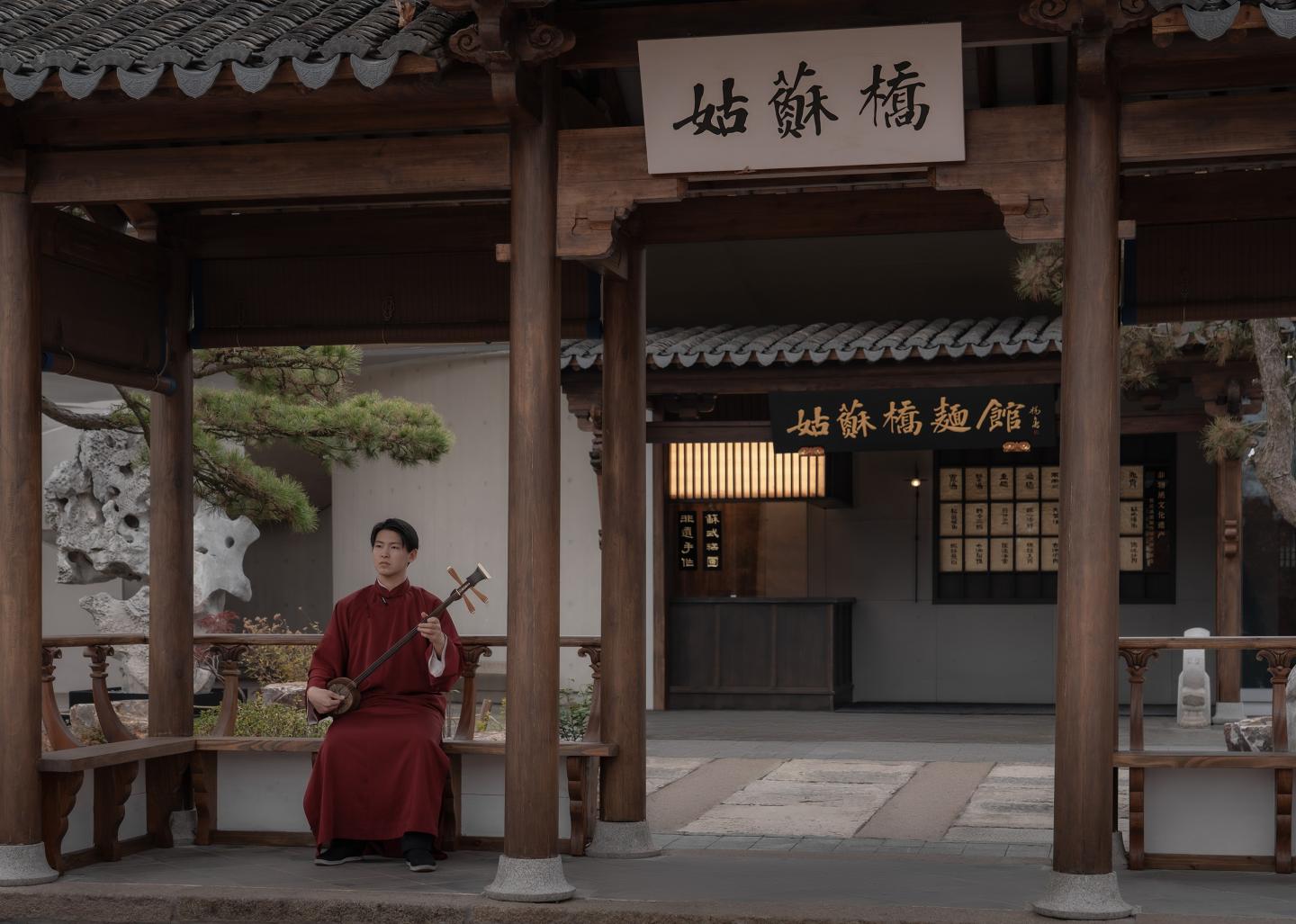
Looking back at Tiger Hill, visitors to the Gusu Bridge Shishan Branch are first greeted by a mountain gate in the style of the Ming Dynasty, bearing the inscribed plaque “Gusu Bridge”. Railed benches known as “beauty seats” line both sides, embodying the symbolism of a courier station that welcomes travelers from all directions and provides a place for visitors to rest. Beside the gate stands a MingDynasty mounting stone, with a stone lion behind it and a QingDynasty flat bridge nearby. Black pines and aged plum trees are planted on either side; their green branches and gnarled trunks capture the elegant charm of ancient bridge pavilions. In both The Scroll of Agricultural Instructions by Tang Yin of the Ming Dynasty and The Prosperous Scene of Gusu painted by Xu Yang of the Qing Dynasty, one can behold the intertwined scenery of streams and fields typical of Jiangnan’s water towns. The rockeries and water features at the entrance of Gusu Bridge are designed to recreate the artistic conception depicted in these ancient paintings.
Siyi Courtyard
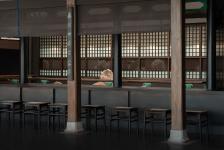
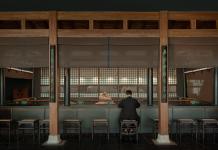
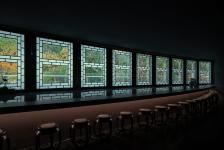
Siyi Courtyard takes its name from the Siyi Temple, a TangDynasty Buddhist monastery at the foot of Shishan Hill. On the first floor, a dedicated space has been created, with a ceiling designed to simulate natural daylight, housing a Siyi Courtyard constructed with Mingstyle wooden structures. Adjacent to the courtyard lies a corridor named Sanshan Corridor. The term “Sanshan” refers to Penglai, Yingzhou, and Fangzhang—the three legendary immortal mountains in ancient Chinese mythology. Built from yellow stones, the rock formations evoke an otherworldly abode that resonates with the grandeur of Shishan Hill. The blue bricks paving the pond are laid in the Suzhoustyle dryland water arrangement. Amid gentle ripples, one may lean against handcarved mahogany seating in the manner of Ming and Qing gardens, enjoy a bowl of carefully crafted soup noodles from Gusu Bridge at the long “Top Scholar’s Reading Desk”, gaze at the hills, and lose oneself in quiet contemplation, savoring the refined literary pleasure of living momentarily in a tranquil retreat.
Lions’ Rocks and Reclining Pines
Shishan Hill is characterized by exposed rocks and thin soil, where pine trees often take root in crevices and stretch horizontally or slantingly, giving rise to the scenic view known as “Lions’ Rocks and Reclining Pines”, which has been as celebrated as “Ancient Firs of Tiger Hill” since ancient times. Following the natural lines of the rocks, Gusu Bridge has built a venue for Suzhou Pingtan performances along the hillside path, preserving the authentic Suzhou charm that defines the establishment. Suzhou Tanci features storytelling and singing, usually performed by a twoperson ensemble, embodying both the fortitude of the rocky cliffs and the tranquility of the reclining pines. Naturally, the beauty of Suzhou garden window lattices is also present here. Fanshaped, square, diamondshaped, and other decorative windows adorn every private dining room, allowing breezes and moonlight to filter through; views framed by round moon gates further enhance the serene elegance of the space.
Laihe Pavilion
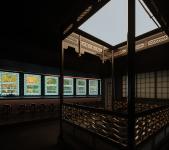
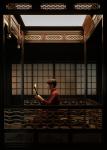
Ascending the stairs to the second floor, one encounters an enclosed square pavilion known as Laihe Pavilion. Crafted in the Suzhou style of the Ming Dynasty, it is inlaid using the traditional lacquer and motherofpearl technique. It serves both as an ornamental structure and a stage for Pingtan performances. “Intoxicated, I ascend the pavilion to watch the dance; a new friend finds joy in seclusion.” In his classic poem Laihe Pavilion, Su Shi expressed his profound longing for a reclusive life. Reading this poem amid the quiet chill of late winter, one cannot help but reflect on the scene of glistening snow and moonlight. In a chaotic and bustling world, it is a rare blessing to always remain free and unrestrained in spirit.
Mirror Platform
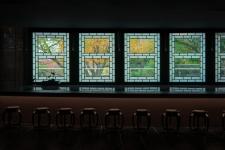
While the first floor features Siyi Courtyard, derived from the ancient Siyi Temple, the second floor continues the poetic theme with the Mirror Platform. Drawing inspiration from Chan Buddhist philosophy, it reminds people to keep a pure mind, free from worldly distractions, and attain a state of serene enlightenment. A full hall named “Glazed Light Courtyard” is made using the traditional Suzhou shellinlay technique, capturing the colors of plants and foliage across all seasons from dawn till dusk. Light refracts through the shells in shifting hues, with natural daylight flowing like a living painting. Beside the Mirror Platform hangs a vertical scroll by Master Yinyuan, founder of the Huangbo sect of Buddhism, inscribed with the line “Empty mountains show no trace of men”. It echoes the timeless Chan wisdom: “Originally, nothing exists; where can dust settle?”
2024
2024
Completion time: October 2024
Main Materials: Wood, grey brick, artistic paint, metal, fabric
Design Company: Not A Studio
Designer: Su Meina, Ma Dawei, Ou Shuqin
Client Name: GU SU QIAO
Photographer: GU SU QIAO,Y³ STUDIO External Cube Space Imaging
GU SU QIAO Y³ STUDIO External Cube Space Imaging