Against the backdrop of the "de-banking" trend, Jinhua Branch of Tailong Bank embraces the concept of a "Future Financial Community", transforming the bank from a mere transactional venue into an open platform that connects the city, communities, and people.
The design leverages modern minimalism to establish a rational order. Through restrained material palettes, light and shadow interplay, and spatial organization, it diminishes the sense of detachment inherent to financial spaces. Meanwhile, by integrating local culture and community-oriented functions, the space achieves a balance between efficiency and warmth, evolving into a public setting that can be seamlessly integrated into daily life.
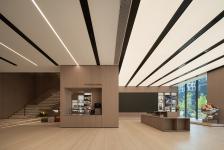
The ground floor is defined as the most publicly accessible interface of the entire building, as well as the starting point for dialogue between finance and the city.
The space features warm wood tones and matte off-white as its primary palette, complemented by the rational accents of metal and glass, thus creating an overall atmosphere that is serene, restrained yet inherently approachable. The horizontally extended spatial layout alleviates the imposing feel typical of traditional banking halls. Natural light filters in through the facades and the ends of the space, working in tandem with artificial lighting to form a well-distributed, layered light environment.
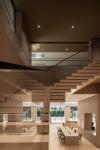
The floating staircase serves as a core element for both vision and circulation, linking the spaces upstairs and downstairs while symbolizing the evolution of financial services from a one-dimensional transactional interface to a multi-dimensional experiential offering.
Its lightweight structure paired with warm-toned light strips reduces the sense of bulk, transforming this functional component into an integral part of the spatial narrative.
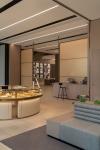
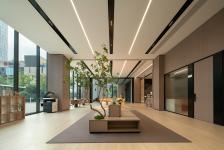
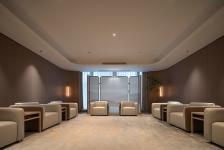
Here, "waiting" is no longer a passive consumption of time, but a carefully designed sojourn experience. Flexible seating, curved display cabinets and precisely controlled lighting combine to create a low-interference environment, allowing people to feel respected and cared for from the moment they step into the space.
In terms of materials, the wood veneers, fabrics and metal details form a subtle contrast, which maintains the professionalism inherent to financial spaces while avoiding a cold and rigid feel. The waiting area is regarded as an extension of the community’s shared living room, serving as a venue for communication, browsing and brief stays, thus integrating financial activities naturally into the rhythm of daily life.
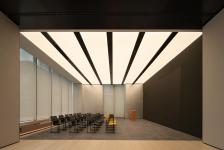
The multi-function hall features highly adaptable interfaces to meet the community’s diverse usage needs, enabling seamless transitions between meetings, seminars and exhibitions under a consistent spatial order.
Abandoning the conventional enclosed counter layout, the service area adopts a modular, semi-open cubicle arrangement instead. The service units not only maintain the necessary privacy between one another, but also preserve the overall spatial continuity through the use of transparent materials and soft backlighting.
The staff entrance hall is conceived as a transitional space that eases the shift from daily routines to an atmosphere of order and focus, conveying its message through a restrained yet articulate spatial language that resonates with the work rhythm and people’s sensory experience.
The elevator lobby, with its highly ordered symmetrical layout and premium materials, exudes a composed and restrained ambiance. The interplay of stone, metal, and light and shadow enhances the sense of longitudinal perspective, endowing this transient transitional space with a distinct sense of ceremony.
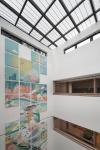
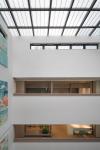
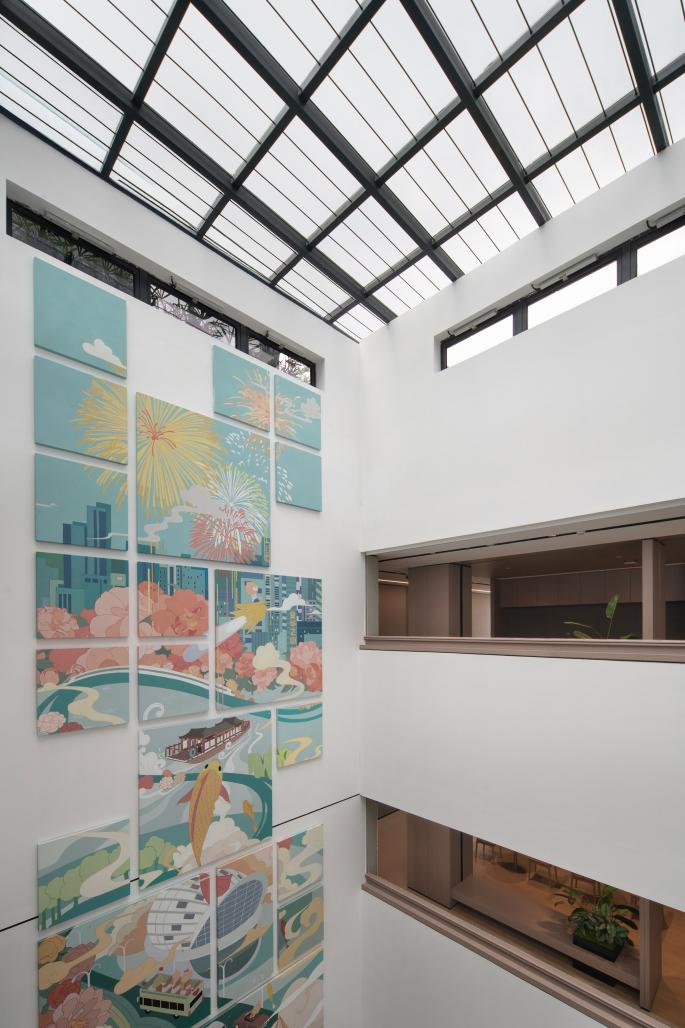
The atrium inside the building takes the urban cultural context of Jinhua as its spiritual origin, skillfully integrating the city’s iconic architectures, local corporate IPs and camellia—its municipal flower—to create a poetic portrait of the contemporary city.
Presented in the form of vertically extended collage, this visual composition echoes the atrium’s transparent spatial order, unfolding the rhythm of urban growth amid the flow of natural light. More than a contemporary interpretation of urban memories, the installation serves as a visual medium for dialogue between people and the city within this public space. It strikes a delicate balance between order and imagination, evoking a gentle sense of identification with the local cultural spirit.
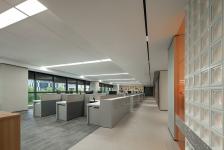
The open office area emphasizes transparency and collaboration. Natural light, glass blocks, and soft backlighting work together to eliminate the oppressive feel of traditional offices, preserving a comfortable scale amid rational efficiency and turning work into a sustainable daily state.
The meeting spaces, characterized by a highly systematic modular design and clear axes, support efficient communication and decision-making. Neutral materials and uniform lighting create a calm, rational atmosphere, directing attention back to the content itself.
The reception room shifts toward an expression with greater emotional and cultural depth. A modern Oriental artistic conception is presented through wood, fabrics and landscape elements. The space embodies poetry within restraint, creating a composed and trustworthy venue for communication and allowing business dialogues to return to the authentic connection between people.
The leisure and fitness area takes modern minimalism as its framework, infusing a dynamic rhythm into the rational order. A neutral gray tone lays the spatial background, accented by wood grains and bright colors, forming a visual balance that is calm yet warm. Natural light pours in through the glass curtain wall, interweaving with linear light strips, reflecting a daily scene that is focused, restrained yet full of energy.
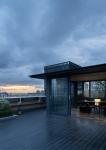
The top-floor space unfolds gently at dusk, with cool gray and dark wood tones outlining a serene silhouette above the city. The cantilevered glass volume exudes a sense of lightness paired with quiet strength; internal and external landscapes permeate each other, forming an open yet restrained social venue. Warm yellow lighting illuminates the wooden flooring and green plants, echoing the faint glow of the distant skyline. Between the rational structure and the soft ambiance, it completes a dialogue about the city, time and poetry.
This project seeks to explore a prototype of financial space that can be shared by the city and sustained through time. Through design strategies centered on community integration, public accessibility and cultural embedding, financial services are seamlessly woven into the fabric of urban daily life.
Here, the space refrains from loudly asserting its functional identity; instead, it adopts a restrained stance to embrace open-ended visions of the future. A rational, efficient yet warm and inclusive financial community is quietly taking shape within the city.
2025
2025
Completion year: 2025
Design company: Damai Design
Project Photography: Hanmo Vision
Hanmo Vision