
Chinese Medicine Hospital and Government Chinese Medicines Testing Institute of Hong Kong
Overview: The Chinese Medicine Hospital (CMH) and Government Chinese Medicines Testing Institute (GCMTI) are funded by HKSAR Government to establish a central healthcare facility for Traditional Chinese Medicine (TCM) services, training, research, hi-education, and testing within a modern hospital and laboratory complex. This initiative aims to improve public healthcare services and to position Hong Kong as an international "gateway" for modern TCM promotion.
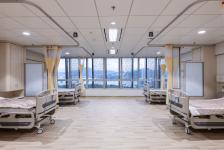
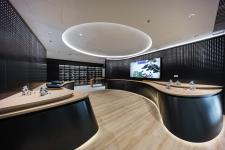
A New Model of Hospital Design – The CMH utilizes TCM as the primary healthcare system, supported by western medicine, which is the first of its kind worldwide. This fundamental concept drives a new operating medical model. Without local precedent, the design prioritizes merging functional spaces of both Chinese & Western medicine operation with flexibility. The distinct nature of TCM consultations and treatments led to the development of a new kind of hospital environment such as cluster-style consult and treatment rooms to suit specific TCM treatment method / flow. The pharmacy is so unique that it needs to stock and cook a high volume of herbal medicine for hundreds of patients daily while running a combination of TCM and Western medicine modes. This is further supported by automated features using QR coded TCM cabinets, robotic TCM sorting & packaging, conveying belt system integrated with dispensary counters.
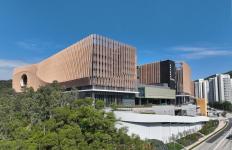
Interplay Between Modern Architecture and Chinese Culture - The CMH and GCMTI, is a healing, living, and working complex, where visitors and users are immersed in an environment that distils the origin of TCM and centuries of Chinese philosophical culture using traditional symbolic references of wellness. Concepts of yin-yang, united form and spirit, harmonies between man and nature / heaven and earth / the five elements (Wood, Fire, Earth, Metal, Water), physical representations on light and shadow, solid and void, form and emptiness, matter and qi are integrated into and inspire the architecture and interior design, landscaping, and wayfinding to create an intriguing and educational experience.
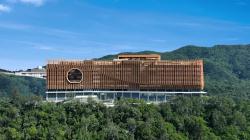
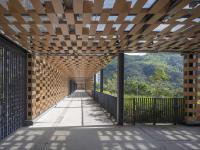
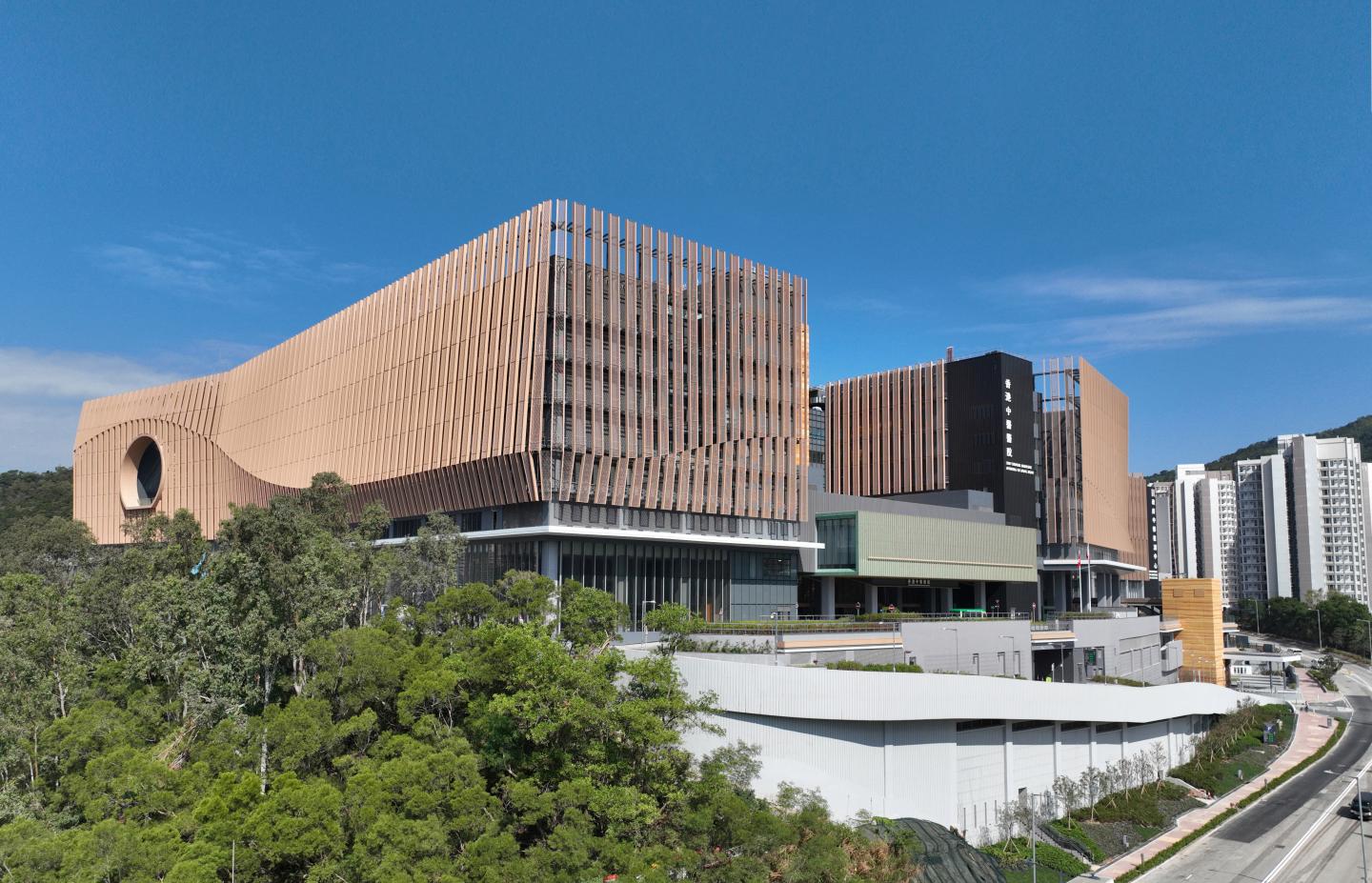
The facades are sheathed in a perforated screen, slightly bending to form an undulating crease that mimics the ridgeline of the surrounding hills. The proportions, colour and materiality of the screen reflect those of tradition Chinese fenestration, providing shading, and a soothing, ambient experience to interiors, creating intricate shadows that move with the sun during the day.
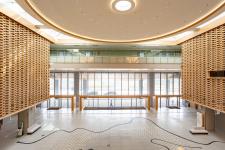
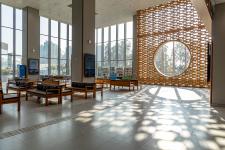
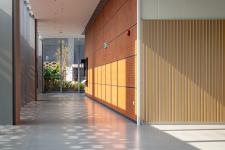
A grand central avenue elegantly links the lower street level pedestrian hub, the ground level CMH entrance, atrium, gardens, courtyards, pharmacy, and GCMTI drop-off colonnade. This avenue provides the setting for a second screen, inspired by traditional medicine cabinets (bai zi gui) —delicately translucent, veiling filtered light—immersing passers-through in a dynamic interplay of yin-yang and the five elements.
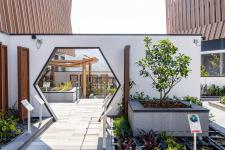
In the GCMTI, a “Herbarium Path” maps the journey of medicinal materials, with each laboratory aligned elementally: Wood (Plant Specimen Curation), Fire (Plant-Originated Curation), Earth (Specimen Repository), Metal/Gold (Decoction Reference), and Water (Formulation Reference). The path continues to the exterior Medicinal plant garden where more than 170 Medicines plant species are showcased.
Smart Technology: The project is the first multi-level hospital in Hong Kong extensively using Modular Integrated Construction (MiC) and employed new lifting techniques, using hybrid steel/concrete units, without in-situ floor slabs. 80% of the works in MiC units were completed off-site, allowing better safety, quality and programme control.
Being a “Smart Hospital”, Automated Mobile Robots (AMR) synchronized with the lift system and service corridor automated doors, are highly utilised for servicing with dedicated clean and dirty lift cores on each floor. These are fitted with charging facilities and supported by a central charging station in the basement. Other features such as pneumatic tube systems, smart toilets, and digital wayfinding are used to enhance operational efficiency and patient experience.
Sustainability: Passive design principles are adopted throughout the building. The design embraces the sloping terrain, tracing its natural contours while embedding podium levels into the landscape. The lower levels are heavily planted, anchored by the most formal landscape in the central garden. Courtyards and terraces thread through the upper floors, pulling nature, greenery, fresh air, and daylight deep into expansive floor plates. The architectural façade screen provides shading, particularly to the long ward floors facing east and west. Views through the screen to the surrounding green hillside, and the setting sun over the sea on the west side from deep within the interiors create a sense of well-being and seamless harmony between architecture and nature.
These features are supported by a host of active sustainable design elements including incorporating solar hot water system, building integrated photovoltaics, battery energy storage systems, rainwater harvesting and condensate water recycling, demand control chilled water, heat recovery for exhaust air among others.
In addition, selection of materials, such as use of steel reinforcement bars made from 97% recycled steel scrap, over 200,000m3 of concrete containing 35% pulverized fuel ash (PFA), use of nano-coatings on roofs to increase heat insulation and the widespread use of prefabrication Multi-trade Integrated Mechanical, Electrical and Plumbing (MiMEP) and Modular Integrated Construction (MIC) further improve the performance of the buildings.
Celebrating Traditional Chinese Medicine with the World - The completion of the CMH and GCMTI fulfil a long-awaited need as an integral part of our healthcare system. It asserts a cultural confidence for our country and our era, embodying profound civic pride that nurtures the advancement of TCM of our country, of Hong Kong and beyond.
2021
2025
Address: 1 Pak Shing Kok Road, Tseung Kwan O, Hong Kong, HKSAR.
Total Site Area: 60,000 sqm
Total CFA: 190,000 sqm
No. of Beds (CMH): 400 beds
Completion year: 2025
Client: - Architectural Services Department
Design and Build Contractor: - China State Construction Engineering (Hong Kong) Limited
Architectural Designer: - Wong & Ouyang (HK) Ltd.
Interior Designer: - ARVA Limited
Medical Planning Designer: - China State Construction Int’l Medical Industry Development Co., LTD.
Specified Interior Fit-out Works Designer (CMH): - James Law Cybertecture International Holdings Ltd.
Display Designer (GCMTI): - One Bite Design Studio
Specified Interior Fit-out Works Designer (GCMT): - Room 23 Limited
Building Services Designer: - WSP (Asia) Ltd.
Structural and Geotechnical Designer: - Siu Yin Wai & Associates Ltd.
Landscape Designer: - ADI Limited
Wing Chuen Fung