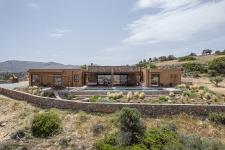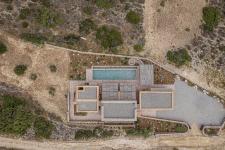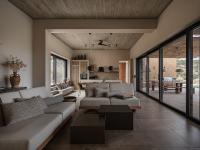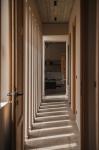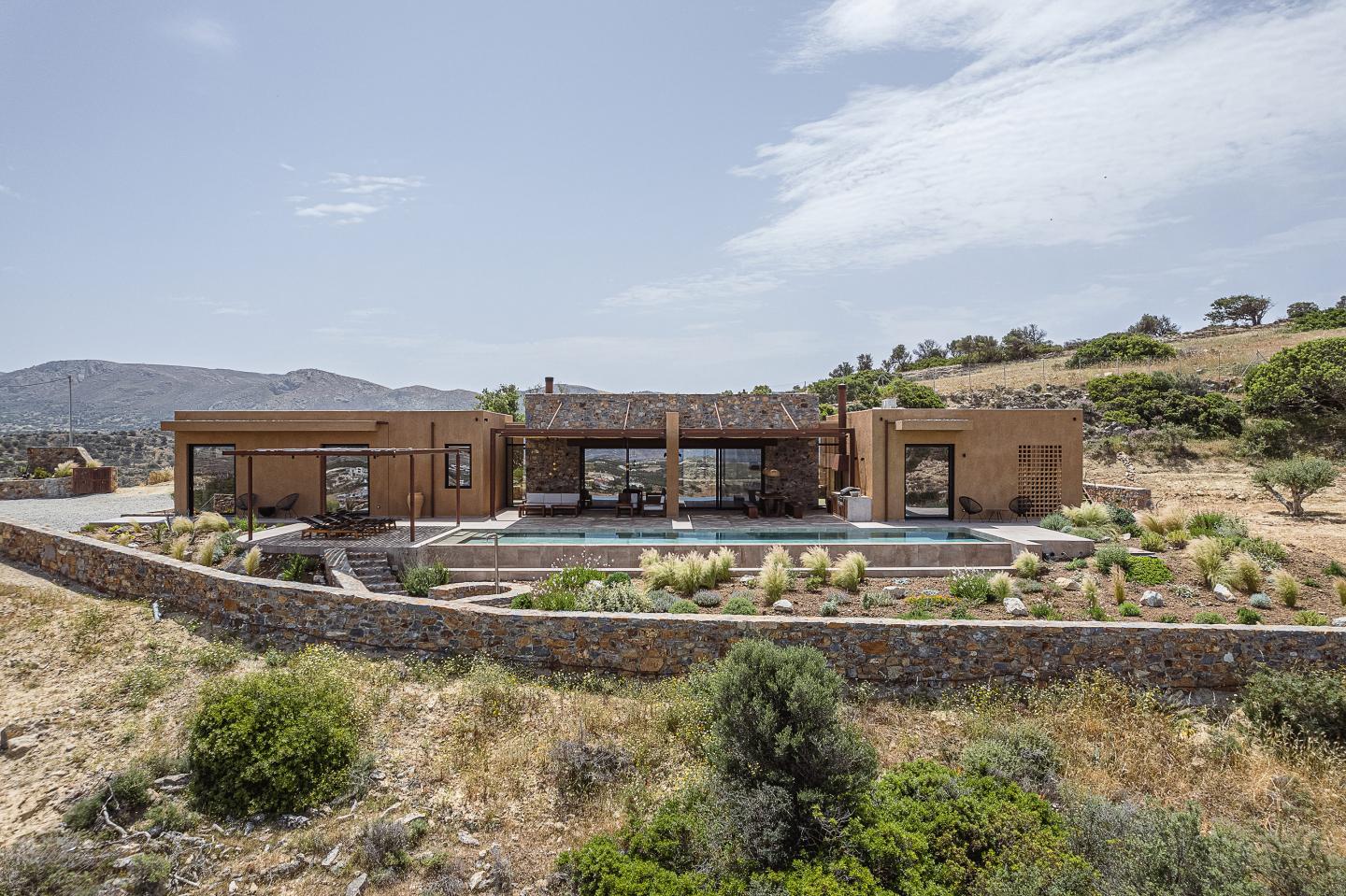
Three distinct and carefully defined volumes, connected by transparent glass corridors, compose the residence. Each volume houses a different function — living, sleeping, and working — while the glass links create both physical and visual continuity between them. These light-filled connectors allow the surrounding landscape to flow through the house, blurring the boundaries between interior and exterior.
The structure is partly embedded in the hillside, using the slope as both shelter and compositional element. Built with local stone, concrete, and wood, the residence establishes a dialogue with the rugged topography and the dry, sun-bleached textures of Southern Crete. The materials were chosen not only for their honesty and durability but also for their ability to age naturally, allowing the building to merge even more deeply with its environment over time.
The overall composition is minimal, geometric, and quietly expressive. It stands in deliberate contrast to the nearby sheepfold — a humble, time-worn structure — yet it relates to it through the same sincerity of construction and simplicity of form. Protected by the hill, the residence opens generously toward views of the settlement, the distant sea, and the surrounding mountains, offering a constantly shifting experience of light and shadow throughout the day.
This is an architecture that does not impose itself on the landscape. Instead, it seeks balance and coexistence — an architecture that integrates, breathes, and ultimately belongs.
2022
2025
Technical Description
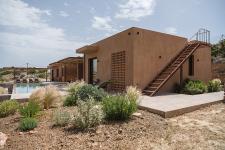
A residence situated on a hillside above a settlement, integrated into the landscape and in dialogue with nature. Three distinct parallelepiped volumes, slightly offset from one another, are connected by two transparent glass passages. The central, tallest volume is made of stone, while the two adjacent, equally tall volumes are coated with an “earth”-colored plaster.
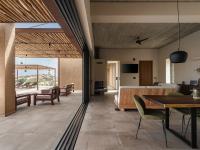
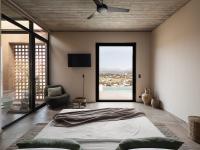
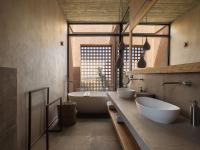
The first volume contains a bedroom with an en-suite bathroom, an office, and a shared WC. The central volume includes the entrance and the shared living areas—kitchen, dining room, and living room—in a single open-plan space. The third volume houses the master bedroom with an en-suite bathroom, which opens onto a planted courtyard.
Between the three volumes, and in front of the central one, a large pergola is constructed, extending to the swimming pool, effectively “expanding” the living space to the outdoors. Large sliding glass panels on the north and south sides of the central volume create a seamless transition from the natural hillside to the swimming pool, offering views of the settlement, the plain, and the sea, while enabling natural ventilation and cooling when opened.
The entrance to the residence is located at the rear side of the volumes. Together with their offset positioning, it creates a wind-protected backyard. The design of the outdoor area is completed by an independent pergola at the pool area, a circular stone staircase leading to the outdoor shower, large freely placed stones marking the plot boundaries, landscaping, and a gravel-paved entrance and parking area.
Natural materials from the region were used: local stone, rust-colored metals, chestnut wood, exterior plaster with straw in earth tones, beige-colored interiors, cotto tiles on the floors both indoors and outdoors, black aluminum window frames combined with iroko wood, and gravel in the entrance, parking areas, and rooftops.
The design of the residence began in 2021, was completed in 2022, and the construction lasted two years, from 2023 to 2025.
PROJECT TEAM
Lead Architects: paly architects (Nikos Lykoudis – Ismini Papaspiliopoulou)
Design Team: Irini Tricha, Olga Koutroumanou, Ileana Toli, Fil Lykoudis
Interior Design: paly architects, Grit Klabuhn, Michael Karsten Brieske
Lighting Design: paly architects
Site Supervision: Nikos Lykoudis, Fil Lykoudis, Irini Tricha
Photography: Giorgos Anastasakis
George Anastasakis